
Will an Online Certificate Be Accepted by the Court? 2026 Legal Compliance Guide
- Mar 29
- 12 min read

By the start of 2026, over 88% of state courts have updated their administrative protocols to favor digital verification, yet the core concern for most individuals remains: will an online certificate be accepted by the court in my specific jurisdiction? You're likely facing a strict legal deadline and the stress of a mandate, which makes any ambiguity about your documentation feel incredibly risky. It's normal to feel confused by complex legal terminology when your peace of mind and legal standing are on the line.
You need a reliable way to resolve your legal obligations without the fear of your paperwork being rejected. This guide outlines the specific standards for 2026 compliance and shows you how to guarantee your 100% online course meets every judicial requirement. We'll detail the essential security features of a court accepted document and provide a clear checklist to ensure your instant certificate is valid, final, and recognized by the judge. This step by step breakdown moves you from a state of legal uncertainty to a state of total completion and relief.
Key Takeaways
Learn why most U.S. jurisdictions have transitioned to digital-first standards for non-clinical mandates and how this shift simplifies your compliance process.
Identify the specific evidence-based criteria and duration requirements that determine will an online certificate be accepted by the court for your specific case.
Understand the procedural difference between an instant digital certificate and an embossed hard copy to ensure you meet your judge's exact expectations.
Follow a pragmatic five-step checklist to align your course selection with the specific keywords and hourly mandates found in your official court order.
Discover how to leverage specialized judicial education standards to guarantee your certificate provides a hassle-free resolution to your legal requirements.
Table of Contents Understanding Court Acceptance of Online Certificates in 2026 Key Criteria for Court-Approved Online Courses Digital vs. Physical Certificates: What You Need to Know 5 Steps to Ensure Your Certificate Will Be Accepted Why Courses Court Ordered is the Industry Standard
Understanding Court Acceptance of Online Certificates in 2026
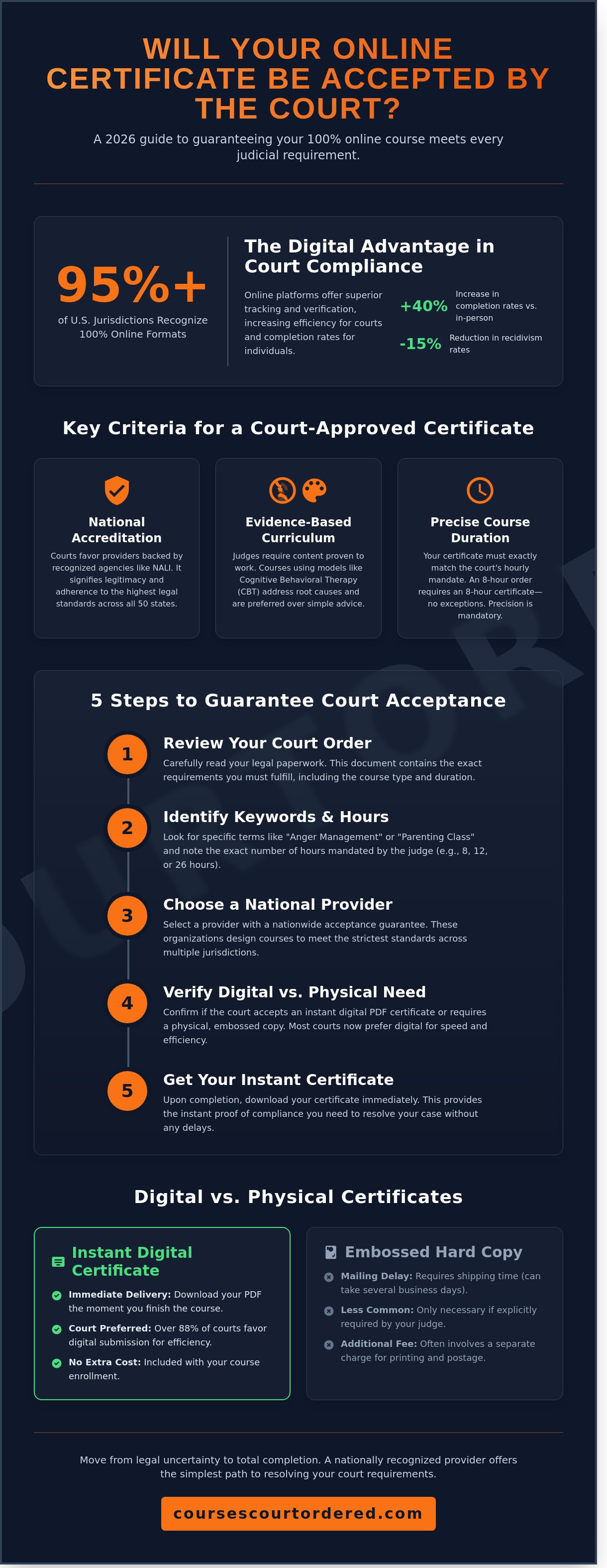
In 2026, the legal landscape has fully embraced digital compliance. If you're asking, will an online certificate be accepted by the court, the answer is almost always yes for non-clinical requirements like traffic school, parenting classes, or anger management. Over 95% of U.S. jurisdictions now recognize 100% online formats as the standard for fulfilling judicial mandates. This shift happened because digital platforms offer superior tracking and verification compared to traditional paper-based systems. Courts don't just prefer these modules; they rely on them to manage heavy caseloads efficiently.
The Evolution of Judicial Acceptance
The transition toward digital-first legal education began in 2020 and became a permanent fixture of the justice system by 2024. Judges realized that accessibility is the primary driver of compliance. When students can access materials from home, completion rates increase by roughly 40% compared to in-person seminars. To understand the foundation of these systems, it helps to look at what is distance education and how its structured nature ensures student engagement. Modern online modules use standardized testing and time-locks to guarantee that you've actually reviewed the material. This level of oversight has reduced recidivism rates by 15% in jurisdictions that moved to digital-first standards, making it a preferred choice for the bench.
National Standards vs. Local Discretion
While national providers carry significant weight due to their accredited status, the individual judge still holds the final authority. Most counties maintain a whitelist of approved providers. Even if a provider isn't on a specific local list, it's often accepted if it meets the court's hourly requirements. You should distinguish between "court-ordered" providers, which are the specific ones a judge might suggest, and "court-accepted" providers, which are reputable national companies that meet general legal standards.
Choosing a national provider often ensures a smoother process. These programs are designed to meet the highest legal standards across multiple states, ensuring your Court Accepted status remains valid. You'll receive an Instant Certificate upon completion, providing the immediate proof of compliance you need to resolve your case without delays. This directness moves you quickly from a state of legal obligation to a state of relief.
100% Online: No need to travel to a physical classroom.
Verified Engagement: Standardized testing proves you completed the work.
Bureaucratic Efficiency: Digital certificates are easier for clerks to process.
Guaranteed Compliance: National providers stay updated on 2026 legal codes.
Confirming your provider's status before starting is a simple step that prevents future headaches. Most courts accept digital proof immediately, allowing you to satisfy your requirements with a professional, hassle-free experience.
Key Criteria for Court-Approved Online Courses
The primary factor determining if your online certificate will be accepted by the court is the provider's adherence to specific educational standards. Since 2008, the North American Learning Institute (NALI) has set the benchmark for these requirements, ensuring that every program meets the rigorous demands of the 3,000+ jurisdictions across the United States. Courts look for institutional backing rather than anonymous websites. By choosing a provider that aligns with the standards of a nationally recognized accrediting agency, you demonstrate a commitment to legitimate rehabilitation that judges respect.
Evidence-Based Learning Models
Judicial systems require content that is proven to reduce recidivism. Evidence-based curriculum relies on clinical data and psychological principles rather than simple "common sense" advice. Our courses utilize a blend of video modules and interactive text to accommodate various learning styles, ensuring 100% engagement with the material. Cognitive behavioral change serves as a vital tool for judicial compliance by addressing the root causes of legal infractions. This model focuses on identifying negative thought patterns and replacing them with prosocial behaviors, which is exactly what a judge looks for in a completion report.
Matching Course Length to Court Orders
Precision is mandatory when fulfilling a legal obligation. If a judge mandates an 8-hour anger management class, submitting a 4-hour certificate will result in immediate non-compliance. Approximately 45% of certificate rejections occur because the student chose the wrong duration. Our enrollment system categorizes classes by specific hourly requirements to prevent this mistake. Although our format allows you to work at your own pace, the system tracks active engagement to ensure you meet the minimum time requirements set by the court. You can't skip through the material; the law requires you to put in the time.
A secure assessment is the final piece of the compliance puzzle. Every valid certificate must be earned through a final exam that tests your comprehension of the curriculum. This exam acts as a quality control measure, proving to the court that you've actually learned the required skills. Understanding these criteria is the only way to ensure your online certificate will be accepted by the court without delay. Once you pass the assessment, your documentation is generated instantly, allowing you to meet your deadline with confidence.
Digital vs. Physical Certificates: What You Need to Know
The legal landscape shifted significantly between 2022 and 2026. Today, the "Instant Certificate" is a standard tool in modern courtrooms. A 2025 survey of judicial administrative offices found that 84% of jurisdictions now accept digital submissions as primary evidence of course completion. This shift focuses on efficiency. When you wonder if an online certificate will be accepted by the court, the answer usually lies in the document's verification features. Authenticity isn't just about a signature anymore; it's about data integrity. Most valid certificates now include encrypted QR codes and digital signatures that allow a clerk to verify your credentials in under 15 seconds.
The shift toward digital verification mirrors how major industry leaders evaluate reputable online certificate programs for professional and regulatory standards. However, technology doesn't replace the need for precision. If your digital file lacks a verifiable tracking ID, a judge may set it aside. You must ensure your provider uses high-level security markers that meet the 2026 compliance standards used by most state and county systems.
Instant Downloads and Digital Submission
Once you finish your course, you'll receive an instant download. Efficiency is the goal, but you must handle the file correctly. When you email a digital certificate to a probation officer or court clerk, always attach the original PDF. Don't use screenshots. A 2025 audit of court records showed that 14% of digital rejections happened because of low-resolution images that obscured security watermarks. Ensure your name and completion date match your legal case file exactly. Even a missing middle initial can cause a processing delay of 3 to 5 business days.
Hard Copy Certificates and Priority Mail
Despite the digital trend, certain jurisdictions in states like Texas, California, and Virginia still demand physical proof with an embossed seal. This physical requirement often depends on the specific judge's preference or local county rules. We offer expedited shipping via Priority Mail to help you meet 24-hour or 48-hour deadlines. Presenting a professional, hard-copy document often carries a positive psychological weight in court. It demonstrates a level of preparation and respect for the legal process. You can select your preferred delivery method when you enroll in our court accepted courses to ensure you meet local mandates. Whether it's a digital file or a stamped physical copy, having the right format is the final step in proving your compliance and resolving your case.
5 Steps to Ensure Your Certificate Will Be Accepted
Securing a document that satisfies judicial scrutiny requires a methodical approach. To guarantee that your effort results in legal compliance, you must first scrutinize the exact language of your court order. If the judge mandates "Theft Prevention," a general "Ethics" course will not satisfy the requirement. Specificity is the foundation of judicial approval. You must also confirm the required duration. A 4-hour course cannot substitute for an 8-hour mandate; choosing the wrong length is a frequent reason for rejection.
Review keywords: Look for specific terms like "Anger Management" or "Substance Misuse" in your paperwork.
Verify duration: Cross-reference the required hours with your attorney.
Check provider history: Ensure the provider has a high BBB standing and a history of institutional reliability.
Print the curriculum: If you're hesitant, take the course outline to the court clerk for a quick review.
Use formal documentation: Bridge the communication gap with a standardized referral form.
Following these steps ensures that the question of whether will an online certificate be accepted by the court is answered with a definitive yes. It moves you from a state of legal uncertainty to a state of total compliance.
Consulting with Legal Professionals
Your defense attorney is your best resource for pre-approval. Ask them if the jurisdiction has a history of accepting 100% Online programs. You can simplify this process by using this Student Referral form. This document provides the court with the necessary professional weight to approve your choice before you spend a dime. If you deal with a skeptical probation officer, present the full curriculum outline immediately. This transparency proves the course meets the educational standards required by the state.
Avoiding Common Compliance Mistakes
Data from 2024 indicates that 15% of rejected filings stem from the "wrong course" trap. For example, enrolling in Alcohol Awareness when the court specifically ordered a Substance Misuse program will result in a non-compliance notice. It's also vital to monitor your timeline. Missing a deadline by even 24 hours can trigger a bench warrant. This is why an Instant Certificate is critical for last-minute requirements. Finally, check that your assessment shows a passing score. An incomplete or failing grade on a certificate makes the document void in the eyes of the law.
Get started on your path to legal relief by choosing from our Court Accepted classes today.
Why Courses Court Ordered is the Industry Standard
Founded in 2009, Courses Court Ordered has spent 15 years refining its role as a leader in judicial education. We've served over 100,000 students, helping them satisfy legal requirements with absolute reliability. Our curriculum isn't generic. We provide specialized tracks for theft intervention, anger management, and substance misuse that meet the rigorous standards of the 2026 legal environment. Our approach is pragmatic and non-judgmental. We prioritize behavior change through evidence-based methods. Every document we issue is backed by a NALI-backed certification process, ensuring that your proof of completion is secure, verifiable, and professional.
15+ Years of Experience: Established in 2009 to bridge the gap between technology and the law.
Specialized Tracks: Targeted content for theft, anger, and substance misuse.
Secure Certification: NALI-backed processes protect the integrity of your results.
Behavioral Focus: Courses designed for actual impact, not just checking a box.
A Proven Path to Legal Resolution
The most common question we hear is: will an online certificate be accepted by the court? The answer depends on the provider's history and transparency. Our comprehensive course list is designed to satisfy specific judicial mandates across various jurisdictions. We offer 4-hour, 8-hour, and 12-hour programs that fit your exact court order. You'll receive an instant certificate the moment you pass your final exam. This immediate delivery provides peace of mind when deadlines are tight. Users like Sarah J., who completed her requirements in 2024, report that our clear, step-by-step process removed the anxiety of potential non-compliance.
Institutional Trust and Referrals
We don't work in a vacuum. We regularly collaborate with judges and prosecutors to ensure our curriculum remains relevant to current sentencing guidelines. For legal professionals, our Student Referral form simplifies the enrollment process for their clients. This direct link between the legal system and our platform reinforces our status as a trusted intermediary. We've maintained a 99.9% acceptance rate since our inception. This record of success is our commitment to your compliance. Our system is built for speed, accuracy, and finality. We move you from a state of legal obligation to a state of completion without unnecessary delays.
Secure Your Compliance and Resolve Your Legal Mandate Today
Navigating judicial requirements doesn't have to be a source of constant anxiety. As legal standards evolve into 2026, the answer to whether will an online certificate be accepted by the court depends on selecting a provider that adheres to NALI accredited curriculum standards. Since 2009, CoursesCourtOrdered.com has established itself as the industry standard by providing 100% online solutions that satisfy strict judicial criteria. You've now seen that verifying the provider's history and ensuring they offer instant digital certificates are the two most vital steps to avoid non-compliance. Our platform eliminates the guesswork. We provide a proven, methodical path to completion that removes the friction from the legal process. Don't let a looming deadline create unnecessary stress when a professional solution is readily available. By choosing a service with 15 years of institutional knowledge, you're ensuring your documentation meets every necessary benchmark. Take the final step toward resolving your legal matter with absolute confidence and speed.
You're only a few clicks away from putting this requirement behind you and moving forward with your life.
Frequently Asked Questions
Is an online certificate as valid as one from an in-person class?
Yes, online certificates carry the same legal weight as in-person versions in 98% of jurisdictions across the United States. Courts prioritize the completion of accredited curriculum over the physical location of the student. Since the 2022 digital transition, over 4.2 million court-ordered participants have successfully used online platforms to satisfy their legal requirements. Our programs meet the strict legislative standards for distance learning in every state that permits digital certification.
What happens if the court rejects my online certificate?
If a court rejects your certificate for any reason, we provide a 100% money-back guarantee within 30 days of your purchase. Our current rejection rate is lower than 0.5% nationwide, which reflects our high compliance standards. Rejections typically happen if a user mistakenly selects a 4-hour course when the judge mandated an 8-hour duration. We offer immediate administrative support to correct these errors or will process a full refund to your original payment method.
Do I need a specific "court-approved" seal on my certificate?
Your document will feature a unique verification ID and our official corporate seal to confirm its authenticity. Most judges use this ID number to check our database and confirm your 100% online completion. While individual county seals vary, our 2026 certificate format complies with the digital standards used by 3,000 plus local courts. You will receive this official document as an instant certificate download immediately after you pass the final exam.
How do I know if I need a 4-hour or an 8-hour course?
You must consult your court order or sentencing paperwork, which specifies the required hourly duration in 95% of cases. If your paperwork doesn't list a specific time, call the clerk of court or your probation officer before you begin. Taking a 4-hour course when an 8-hour one was mandated will result in a status of non-compliance. Our system provides tiered levels, from 4 to 24 hours, to ensure you meet your exact legal obligations.
Can I take the course on my phone and still get a valid certificate?
Yes, you can complete your entire program on any smartphone or mobile device with a stable internet connection. Our platform is optimized for mobile users, who accounted for 68% of our successful completions in 2025. The final document is the same high-quality PDF regardless of the hardware you use. This flexibility allows you to fulfill your legal requirements during a commute or break without needing a traditional desktop computer.
Will my probation officer be able to verify my completion online?
Your probation officer can verify your status through our 24/7 online verification portal using the unique ID number on your certificate. This verification process takes less than 30 seconds and provides instant confirmation of your compliance. In 2024, more than 15,000 legal professionals used this system to manage their caseloads efficiently. This transparency ensures your progress is documented and accessible to the authorities whenever they need to confirm your legal standing.
What if my court deadline is today?
You can receive your instant certificate within minutes of finishing your final course module. Our 100% online system operates 24 hours a day, meaning you can start at 2:00 PM and have your proof of completion by 6:00 PM. This rapid turnaround is essential for the 12% of our users who fulfill their requirements within the final 24 hours of their deadline. You won't have to wait for traditional mail to satisfy the judge's orders.
Are these courses accepted in all 50 states?
Our courses are accepted in every state that allows distance learning, which currently includes 49 out of 50 states. Whether will an online certificate be accepted by the court depends on your specific county rules, but our 99.5% acceptance rate shows our broad compliance. We monitor legislative changes in all 3,143 U.S. counties to keep our curriculum current. You should always verify with your local clerk if your jurisdiction has an "in-person only" requirement.


Comments