
What is an Alcohol Awareness Class? A Comprehensive Guide to Court-Ordered Education
- Apr 21
- 12 min read
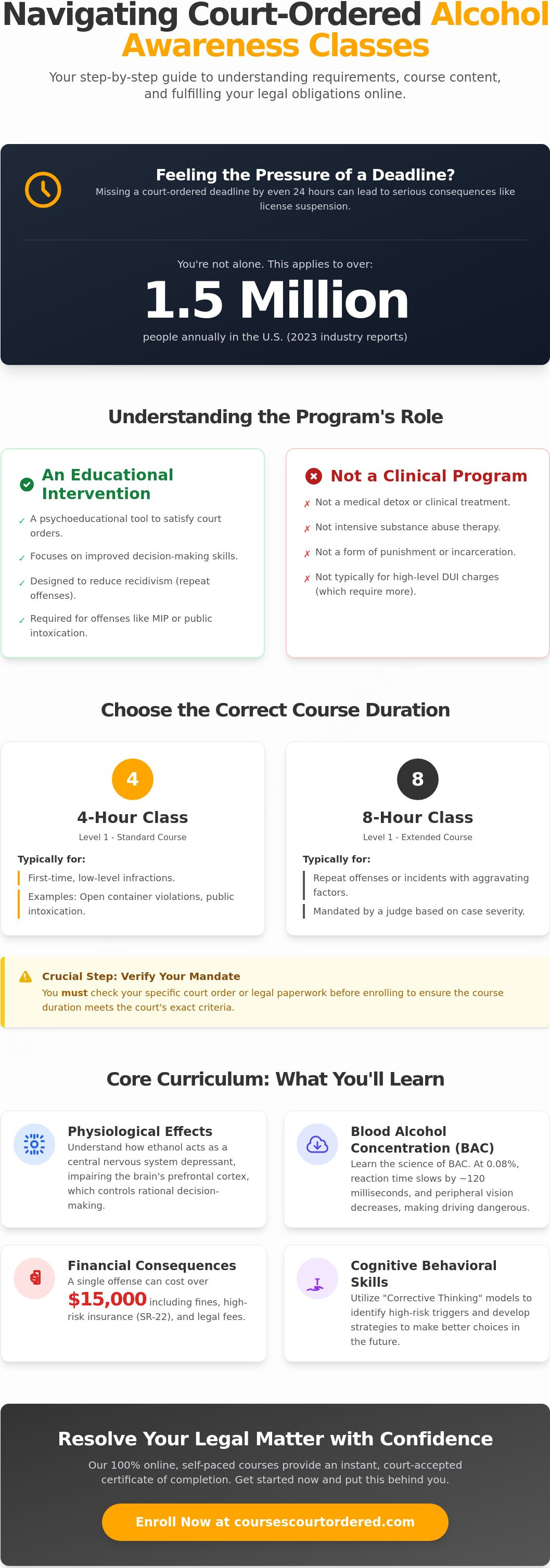
Last Tuesday, Michael discovered that missing a court-ordered deadline by just 24 hours could trigger an immediate license suspension. If you've recently received a similar mandate, you're likely feeling the weight of that same ticking clock. We understand that the pressure to find a legitimate alcohol awareness class is high. It's common to feel confused about whether an 8-hour or 4-hour course meets your specific legal requirements or if a judge will actually accept your documentation after you've completed the work.
This guide provides the professional clarity you need to move from legal obligation to a state of relief. You'll learn exactly how these mandated courses satisfy judicial standards, which currently apply to over 1.5 million people annually according to 2023 industry reports. We'll outline the core curriculum, clarify the differences in course durations, and explain the process for obtaining a hassle-free, instant certificate of completion. By the end of this guide, you'll have a guaranteed path to resolving your legal matter through a 100% online format that fits your schedule.
Key Takeaways
Understand the legal framework of psychoeducational programs designed to reduce recidivism through improved decision-making skills.
Explore the core curriculum covering the physiological effects of substance use and the mechanics of Blood Alcohol Concentration (BAC).
Learn the essential steps to verify your specific court mandate so you can enroll in the correct level and duration of an alcohol awareness class.
Evaluate the benefits of digital learning platforms to ensure your chosen course is fully compliant with modern judicial standards.
Identify the most efficient path to securing a court-accepted certificate using a 100% online, evidence-based intervention system.
Table of Contents Understanding the Role of an Alcohol Awareness Class in the Legal System The Core Curriculum: What You Learn in a Court-Ordered Alcohol Course Online vs. In-Person Alcohol Education: Comparing Compliance and Convenience How to Verify if an Online Alcohol Awareness Class Meets Your Mandate Completing Your Requirement with Courses Court Ordered
Understanding the Role of an Alcohol Awareness Class in the Legal System
An alcohol awareness class is a structured psychoeducational program designed to address the behaviors behind substance misuse and its resulting legal consequences. It's not a clinical treatment program or a medical detox. Instead, it serves as a mandated educational tool to help individuals understand the legal, personal, and social risks of their actions. These classes are standard requirements for offenses such as Minor in Possession (MIP), public intoxication, or safety violations in the workplace. While a Driving Under the Influence (DUI) charge often requires more intensive, multi-week programs, an awareness class focuses on the psychological triggers and decision-making processes that lead to legal trouble.
The primary goal of these courses is the reduction of recidivism. By shifting the focus from punishment to education, the legal system aims to provide offenders with the skills needed to make better choices. This approach is distinct from intensive substance abuse treatment, which is reserved for individuals diagnosed with a clinical dependency. An alcohol awareness class provides a pragmatic path for those who need to satisfy a court order while gaining a deeper understanding of how alcohol impacts cognitive function and legal standing.
Why Courts Prefer Educational Intervention
Judges, prosecutors, and probation officers increasingly favor behavior-changing intervention over traditional incarceration for first-time or low-level offenders. Statistics from the Bureau of Justice Assistance indicate that educational interventions can significantly lower the likelihood of repeat offenses compared to punitive measures alone. These modules address the root cause of the violation by teaching participants to identify high-risk situations. When a court assigns an alcohol awareness class, it's looking for objective proof that the individual has completed a curriculum that meets state or local standards. This process moves the participant from a state of legal obligation to a state of compliance and relief.
Standard Course Durations: 4-Hour vs. 8-Hour Options
Legal compliance depends on the specific "seat time" required by your court order. Jurisdictions determine these hours based on the severity of the incident and the individual’s prior record. A 4-hour course is typically the standard for first-time, low-level infractions like an open container violation. If the violation involves a repeat offense or specific aggravating factors, a judge may mandate an 8-hour Level 1 program. You must verify your specific legal paperwork before enrollment to ensure the duration meets the court's criteria. Our 100% Online platform allows you to complete these requirements at your own pace; this leads directly to an Instant Certificate that serves as your official proof of completion.
The Core Curriculum: What You Learn in a Court-Ordered Alcohol Course
A court-ordered alcohol awareness class serves as a structured intervention designed to provide objective data about substance use. It's not a lecture on morality. Instead, it focuses on the physiological and legal realities of consumption. You'll study how ethanol acts as a depressant on the central nervous system, slowing down the firing of neurons. This process directly impairs the prefrontal cortex, which is the area of the brain responsible for rational decision-making and impulse control. Understanding these biological shifts is the first step toward maintaining long-term compliance with judicial requirements.
Understanding Blood Alcohol Concentration (BAC) is a foundational element of the syllabus. At a BAC of 0.08%, your peripheral vision decreases and your reaction time slows by approximately 120 milliseconds. These physiological changes make operating a vehicle or heavy machinery dangerous. Beyond the physical risks, the curriculum details the financial consequences of a conviction. According to data from the National Highway Traffic Safety Administration and various state departments, the total cost of a single alcohol-related offense often exceeds $15,000. This includes court fees, mandatory high-risk insurance (SR-22) filings, and potential loss of professional licensure.
Cognitive Behavioral Foundations
Modern courses utilize "Corrective Thinking" models to help you identify specific triggers. You'll examine the cycle where a specific thought leads to a feeling, which then results in the decision to drink. By recognizing these patterns, you can develop practical strategies to handle social pressure or high-stress environments. These exercises focus on improving impulse control, ensuring you have the tools to meet your legal obligations and avoid future violations. This methodical approach turns a legal mandate into a practical set of life skills.
Health and Social Impact Education
The curriculum also addresses the long-term biological risks. Excessive consumption is linked to over 60 different diseases, including chronic liver conditions and cardiovascular issues. However, the impact isn't limited to the individual. You'll learn about the "ripple effect," which describes how alcohol misuse affects family stability, workplace productivity, and general community safety. If you need to fulfill a legal mandate quickly, you can find a Court Accepted alcohol awareness class that fits your schedule. This education helps you determine if your current patterns require further professional treatment or if these new strategies are sufficient for long-term compliance. The goal is to move you from a state of legal obligation to a state of completion and relief.
Online vs. In-Person Alcohol Education: Comparing Compliance and Convenience
Since the global shift in 2020, the legal landscape for completing an alcohol awareness class has undergone a permanent transformation. While traditional in-person seminars were once the standard, approximately 85% of jurisdictions have now integrated digital learning into their approved diversion programs. This evolution allows students to meet legal obligations without the logistical burden of commuting or taking time off work. The transition from physical classrooms to digital interfaces has proven that standardized, text-based, and video-supported learning often results in higher retention rates than traditional lectures.
The Reality of Court Acceptance in 2026
Modern judicial standards in 2026 prioritize curriculum quality over physical presence. Judges look for evidence-based content, secure identity verification, and a clear path to certification. Most courts recognize that digital platforms offer consistent instruction that doesn't vary based on an individual instructor's mood or energy level. If the provider maintains high standards, the certificate holds the same legal weight as one earned in a basement classroom. To verify if your specific jurisdiction permits digital completion, consult our guide on Are Online Court Classes Accepted? A 2026 Guide.
Accessibility and Learning Styles
The 100% online format caters to various learning speeds and cognitive styles. Traditional classrooms often move at a pace that doesn't suit every student, but self-paced modules allow for better information retention. If you need to review a specific module on blood alcohol concentration or legal consequences, you can simply pause and restart the material. This "start and stop" functionality is essential for working professionals who must balance a mandated alcohol awareness class with a 40-hour work week. Completing requirements privately also removes the social stigma often associated with attending a public substance abuse seminar. It turns a stressful legal requirement into a manageable, private task.
Online courses are typically 30% to 50% more affordable than their in-person counterparts. This price difference exists because digital providers don't pay for physical classroom rentals, utilities, or on-site security. For the student, this translates to a lower enrollment fee and zero travel expenses. Efficiency is the primary driver of the modern compliance process. Once the final exam is passed, the delivery of an instant certificate ensures that deadline-sensitive compliance is handled immediately. This streamlined process moves you from a state of legal obligation to a state of completion with absolute reliability.
How to Verify if an Online Alcohol Awareness Class Meets Your Mandate
Your court order or referral form is the definitive blueprint for legal compliance. Before you pay for any alcohol awareness class, you must cross-reference your paperwork against the provider's curriculum. Look for specific designations such as "Level I Alcohol Education" or "Level II Treatment." These classifications aren't interchangeable; enrolling in a 4-hour course when the judge mandated 12 hours will result in a rejection of your certificate and a potential violation of your probation. This error can lead to additional legal fees or extended court supervision.
Verification requires a methodical approach. Start by checking the provider's credentials. Legitimate institutions often maintain affiliations with NAADAC, the Association for Addiction Professionals, which has set national standards for behavioral health education since 1972. You should also look for NALI affiliations. If a provider cannot produce proof of these credentials, their certificate may lack the bureaucratic weight required by your jurisdiction. You must also confirm if your court accepts a digital PDF certificate or requires a physical copy with a "wet signature" and an embossed seal. While roughly 65% of modern jurisdictions now accept digital filings, the remaining 35% still demand traditional mail delivery to prevent document tampering.
Key Red Flags in Education Providers
Be wary of any website that uses high-pressure sales tactics or guarantees specific legal outcomes. No educational provider can "make the charge go away" or "guarantee a dismissal." These are legal results that only a judge or prosecutor can facilitate. Additionally, "free" courses are often a trap. While the instructional material might be free, these sites frequently charge exorbitant, hidden fees for a certificate that isn't recognized by the court system. A legitimate alcohol awareness class provides a verifiable document backed by an accredited institution from the moment you begin the course.
State-Specific Considerations
State laws vary significantly regarding online education standards. For example, if you're dealing with a mandate in the Sunshine State, you must follow the specific Florida Drug and Alcohol Course requirements to ensure your completion is recorded correctly with the DMV or the local court. While many programs are nationally recognized, certain states like Texas or Virginia may require providers to hold a specific state-level license. When you're in doubt, send the course syllabus to your probation officer or attorney for written approval before you begin the first module.
Ensure your compliance by choosing a program designed for judicial acceptance. View our court-accepted alcohol awareness classes to find the right hour requirement for your specific case.
Completing Your Requirement with Courses Court Ordered
Fulfilling a legal mandate shouldn't be a source of constant anxiety. At Courses Court Ordered, we provide a streamlined path to compliance through evidence-based, cognitive-behavioral intervention. Our curriculum doesn't just present facts; it focuses on the psychological triggers behind substance use to help you make better decisions. Because our platform is 100% online, you can finish your alcohol awareness class from any device without the need for classroom travel or time off work. We eliminate the friction of hidden fees or complex registration processes, allowing you to focus entirely on the material.
Our approach is pragmatic and non-judgmental. We understand that navigating the legal system is stressful. Our goal is to act as a competent guide that moves you quickly from a state of obligation to a state of relief. By choosing a program that meets judicial standards, you ensure that your efforts are recognized by the court, avoiding the risk of non-compliance and further legal complications. Our systems are built for speed and reliability, ensuring that every user has a clear path toward resolution.
Our 4 and 8-Hour Alcohol and Substance Misuse Courses
We offer specialized tracks designed to meet specific court orders. The 4-hour curriculum focuses on the immediate legal and physical impacts of substance misuse, while the 8-hour course provides a more comprehensive look at behavioral change and long-term risk reduction. You can view all available options on our courses page. Legal professionals across the country frequently utilize our Student Referral form to streamline the process for their clients. For those needing specific compliance details, our 4-Hour Drug and Alcohol Course Guide offers a breakdown of what to expect during the 2026 reporting cycle.
Reaching the Finish Line: Certification and Beyond
The final step in your alcohol awareness class is the evaluation. Once you pass, you'll receive an instant certificate of completion in digital format. There's no waiting period; the document is available for immediate download so you can submit it to your attorney or probation officer right away. If your specific jurisdiction or court clerk requires a physical document with an embossed seal, we provide several expedited shipping options to ensure it arrives before your deadline. This finality allows you to close this chapter of your legal journey and move forward with confidence. We provide the tools you need to meet your obligations without the typical bureaucratic hurdles.
Resolve Your Legal Requirements with Confidence
Navigating a court mandate requires a clear path and reliable resources to ensure your legal standing remains secure. An alcohol awareness class serves as a critical bridge between a judicial obligation and a successful resolution, providing the essential education required by the court. By choosing a digital format, you gain the ability to learn at your own speed while meeting every specific requirement set by the judge or probation officer. This flexibility ensures that your professional and personal life continues without the interruption of rigid in-person schedules.
Since 2009, CoursesCourtOrdered.com has helped individuals across the country satisfy their requirements with absolute reliability. Our curriculum is 100% online and self-paced, allowing you to finish the material whenever it's most convenient for you. Because our certificates are accepted by most jurisdictions nationwide, you can proceed with the confidence that your time is being used effectively to clear your record. You've already done the hard work of identifying what's needed; now it's time to finish the process. Take the final step toward putting this legal matter behind you and achieving the peace of mind you deserve.
Frequently Asked Questions
Is an online alcohol awareness class court-accepted?
Yes, online classes are widely accepted by courts in all 50 states, provided the provider meets specific jurisdictional standards. While approximately 95% of courts recognize digital certification, you should always verify your specific court order before enrolling. Our 100% online courses are designed to satisfy national requirements for court-ordered education, ensuring a smooth path to compliance.
How long does it take to get my certificate of completion?
You’ll receive an instant certificate of completion immediately after you pass the final exam. There's no waiting for physical mail or manual processing. You can download the PDF document right away to meet your legal deadline. This fast delivery ensures you maintain compliance and resolve your legal obligations without unnecessary administrative delays.
What is the difference between an alcohol awareness class and a DUI class?
An alcohol awareness class focuses on general substance education and decision-making, while a DUI class is a specialized program specifically for driving-related offenses. DUI programs often require 12 to 52 hours of clinical supervision depending on state laws like California's Title 9 regulations. Awareness classes are typically shorter, often ranging from 8 to 24 hours of educational content.
Can I take this class on my phone or tablet?
You can complete the entire course on any smartphone, tablet, or computer with a standard internet connection. The platform is fully mobile-responsive, which allows you to switch between devices without losing your progress. This flexibility helps you finish your mandated education during breaks or while commuting. It’s a 100% online experience designed for your convenience.
What happens if I fail the final exam?
You can retake the final exam as many times as necessary at no additional cost until you pass. Most students achieve the required passing score of 70% or higher on their first attempt. If you don't succeed initially, the system allows for an immediate review of the material so you can try again right away without any penalty.
Do I have to complete the course all at once?
No, you don't have to finish the course in a single sitting because the system saves your progress automatically at every step. You can log in and out as your schedule permits. This self-paced format is ideal for individuals balancing work and family obligations while fulfilling a court-ordered alcohol awareness class requirement.
How much does a court-ordered alcohol awareness class cost?
Costs for court-ordered education vary based on the specific number of hours required by your legal mandate. According to 2023 industry data, standard 8-hour courses typically start at different price points than intensive 24-hour programs. You'll see the exact price for your required duration during the registration process before you are asked to submit any payment.
Will my employer find out I took this class?
Your enrollment and completion status remain strictly confidential and aren't shared with employers or third parties without your explicit written consent. We prioritize your privacy throughout the entire certification process. Unless you're specifically required to provide the certificate to your workplace as part of a private disciplinary agreement, the record stays between you and the court.


Comments