
Streamlining Justice: The Digital Referral Form for Offender Treatment in 2026
- 5 days ago
- 11 min read
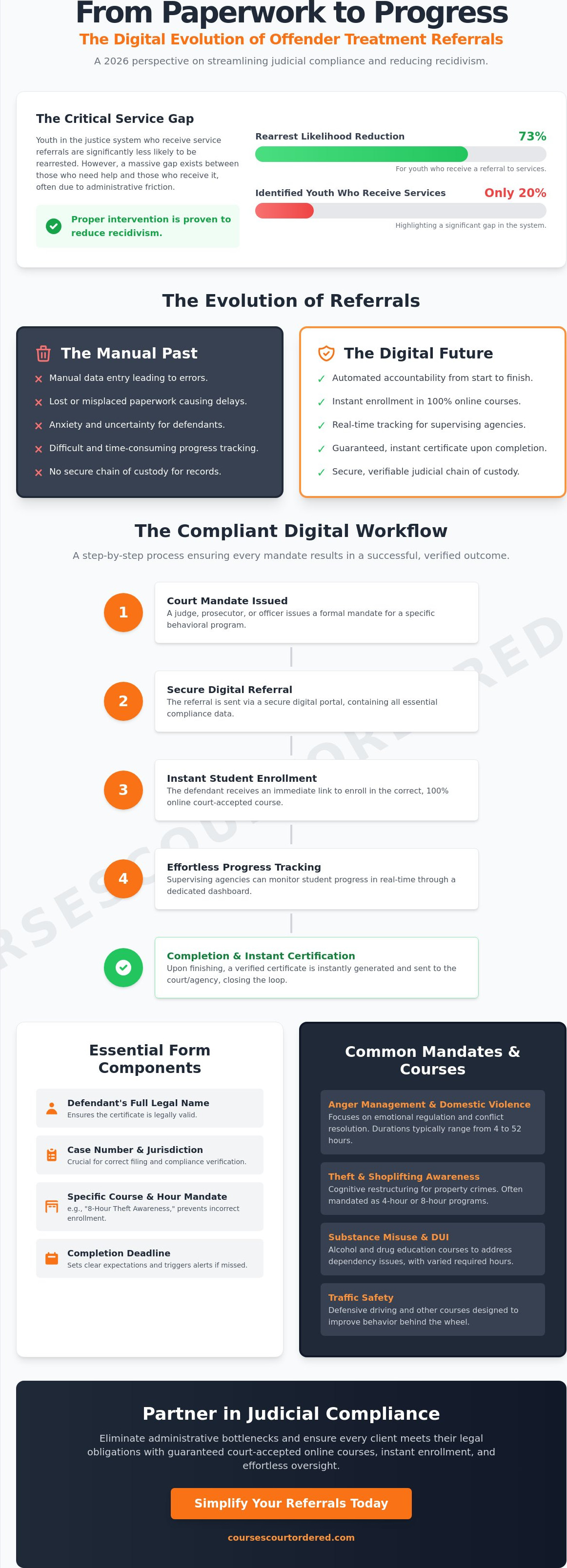
Did you know that youth in the juvenile justice system are 73% less likely to be rearrested within three months when they receive a referral to services, yet only 20% of those identified as needing help actually get one? This gap often results from the friction of manual data entry and the anxiety of lost paperwork. You likely feel the pressure of ensuring every defendant accesses a program that is strictly court accepted without the constant headache of tracking their progress manually.
In 2026, the referral form for offender treatment has evolved into a digital bridge that automates accountability from the initial mandate to final certification. This article demonstrates how a standardized digital process ensures legal compliance and provides your clients with instant enrollment in 100% online courses. We will examine how these tools eliminate uncertainty about judicial standards, offer real-time tracking, and provide the instant certificate needed to resolve legal obligations with absolute reliability. By moving away from manual filing, you can ensure that every mandate results in a successful, verified outcome.
Key Takeaways
Understand why a standardized referral form for offender treatment is critical for maintaining a secure judicial chain of custody from sentencing through rehabilitation.
Identify the essential data points and course hour specifications required to ensure every referral meets strict court standards.
Discover how transitioning to digital platforms eliminates administrative bottlenecks and facilitates instant enrollment for mandated students.
Learn how to match offender needs with specific 100% online course durations to fulfill legal requirements without the hassle of manual paperwork.
Explore how professional tools simplify agency oversight with effortless tracking and the guarantee of an instant certificate upon completion.
Table of Contents What is a Referral Form for Offender Treatment? Essential Components of a Compliant Referral Form The Evolution of Digital Referrals: Moving Beyond Paper How to Execute a Referral for Offender Treatment Courses Court Ordered: Your Partner in Judicial Compliance
What is a Referral Form for Offender Treatment?
A referral form for offender treatment is a formal legal document issued by a court or supervising agency. It mandates that a defendant participate in a specific behavioral intervention program as part of their sentencing or probation. This document serves as the official starting point for offender rehabilitation, ensuring that the individual is directed toward a program that meets specific jurisdictional requirements. By 2026, these forms have moved beyond simple administrative requests. They now act as a secure link in the judicial chain of custody, ensuring that the person who was sentenced is the same person who completes the mandated course.
The primary goal of this process is the reduction of recidivism through targeted, evidence-based education. When a court issues a mandate, it isn't just checking a box. It's attempting to provide the offender with the tools necessary to avoid future legal complications. Modern standards in 2026 require more than just a name and a case number. High-compliance environments now demand specific course hours and verified provider links to ensure the intervention is legitimate and court accepted. This precision prevents administrative errors that could lead to a violation of probation or unnecessary legal delays.
Key Stakeholders in the Referral Process
Judges and prosecutors are the primary architects of the mandate. They set the legal requirements for behavioral change to ensure the sentence serves the community's interest. Probation officers act as the day-to-day managers of these referrals. They need a system that allows them to track progress without chasing paper. Finally, defense attorneys use these forms to give their clients a clear path to resolution. A well-organized referral helps a client move from a state of legal obligation to a state of completion and relief.
Common Mandates Requiring a Formal Referral
Courts typically use a referral form for offender treatment to address specific behavioral issues. These mandates often include:
Anger Management and Domestic Violence: These courses focus on emotional regulation and conflict resolution.
Theft Awareness: Programs designed for shoplifting prevention and cognitive restructuring regarding property crimes.
Substance Misuse: Alcohol education and drug awareness courses mandated to address chemical dependency issues.
If you are a professional looking to simplify this process, you can refer a student directly through our secure portal to ensure they receive instant enrollment and a guaranteed certificate of completion. Matching the right course to the specific mandate is the most efficient way to ensure judicial compliance.
Essential Components of a Compliant Referral Form
A compliant referral form for offender treatment serves as the legal blueprint for a defendant's behavioral correction. Accuracy is paramount. If the student's data is incorrect, the final certificate becomes legally void, forcing the individual to repeat the process. This administrative friction is exactly what digital systems in 2026 aim to eliminate. Every form must include the defendant's full legal name, case number, and specific jurisdiction to ensure the resulting certification is filed without delay.
Course specifications must be clearly defined within the document. For instance, a court might mandate a 4-hour course for a first-time petty theft offense, whereas a repeat offender might require an 8-hour intensive program. In Texas, specialized treatment providers like a Licensed Sex Offender Treatment Provider (LSOTP) utilize specific paperwork like Form 3239, which involves a $375.00 licensing fee to maintain professional standards. Similarly, your referral must specify whether the defendant needs a 4-hour Traffic Safety course or a standard 8-hour behavioral class to meet the judge's exact orders. Providing these details upfront prevents the student from enrolling in the wrong level of intervention.
Reporting and deadline management are the final pillars of a compliant form. The document should explicitly state the timeline for course commencement and completion. If a student doesn't start within the court-mandated window, the system should ideally trigger an automated alert for the supervising officer. The court expects to receive the certificate through a verified digital portal to maintain a secure chain of evidence. If you are unsure which level to select, you can view our full list of court accepted courses to match the mandate perfectly.
Selecting the Correct Intervention Level
Distinguishing between general education and clinical treatment is a vital step. A referral for a 4-hour course is often an educational intervention focusing on cognitive-behavioral basics. Clinical treatment requires deeper psychological oversight. You must ensure the curriculum focus aligns with the specific offense and the individual's prior legal history. This alignment ensures the referral form for offender treatment satisfies the clerk of courts and the sentencing judge.
Legal Verbiage and Accountability
To be recognized by the court, the form needs standard accountability clauses. These clauses outline the consequences of non-compliance, such as a potential violation of probation. Under 2026 digital standards, privacy and data security are also top priorities. Offender information must be handled securely to prevent unauthorized access while allowing for real-time compliance tracking by probation officers and legal counsel.
The Evolution of Digital Referrals: Moving Beyond Paper
Physical paperwork is rapidly becoming a liability in the judicial system. Static PDF documents and handwritten forms create administrative bottlenecks that often lead to compliance gaps. When a paper referral is lost or filed incorrectly, the offender's progress stalls; this creates unnecessary friction for both the court and the defendant. By 2026, the transition to digital systems has proven its value. Statistics from digital referral implementations in healthcare and social services show a 108% increase in referral volume once manual processes are removed. This efficiency is now the standard for court-mandated interventions.
The modern referral form for offender treatment utilizes digital links to facilitate instant enrollment. Instead of waiting days for a physical document to be processed, an offender can receive a secure link and begin their course immediately. This digital approach also allows for real-time tracking. Officers no longer need to conduct manual check-ins to see if a student has started their mandate. They can view progress updates through a secure dashboard, ensuring that every deadline is met without the need for constant phone calls or emails. Digital certificates further strengthen this chain of custody by eliminating the risk of forged or lost documents.
Integration with Online Court Solutions
Digital forms now sync seamlessly with modern case management systems. This interoperability ensures that student data is transmitted securely between the court and the provider. The North American Learning Institute plays a critical role in this evolution, providing the secure, cloud-based infrastructure required for reliable tracking. For legal professionals looking to modernize their workflow, using a Referral Program for Legal Professionals offers a streamlined alternative to traditional paper-based methods. These systems are designed to satisfy the rigorous standards of 2026 judicial requirements.
Benefits for the Offender
Moving beyond paper significantly reduces the "friction to start" for the offender. Immediate access to the mandated course helps maintain the momentum of the sentencing phase, reducing the anxiety often associated with complex legal requirements. Because these programs are 100% online and mobile-friendly, offenders can fulfill their obligations without the logistical burden of finding transportation or missing work. This convenience doesn't just lower stress; it increases the likelihood of successful course completion and long-term compliance with court orders.
How to Execute a Referral for Offender Treatment
Executing a referral form for offender treatment is a methodical process designed to ensure absolute judicial compliance. It begins with a precise assessment of the offender's specific needs based on the court's sentencing guidelines. You must identify the core behavioral issue being addressed to select the correct curriculum. Once the focus is determined, you'll choose the appropriate course duration. As of May 2026, standard mandates typically require a 4-hour course for $25 or an 8-hour course for $50. Matching the hour requirement exactly is essential to prevent the court from rejecting the final certification.
After selecting the course, you complete the digital referral form. This action triggers an automated enrollment email sent directly to the student, allowing them to begin their 100% online coursework immediately. This automation removes the administrative burden of manual follow-ups. You can then monitor the student's dashboard to track their progress and see when they reach final assessment testing. This real-time oversight ensures that legal deadlines are met. Once the student completes the program, you receive an instant certificate of completion for official court filing, providing a hassle-free conclusion to the mandate.
Matching Offenses to Course Types
Precision in course selection is the key to a successful referral. If you are referring a student for a property crime, you should select a Theft Awareness Class to address cognitive distortions related to shoplifting. For cases involving interpersonal disputes, selecting Anger Management Classes provides the necessary emotional regulation tools. When a mandate involves chemical dependency or impaired driving, utilizing the Drug and Alcohol Course ensures the student receives evidence-based substance misuse education.
Verifying Court Acceptance Nationally
Ensuring national court acceptance requires choosing programs that adhere to strict evidence-based curriculum standards. A valid referral must lead to a formal, verifiable certificate that the clerk of courts will recognize without question. It's highly recommended to choose NALI-affiliated programs. These courses are designed to meet the rigorous demands of various jurisdictions, providing guaranteed acceptance and a proven path toward resolving legal complications. To ensure your clients meet their requirements accurately, you can refer a student today through our secure digital portal.
Courses Court Ordered: Your Partner in Judicial Compliance
Selecting a partner for judicial compliance requires a focus on absolute reliability and institutional knowledge. Courses Court Ordered provides a streamlined, professional referral tool specifically engineered to meet 2026 legal standards. Our platform eliminates the administrative friction that often leads to non-compliance. By using our digital referral form for offender treatment, you ensure that every mandate is tracked from the moment of sentencing to the final issuance of a certificate. This level of calm efficiency lowers stress for legal professionals and defendants alike.
Our system is built on the promise of 100% online accessibility and court accepted curriculum. Thousands of judges and attorneys trust our evidence-based courses because they prioritize the success of the customer while maintaining judicial weight. We understand that legal deadlines are high-pressure. That's why we've designed a process that moves the student quickly from a state of legal obligation to a state of completion and relief. Every step is methodical; it mirrors the procedural nature of the legal system itself to ensure the outcome is never in doubt.
Our National Referral Network
We support courts and agencies across the United States with a robust infrastructure designed for high-volume caseloads. High-volume probation departments benefit from customized reporting options that allow for effortless tracking of hundreds of students simultaneously. This centralized oversight ensures that no offender falls through the cracks due to lost paperwork or manual entry errors. You can access our full catalog of court ordered classes online to see how our 4-hour and 8-hour programs align with your specific jurisdictional requirements.
Reassuring Results for Every Case
Every course we offer features a cognitive-behavioral focus that satisfies the most rigorous judicial requirements. Our primary goal is the successful and rapid resolution of legal matters. To support this, we provide instant digital certificates as a signature value proposition. If a physical copy is required for the clerk of courts, we offer expedited shipping options to ensure deadlines are never missed. The outcome is never in doubt when you use a proven path toward resolving legal complications. You can simplify your caseload and ensure 100% compliance by choosing to Refer a Student Now through our secure digital portal.
Modernizing Judicial Outcomes with Digital Precision
The transition from administrative friction to digital efficiency is the hallmark of justice in 2026. By adopting a standardized referral form for offender treatment, you ensure that every mandate is handled with precision and speed. We've examined how moving beyond manual data entry eliminates lost paperwork and provides probation officers with real-time tracking capabilities. This shift doesn't just simplify your workflow; it ensures that every student accesses a program that meets strict judicial standards without the risk of administrative delays.
Since being founded in 2009, Courses Court Ordered has focused on providing an evidence-based cognitive behavioral curriculum that is 100% online and court accepted. Our specialized tools are designed to move users from a state of legal obligation to a state of completion and relief with absolute reliability. You can eliminate the anxiety of non-compliance by choosing a proven path toward resolving legal complications. Streamline Your Referrals Today to ensure your clients receive the instant certificate they need for a successful and rapid resolution.
Frequently Asked Questions
What is the purpose of a referral form for offender treatment?
The primary purpose of a referral form for offender treatment is to establish a secure, verifiable link between a court mandate and a behavioral intervention provider. It ensures that the offender is directed to the exact curriculum and course duration required by their sentence. This document maintains the judicial chain of custody, providing the court with a reliable record that the specific legal obligation has been initiated.
Can a defense attorney use a referral form to enroll a client proactively?
Defense attorneys can and frequently do use our referral system to enroll their clients proactively before a final sentencing hearing. Initiating a court-accepted course early demonstrates a client's commitment to rehabilitation and can often help in negotiating more favorable terms. This proactive approach helps resolve legal complications before they escalate into high-pressure deadlines or potential probation violations.
Are digital referral forms accepted by all courts in 2026?
Digital referral forms are accepted by the vast majority of jurisdictions across the United States in 2026. As courts have modernized to handle remote hearings and electronic filing, digital systems have become the preferred standard to avoid administrative bottlenecks. These digital versions are more secure than paper documents and provide the real-time tracking that modern judicial standards demand for a referral form for offender treatment.
What information is required to complete a student referral?
To complete a student referral, you must provide the offender's full legal name, their case number, and the specific jurisdiction overseeing the case. You also need to select the mandated course type and duration, such as a 4-hour program for $25 or an 8-hour program for $50. Accurate data is essential because errors in these fields can lead to a certificate being rejected by the clerk of courts.
How does the court receive the certificate of completion?
The court receives the certificate of completion through a secure digital portal or via the student’s direct submission of the verified document. Our system generates an instant certificate the moment the final assessment is successfully passed. For jurisdictions that still require physical documentation, we offer expedited shipping options to ensure the hard copy arrives before the court-mandated deadline.
Is there a fee for agencies to use the Courses Court Ordered referral tool?
There is no fee for agencies, probation departments, or legal professionals to use our professional referral tool. The only cost involved is the enrollment fee for the specific course, which is typically paid by the offender at the time of registration. This allows agencies to manage high-volume caseloads and track student progress without any impact on their departmental budget.
Can I track the progress of multiple offenders through one referral account?
You can track the progress of multiple offenders through a single, centralized referral dashboard designed for high-volume oversight. This account allows you to see the enrollment status and current progress of every student you have referred in real-time. It eliminates the need for manual check-ins and provides a clear view of compliance across your entire caseload with just a few clicks.
What happens if a student fails to complete the referred course?
If a student fails to complete their referred course by the established deadline, the supervising agency is notified through their tracking dashboard. Non-completion usually results in a violation of probation or other legal penalties as determined by the sentencing judge. Our system provides the transparency needed for officers to take immediate action if a mandate is not being fulfilled as required.


Comments