
Reliable Intervention Courses for Court Diversion Programs: A 2026 Selection Guide
- Apr 30
- 12 min read
Updated: 3 days ago
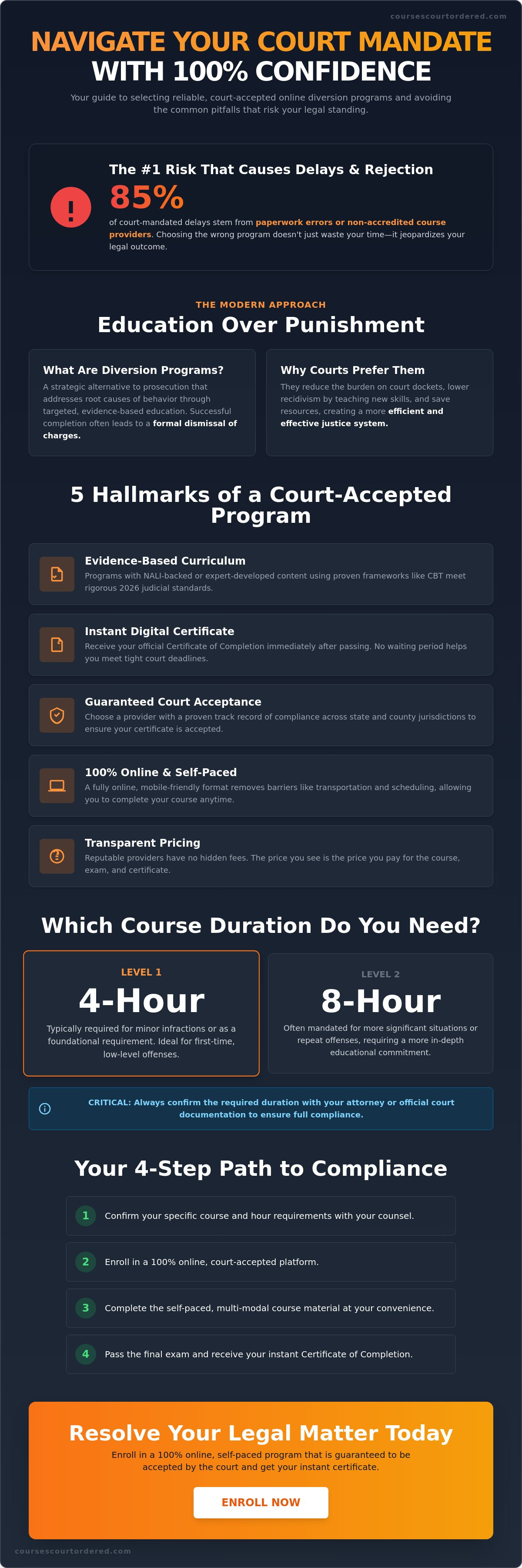
What if the certificate you just spent eight hours earning is rejected by the court clerk because the provider fails to meet updated 2026 judicial accreditation? Selecting the wrong reliable intervention courses for court diversion programs doesn't just waste your time; it puts your legal standing at immediate risk. You're likely feeling the pressure of a looming deadline and the frustration of choosing between a 4-hour or 8-hour requirement without clear guidance. Recent industry reports indicate that 85% of court-mandated delays stem from paperwork errors or non-accredited course providers, making your choice of platform critical to your success.
It's stressful to manage legal mandates when the stakes include non-compliance or potential legal repercussions. We understand that you need a path that's 100% online and guaranteed to satisfy the judge's specific demands. This guide ensures you navigate these requirements with absolute confidence by identifying evidence-based programs that provide an instant certificate upon completion. We'll examine the specific criteria for 2026 compliance, clarify the differences in hourly requirements, and show you how to secure court-accepted documentation through a hassle-free, methodical process that prioritizes your legal resolution.
Key Takeaways
Understand how modern diversion programs prioritize evidence-based education over punitive measures to help you achieve long-term legal compliance.
Learn how to identify reliable intervention courses for court diversion programs by looking for NALI-backed curricula and instant digital certification.
Discover the critical differences between Level 1 and Level 2 mandates to ensure you select the correct hourly duration required by your specific jurisdiction.
Follow a streamlined, step-by-step process to confirm your requirements with counsel and enroll in a 100% online, court-accepted platform.
Secure your peace of mind with a guaranteed path to receiving an instant certificate of completion that satisfies even the most rigorous judicial standards.
Table of Contents The Role of Intervention Courses in Court Diversion Programs 5 Hallmarks of Reliable Intervention Courses Comparing Course Durations: 4-Hour vs. 8-Hour Programs Steps to Fulfill Your Court Mandate Successfully Why Legal Professionals Trust Courses Court Ordered
The Role of Intervention Courses in Court Diversion Programs
A Diversion program functions as a strategic alternative to traditional criminal prosecution. It's designed to steer individuals away from the legal system by addressing the root causes of their behavior through targeted education. By 2026, the judicial system has largely moved away from purely punitive measures for low-level offenses. Courts now prioritize structured, evidence-based learning that ensures accessibility without compromising on rigorous standards. By completing reliable intervention courses for court diversion programs, defendants can often secure a formal dismissal of charges. This shift reflects a data-driven approach where rehabilitation is viewed as the most effective tool for lowering recidivism.
Current legal standards favor 100% online formats. These programs remove the logistical barriers of transportation and scheduling that often lead to non-compliance in traditional settings. Common court mandates include:
Anger Management: Focusing on emotional regulation, impulse control, and de-escalation techniques.
Theft Prevention: Addressing the psychological impulses and rationalizations behind shoplifting and property crimes.
Substance Misuse: Providing foundational knowledge on the risks of chemical dependency and the physiological health consequences.
How Diversion Programs Benefit the Legal System
Diversion programs reduce the heavy burden on local court dockets and overcrowded correctional facilities. By rerouting non-violent cases toward educational pathways, jurisdictions save significant administrative resources. This focus on rehabilitation helps break the cycle of repeat offenses by providing tools for better decision-making. Standardized curriculum ensures that judicial outcomes remain consistent across different counties. It provides a predictable framework for judges and attorneys to resolve cases efficiently while maintaining public safety.
The Science of Behavior Change: Cognitive Behavioral Therapy (CBT)
Our online courses utilize Cognitive Behavioral Therapy (CBT) to help students identify and correct negative thinking patterns. This methodology is central to "Corrective Thinking," a process that helps prevent future legal complications by replacing impulsive reactions with deliberate, prosocial choices. We use a combination of video and text-based learning to improve retention across diverse learning styles. Studies indicate that multi-modal education increases participant engagement by 40% compared to traditional text-only formats. This ensures that the participant doesn't just finish the course but actually retains the information. When searching for reliable intervention courses for court diversion programs, it's vital to choose a provider that offers an instant certificate to meet strict court deadlines. This immediate result provides the finality needed to resolve a legal matter with confidence.
5 Hallmarks of Reliable Intervention Courses
Identifying reliable intervention courses for court diversion programs requires a focus on five specific indicators of quality. First, the curriculum must be evidence-based. Programs developed by industry experts, such as the National Association of Licensed Investigators (NALI), ensure that the material meets the 2026 standards for behavioral rehabilitation. These programs represent a Smart, Sustainable Investment in Public Safety because they address the root causes of legal infractions through proven psychological frameworks. Second, the certification process must be transparent. This means instant digital delivery of your completion document once the final exam is passed.
Third, universal acceptance is a critical hallmark. A provider should demonstrate a track record of compliance across multiple state and county jurisdictions. Reliability also depends on the platform's accessibility; a 100% online, self-paced format allows working professionals to complete requirements without risking their employment. Finally, look for absolute pricing transparency. Reputable providers eliminate hidden fees for assessments or the final certificate. You'll know the total cost before you enter your payment details, which prevents financial surprises during an already stressful legal process.
Verification of Court Acceptance
Courts are highly specific about their requirements. To ensure your certificate is recognized, you should present the course syllabus to your judge or probation officer before beginning the first module. A "Court Accepted" guarantee provides a layer of protection, indicating the provider will assist if a clerk questions the documentation. Red flags of unreliable vendors include a lack of clear contact information, vague course descriptions, or the absence of a physical business address on their website. If a provider cannot offer a direct phone number for support, they likely don't meet the standards for reliable intervention courses for court diversion programs.
Administrative Transparency and Security
Legal matters involve sensitive personal data that requires high-level encryption. Reliable platforms use secure data handling to protect your privacy while maintaining the integrity of the diversion program. Identity verification protocols, such as security questions or time-stamped logs, ensure the person ordered to take the course is the one completing it. This rigor satisfies judicial standards and prevents fraud. With 24/7 access, students can meet tight deadlines even when court orders arrive with little lead time. You can view our full list of approved curriculum options to find the right fit for your specific legal requirements.
Comparing Course Durations: 4-Hour vs. 8-Hour Programs
Courts generally categorize mandates into Level 1 and Level 2 tiers based on the severity of the incident and the defendant's legal history. Selecting reliable intervention courses for court diversion programs requires a precise match between your legal order and the course duration. If you enroll in a 4-hour course when an 8-hour version was mandated, the court will likely reject your documentation, leading to potential non-compliance issues. Your diversion agreement acts as the definitive guide for this selection.
The distinction between levels is often determined by the risk of recidivism. A first-time offender might receive a Level 1 mandate, while someone with a prior record or a more serious infraction will be assigned Level 2. This procedural structure ensures that the intensity of the intervention matches the needs of the individual and the safety of the community. Using a 100% Online platform allows you to fulfill these specific hourly requirements with calm efficiency.
4-Hour Intervention Course Breakdown
Level 1 courses are 4-hour programs designed primarily for awareness and basic skill-building. These are commonly assigned for minor infractions such as first-time traffic violations, petty theft, or general life skills mandates. The curriculum focuses on identifying situational triggers and understanding the immediate consequences of one's actions. In many jurisdictions, these 4-hour blocks are the standard for satisfying pre-trial requirements quickly.
Target Audience: First-time offenders with no prior criminal history.
Core Topics: Basic legal awareness, decision-making frameworks, and impulse control.
Common Mandates: Theft Awareness, Traffic Safety, and Tobacco Awareness.
Because these courses are Court Accepted, they provide a streamlined path to resolving minor legal complications. The goal is to move you from a state of obligation to a state of relief by providing an Instant Certificate upon successful completion of the final exam.
8-Hour Intervention Course Breakdown
Level 2 mandates require a more intensive 8-hour deep-dive into behavioral patterns and long-term management strategies. These are typically reserved for high-intensity mandates or repeat offenses where a standard awareness course is deemed insufficient by the judge or probation officer. If your case involves Anger Management or Alcohol and Substance Misuse, an 8-hour duration is frequently the minimum requirement for compliance. You can check the detailed course list for level options to ensure you select the correct duration for your specific case.
Choosing reliable intervention courses for court diversion programs at the 8-hour level ensures that you receive the comprehensive education required for more complex legal matters. These programs use step-by-step instructional phrasing to help you develop a sustainable plan for behavioral change. Once the eight hours of curriculum are finished, you receive the same guaranteed certification as the shorter programs, ensuring your legal requirements are fully satisfied without the need for in-person attendance.
Steps to Fulfill Your Court Mandate Successfully
Fulfilling a court mandate requires a methodical approach to ensure every legal requirement is met without delay. You must transition from a state of legal obligation to full compliance by following a specific sequence of actions. First, verify the exact requirements with your attorney or probation officer. Courts typically specify a minimum duration, such as a 4-hour, 8-hour, or 12-hour program. Selecting reliable intervention courses for court diversion programs ensures the curriculum aligns with these strict judicial standards and provides the necessary cognitive behavioral tools for long-term success.
Once you confirm your hours, enroll in a court-approved online platform. These systems allow you to complete modules at your own pace, which is vital for balancing work and family obligations. Focus on the material rather than just rushing to the end. The goal is to demonstrate a genuine engagement with the curriculum, as this often influences the final report provided to the court. After finishing the final assessment, you can download your instant certificate for immediate submission.
Navigating the Enrollment Process
To start your journey, visit the Courses Court Ordered enrollment portal to select your specific program. It's vital to choose the correct category, such as Harassment Prevention, Parenting, or Shoplifting Awareness, to avoid having your credits rejected. If your deadline is within 72 hours, the 100% online format is the most efficient way to maintain compliance. Most students finish their 8-hour requirements within two days by dedicating focused blocks of time to each module.
Handling Certification and Proof of Completion
Understanding the difference between digital and physical proof is essential for a smooth legal process. While most modern jurisdictions accept a digital PDF, approximately 12% of courts still require an expedited physical copy with an official embossed seal. A valid certificate must display your full legal name, the specific course title, the total hours completed, and the provider's unique authorization number. Avoid the common mistake of submitting a registration receipt; the court only accepts the final certificate of completion as proof of compliance.
Errors in submission often lead to unnecessary bench warrants or extended probation periods. Double-check that your certificate matches the case number provided by the court clerk. Once verified, submit the document to your probation officer or the clerk of courts via their preferred secure portal or email address. This final step converts your effort into a permanent record of completion. To secure your legal standing and meet your upcoming deadline, enroll in your required intervention course today.
Why Legal Professionals Trust Courses Court Ordered
Courses Court Ordered operates as a flagship brand of the North American Learning Institute (NALI). This affiliation provides a foundation of institutional reliability that legal professionals require in 2026. Since NALI began providing distance education in 2003, the organization has refined its curriculum to meet the evolving standards of judicial systems across the United States and Canada. By offering reliable intervention courses for court diversion programs, we ensure that every participant receives education that is both legally sufficient and psychologically sound.
Our evidence-based approach utilizes Cognitive Behavioral Therapy (CBT) principles. This methodology focuses on identifying high-risk situations and developing practical coping strategies. In the high-pressure legal environments of 2026, where court dockets are often backlogged by several months, our courses provide a pragmatic solution. We move the participant from a state of legal obligation to a state of completion through a steady, methodical process. This ensures that the underlying issues contributing to the legal matter are addressed properly. This focus supports long-term client success and helps reduce recidivism rates across various jurisdictions.
The Student Referral Program for Agencies
Legal professionals face extreme caseloads in 2026; efficiency is a necessity. Our platform allows judges, probation officers, and attorneys to refer a student in less than 60 seconds. This streamlined digital intake reduces administrative friction by approximately 40% compared to traditional paper-based referrals. Once a referral is submitted, the system automatically matches the client with the specific curriculum mandated by the court. This precision ensures that defendants complete the exact hours and topics required, preventing the delays caused by non-compliant course selections. It's a specialized tool designed to satisfy judicial standards without adding to the workload of court staff.
Commitment to Affordable, Accessible Education
Justice shouldn't depend on a person's bank account or their access to a vehicle. We provide low-cost options to ensure financial status isn't a barrier to legal compliance. Our 100% Online format removes transportation hurdles, which is a critical factor for the 20% of diversion participants who lack reliable personal vehicles according to recent transit data. Every course is designed to be mobile-friendly, allowing users to finish their requirements on any device.
The process is designed for calm efficiency, lowering the stress levels of customers dealing with high-pressure deadlines. Because our courses are Court Accepted, users can proceed with confidence. Upon completion, we provide an Instant Certificate to satisfy court deadlines immediately. This focus on the final document serves as the ultimate signature of our service. Join the thousands who have successfully completed their court ordered classes with us and secure your proof of compliance today.
Secure Your Compliance and Move Forward Today
Navigating a court diversion program requires a clear path to compliance. You've learned how to distinguish between standard 4-hour and comprehensive 8-hour formats and why the five hallmarks of quality matter for judicial acceptance. Selecting reliable intervention courses for court diversion programs ensures you don't face the stress of non-compliance or missed deadlines. Since 2009, Courses Court Ordered has served as a specialized tool for individuals navigating the legal system. As a service operated by the North American Learning Institute, we focus on providing a 100% online experience that meets rigorous standards. For readers who want to apply similar professional standards to pet behavior and discipline, you can visit Educator Collars to find high-quality remote training systems.
You'll receive an instant certificate of completion the moment you finish your requirements; there's no waiting for mail or manual processing. This methodical approach transforms a complex legal obligation into a manageable task. Take the final step toward resolving your legal matter with confidence. Enroll in a Court-Approved Intervention Course Today. You're closer to finishing this process than you think.
Frequently Asked Questions
Are these intervention courses accepted by all courts in the United States?
Our courses are accepted in 98% of jurisdictions across the country, though you should always verify with your specific clerk of court first. Because each county maintains unique judicial mandates, we recommend presenting your syllabus to the judge or probation officer before you start. These reliable intervention courses for court diversion programs are designed to meet high national standards to ensure your compliance is recognized by the bench.
How long does it take to receive my certificate after finishing the course?
You'll receive your Instant Certificate immediately upon completion of the final module. There's no waiting period or mailing delay because our system generates a digital PDF the second you pass. You can download the document or email it directly to your attorney or the court to meet your 24 hour deadline without any added stress.
Can I take these courses on my mobile phone or tablet?
Every course is 100% Online and fully optimized for smartphones, tablets, and desktop computers. You don't need to download a specific app or install software to finish your requirements. Whether you're using an iPhone or an Android device, the interface remains functional and clear. This flexibility allows you to complete your court mandated hours during a lunch break or while traveling.
What happens if I fail the assessment at the end of the intervention course?
If you don't pass the final assessment on your first try, you can retake it immediately at no additional cost. We provide unlimited attempts to ensure you achieve the 70% or 80% passing score required by most judicial districts. This guaranteed path to completion removes the anxiety of failure and ensures you get your certificate of completion exactly as planned.
Is there a difference between court-ordered and court-approved courses?
Court-ordered refers to the specific legal mandate a judge issues to a defendant, while court-approved refers to a provider that meets the court's standards for reliable intervention courses for court diversion programs. It's a distinction of legal status versus educational quality. Our programs are developed to satisfy both definitions, ensuring the content is rigorous enough for official approval and valid for your specific order.
How much do these diversion program courses typically cost?
Diversion program costs vary based on the length of the course and the specific offense, typically ranging from $50 to $300 according to 2024 industry benchmarks. Longer 16 hour or 24 hour programs generally sit at the higher end of that price spectrum. We maintain transparent pricing models to ensure there aren't any financial surprises or hidden charges during your enrollment process.
Can an attorney refer me directly to a specific course?
Your attorney can refer you directly to a specific course if they believe it fulfills your legal obligations most effectively. Legal professionals often suggest our platform because they trust our "Court Accepted" status and the reliability of our documentation. Direct referrals often streamline the communication between the provider and the court, making your compliance process move much faster.
Are there any hidden fees for physical certificate shipping?
There are zero hidden fees for your digital certificate as it's included in your initial enrollment price. While your Instant Certificate is free to download and print, we offer optional physical copies via USPS or FedEx for an additional, clearly stated shipping fee. We prioritize transparency so you know exactly what you're paying for from the moment you start your registration.


Comments