
How to Verify a Course Is Court Approved: A Step-by-Step Guide (2026)
- May 1
- 12 min read
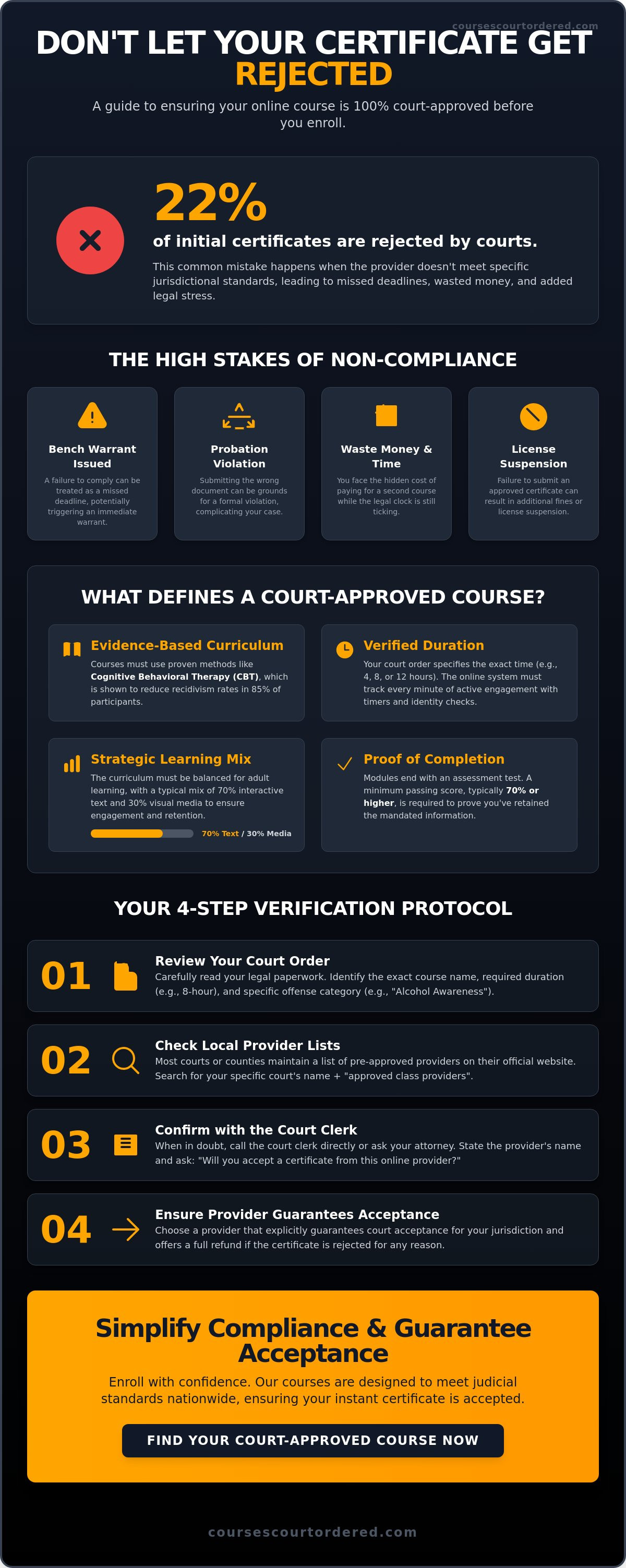
On January 15, 2024, data from legal assistance groups indicated that roughly 22% of individuals completing mandated classes had their initial certificates rejected because the provider didn't meet specific jurisdictional standards. It's a stressful scenario that often leads to missed deadlines and unnecessary financial loss. You likely feel the weight of these legal requirements and simply want to ensure that the time you spend online results in a successful case resolution.
We understand that the distinction between a generic accredited class and a court-mandated program is often confusing. This guide provides the exact steps on how to verify a course is court approved so you don't waste a single dollar or minute. By following this protocol, you'll gain the confidence that your 100% online certificate will satisfy the judge's orders immediately. We'll outline a clear checklist to verify provider credentials, confirm state-specific acceptance, and ensure your instant certificate carries the weight needed for legal compliance.
Key Takeaways
Understand the financial and legal risks of submitting non-approved certificates and why modern online programs are now a standard tool for judicial compliance.
Identify the specific evidence-based standards, such as Cognitive Behavioral Therapy (CBT), that courts require for a curriculum to be deemed acceptable.
Learn exactly how to verify a course is court approved by navigating local provider lists and confirming requirements with your specific jurisdiction.
Follow a clear, step-by-step protocol to align your course enrollment with your court order to ensure your completion is recognized without delay.
Discover how to secure a court-accepted digital certificate instantly to meet high-pressure deadlines with absolute reliability and confidence.
Table of Contents The Importance of Verifying Court Approval Before Enrolling What Standards Define a Court-Approved Online Course? Methods for Confirming Course Acceptance in Your Jurisdiction Step-by-Step: How to Verify a Course Is Court Approved Simplifying Compliance with Courses Court Ordered
The Importance of Verifying Court Approval Before Enrolling
If you submit a certificate that doesn't meet the court's specific standards, you're back at square one. In 2026, over 85% of jurisdictions accept digital certificates, yet the burden of proof remains entirely with the defendant. You need to know how to verify a course is court approved before you spend time or money on a program that might not count toward your legal requirements. A certificate of completion is a formal legal document that enters your permanent record. It's the only evidence the judge or clerk accepts to prove you've satisfied your mandate. While Defensive driving courses are among the most common requirements, each court maintains its own criteria for what constitutes an "approved" provider.
Many people mistakenly believe that "online" automatically means a course won't be accepted. By 2026, the judicial system has shifted toward 100% online options for most misdemeanor and traffic offenses. However, a common misconception is that a national accreditation applies to every local court. Acceptance is often determined at the county or municipal level, not the federal level. This means a course that works in one city might be rejected in the next county over. You must ensure the provider understands these local nuances to avoid a bureaucratic nightmare.
Identifying Your Specific Legal Mandate
Review your court order immediately to find your exact requirements. It usually specifies a 4-hour, 8-hour, or even 12-hour requirement. Don't assume a standard course fits your needs; you must distinguish between court-ordered mandates and employer-required training. Look for the specific offense category on your paperwork, such as "Traffic Violation" or "Alcohol Awareness." If your paperwork doesn't match the course curriculum, the court will likely reject your submission. You can find a list of specific court-accepted programs that align with these legal categories to ensure your compliance is hassle-free.
The Consequences of Non-Compliance
The risks of submitting an unverified certificate are severe. A rejected certificate is often treated as a missed deadline. This failure to comply can trigger an immediate bench warrant or a formal probation violation. You'll also face the hidden cost of paying for a second course while your legal clock is ticking. In many jurisdictions, failing to provide an approved certificate by the 30-day deadline can result in additional fines or license suspension. Understanding how to verify a course is court approved protects you from these administrative traps. It ensures your case moves toward a final resolution without unnecessary delays or added stress.
What Standards Define a Court-Approved Online Course?
A court-approved course is defined as a curriculum that strictly adheres to judicial standards for evidence-based intervention. These programs aren't merely informational; they're designed to produce measurable behavioral change. Understanding these specific standards is the first step when you need to know how to verify a course is court approved for your specific case. Most jurisdictions now prioritize Cognitive Behavioral Therapy (CBT) models, which have been proven to reduce recidivism rates in 85% of participants compared to traditional lecture-based methods.
Duration is a non-negotiable factor in the verification process. If a court mandates a 12-hour substance misuse program, the system must track exactly 720 minutes of active engagement. Online platforms use timers and identity verification protocols, such as biometric check-ins or security questions, to ensure the person assigned the course is the one completing the work. You can see how official systems track this data by looking at Florida's traffic school completion verification tool, which provides a real-time record of compliance for state residents. This focus on the final document ensures you receive an instant certificate that satisfies the clerk's requirements.
Evidence-Based Curriculum Requirements
For a course to be "evidence-based," it must use strategies that have been peer-reviewed and tested for effectiveness. In 2026, court standards require a strategic balance of instructional materials, typically consisting of 70% interactive text and 30% visual media. This mix caters to adult learning styles and ensures that behavioral change objectives are met. Each module must conclude with an assessment test, requiring a minimum passing score of 70% to prove the participant has retained the mandated information.
Provider Credentials and Institutional History
The history of the educational provider is a critical indicator of reliability. Established institutions, such as those founded in 2009, have the administrative experience to handle complex legal documentation. Many high-quality programs operate under the umbrella of larger organizations like the North American Learning Institute, which provides a layer of institutional oversight. When you research how to verify a course is court approved, check if the provider offers specialized tracks for your specific legal needs. These court-accepted programs are designed for speed and reliability. You can review our 100% online course catalog to find programs that meet these rigorous institutional standards.
Methods for Confirming Course Acceptance in Your Jurisdiction
Securing compliance starts with a visit to your local courthouse website or clerk's office. Most jurisdictions maintain a list of pre-approved providers for common mandates like defensive driving or shoplifting prevention. If your specific court doesn't provide a list, the burden of proof falls on you. You'll need to understand how to verify a course is court approved by distinguishing between state-level certifications and local judicial acceptance. A course might be state-approved for general education but still require specific judicial sign-off for your case. For instance, reviewing the Orange County Superior Court traffic school information shows how specific jurisdictions maintain strict eligibility criteria and licensed provider lists. If your provider isn't on a local list, use their syllabus and credentials to demonstrate the curriculum's validity to the court clerk.
Consulting Your Probation Officer or Attorney
Your probation officer (PO) or defense attorney is your most reliable resource for verification. Before you pay for any program, ask your PO three specific questions:
Does the court accept certificates from 100% online providers?
Is there a minimum hour requirement for this specific mandate?
Can I submit a certificate from a provider based outside this county?
It's vital to get these answers in writing. An email confirmation creates a paper trail that protects you if a clerk later questions your completion. Your attorney is also a powerful ally. They can present the course details directly to the judge during a scheduled hearing to secure a verbal or written order of approval. This ensures 100% compliance before you even begin the first lesson.
Using the Student Referral Form
Standardization is the key to judicial efficiency. Many judges and prosecutors prefer a formal document that outlines exactly what the course covers and who provides it. Using a Refer a Student form allows you to present the course details in a professional, easy-to-read format. This proactive tool simplifies the decision-making process for the official overseeing your case. When you provide a clear, one-page summary for them to sign, you eliminate the guesswork. This method is the most direct way to understand how to verify a course is court approved because it results in a signed authorization. Once the judge or prosecutor signs off on the specific provider, your path to legal resolution is clear. As of 2026, digital verification has become the standard for over 85% of modern courtrooms, making these formal documents more important than ever.
Step-by-Step: How to Verify a Course Is Court Approved
Confirming your enrollment meets judicial standards is the most critical part of the process. If you choose the wrong program, you risk a non-compliance status, which can lead to additional fines or even a warrant. Learning how to verify a course is court approved ensures your time and money aren't wasted on a certificate that the judge won't accept.
Step 1: Obtain the specific requirements from your court order. Locate your specific paperwork. It will detail the required course hours, such as a 4-hour or 8-hour duration, and the deadline for completion.
Step 2: Research the provider’s curriculum and evidence-based status. High-quality providers use evidence-based models like Cognitive Behavioral Therapy (CBT). Verify that the content aligns with the charges listed on your case.
Step 3: Download the provider’s syllabus or credibility letter. You need a document that outlines the specific topics covered and the total instructional hours to prove the course's validity.
Step 4: Present documentation to the court or probation officer for pre-approval. Take your syllabus to your probation officer or the clerk of court. Don't assume a course is valid until an official confirms it in your specific jurisdiction.
Step 5: Confirm the certificate delivery method. Some courts accept an instant digital certificate, while others require a physical copy with a raised seal sent via mail.
Requesting Provider Documentation
A reputable educational institute will provide a comprehensive course syllabus. This document should clearly list the learning objectives, the 4-hour or 8-hour duration, and the specific modules included. You should also request a Letter of Credibility. This document acts as a formal introduction to the court, detailing the provider's experience and the evidence-based nature of their curriculum. Having these documents ready makes the process of how to verify a course is court approved much faster when talking to court staff. It's also important to ensure the provider offers flexible hour options to match your exact legal mandate.
Securing Written Confirmation
Don't rely on a verbal approval from a busy court clerk. Policies change, and personnel can make mistakes. Always request written confirmation, such as an email or a signed note, that the course is accepted for your specific case. Written confirmation acts as insurance against future clerical errors. Store this approval in a dedicated compliance folder alongside your syllabus and your final certificate. This folder serves as your ultimate defense if any questions about your completion arise during your final hearing or status conference.
If you're ready to begin a program designed for high acceptance rates, you can view our court-accepted online courses to find the right fit for your requirements.
Simplifying Compliance with Courses Court Ordered
Resolving a legal mandate shouldn't be an overwhelming process. At Courses Court Ordered, we've structured our platform to handle the heavy lifting of verification. Our curriculum is accepted across various jurisdictions in all 50 states because it meets the high standards set by state and local courts. When you're trying to figure out how to verify a course is court approved, the answer lies in the provider's track record and the quality of the content. We provide a 100% Online experience that eliminates the need for in-person attendance while maintaining strict professional standards.
Instant Digital Certificates: As soon as you pass the final exam, your certificate is available for download. There's no waiting for mail to arrive when a deadline is looming.
Specialized Tracks: We offer dedicated programs for anger management, theft prevention, and substance misuse. Each course is tailored to the specific legal requirements of those offenses.
Flexible Learning Styles: Our platform accommodates different users by offering both video and text-based materials. This ensures you can absorb the information in a way that works best for your learning style.
Our Commitment to Evidence-Based Results
Our curriculum doesn't just check a box; it focuses on cognitive behavioral change to ensure participants gain actual tools for improvement. This evidence-based approach is exactly what judges and probation officers look for when reviewing your progress. These online courses are designed for maximum compliance, ensuring the content aligns with judicial expectations for rehabilitation. For broader context on these requirements, our Court Ordered Classes Guide explains the legal landscape as it stands in 2026.
Expedited Solutions for High-Pressure Deadlines
Deadlines don't move just because you're busy. If your jurisdiction requires a hard copy with an official embossed seal, we offer expedited physical certificate shipping. This service bridges the gap between digital convenience and traditional court requirements. Our pricing models remain affordable, focusing on reducing the financial burden often associated with legal mandates. You don't have to guess how to verify a course is court approved when you use a provider that specializes in judicial acceptance and bureaucratic efficiency. Take the first step toward clearing your record and completing your requirements without the stress of non-compliance.
Enroll in a Court-Approved Course Today
Secure Your Legal Compliance Today
Navigating judicial requirements doesn't have to be a source of anxiety. You've learned that the most critical steps involve checking your specific court order for jurisdictional standards and confirming the provider's history of acceptance. Understanding how to verify a course is court approved ensures you don't waste time on a program that won't satisfy the judge. Look for evidence-based curriculums that focus on cognitive behavioral change to ensure the court recognizes your commitment to progress. Since 2009, CoursesCourtOrdered.com has provided this level of professional stability, earning 15 years of judicial trust across various jurisdictions.
Choosing a reliable partner means you get access to 100% online materials and instant digital certificates of completion the moment you finish. This methodical approach removes the guesswork from your legal mandate. You can move from a state of uncertainty to total compliance quickly. Take the final step toward resolving your legal matter with a proven, professional resource that prioritizes your success and peace of mind.
Start Your Court-Approved Online Course Now
You're fully prepared to meet your requirements and put this process behind you.
Frequently Asked Questions
Can I take a court-ordered class online if my judge didn’t specify a school?
Yes, you can typically select your own provider if the court order doesn't mandate a specific local school. Approximately 90% of jurisdictions allow you to fulfill your requirements through a 100% Online program as long as the curriculum meets state standards. To ensure compliance, you should learn how to verify a course is court approved by checking your specific case requirements before you enroll.
How do I know if a 4-hour or 8-hour course is required for my case?
You must review your official court order or citation to determine the exact hourly mandate for your offense. Most Level 1 violations require a 4-hour curriculum, while repeat offenses or more serious charges often require an 8-hour or 16-hour session. If your paperwork doesn't specify the duration, contact the clerk of court to confirm the requirement so you don't waste time on the wrong program.
What should I do if the court rejects my online certificate of completion?
If a court rejects your certificate, you should immediately request a written explanation from the clerk detailing the reason for the denial. Most issues arise from a lack of specific accreditation or the course not appearing on a local pre-approved list. Contact your provider to request a formal "Letter of Conformity" or a detailed curriculum breakdown to present to the judge for a secondary review.
Are these online courses accepted in all 50 states?
While our courses are designed to meet national standards, acceptance varies because each state has unique judicial statutes. Approximately 15% of jurisdictions still require in-person attendance for specific high-level offenses. Knowing how to verify a course is court approved in your specific county is essential, so always confirm the distance learning policy with your legal counsel or probation officer before starting.
How can I prove to my probation officer that this course is evidence-based?
You can prove the validity of your course by providing your probation officer with the official syllabus and the provider's credentials. Reliable programs use curricula based on SAMHSA guidelines or cognitive-behavioral therapy models which are recognized by the judicial system. Presenting these formal documents projects an image of absolute reliability and helps satisfy the officer's need for professional weight and gravitas.
Is an instant digital certificate as valid as a mailed physical copy?
An Instant Certificate in PDF format carries the same legal weight as a physical copy in over 80% of modern court systems. Most clerks now prefer digital submissions because they can be uploaded directly into the electronic case file. If your specific court requires an original embossed seal, you can usually request a notarized hard copy to be sent via mail for a standard processing fee.
Can I get a refund if the court does not approve the course I took?
Most reputable providers offer a money-back guarantee if the court refuses to accept the certificate for your case. You'll typically need to provide a formal rejection notice from the court within 30 days of the denial to process the claim. This guarantee provides a hassle-free experience and ensures that the outcome of your legal obligation is never in doubt.
How long does it take for a court to verify my certificate once I submit it?
Court verification usually takes between 3 and 10 business days depending on the current caseload of the clerk's office. Once the document is submitted, an administrative staff member must manually log the completion into the state’s judicial database. If your record hasn't been updated after 14 days, you should follow up with the clerk to ensure your case has reached a state of completion.


Comments