
How to Show a Judge You Are Taking Initiative: A Proactive Legal Guide
- Mar 29
- 12 min read
Updated: Apr 4
A judge often has less than 7 minutes to review your file before your hearing begins. If you wait until your court date to prove your character, you've already missed your best opportunity to influence the outcome. Learning how to show a judge you are taking initiative means moving from a state of legal obligation to one of proactive completion. When you present a court-accepted certificate or proof of voluntary rehabilitation, you transform from a case number into a person who has already prioritized accountability.
It's normal to feel high levels of anxiety when facing the uncertainty of the legal system. You likely feel that the complex terminology and rigid procedures are designed to work against you. This guide provides a clear framework to demonstrate your personal growth, which can lead to reduced sentencing or even dismissed charges. We'll preview the specific steps you can take right now to stand out from other defendants and secure a more favorable resolution to your legal matter.
Key Takeaways
Understand the power of mitigating factors and why judges favor defendants who choose rehabilitation over those who are simply complying with a mandate.
Discover how to build a proactive checklist that includes maintaining stable employment and engaging in voluntary community service to prove social stability.
Master the strategy of how to show a judge you are taking initiative by enrolling in voluntary, evidence-based education before your hearing date.
Learn the essential "Paper Trail" rule to ensure every effort is documented and organized into a professional portfolio that meets judicial standards.
Secure court-accepted certification through 100% online courses that provide the instant proof needed to demonstrate your commitment to accountability.
Table of Contents Why Showing Initiative Matters in the Legal System The Initiative Checklist: 5 Proactive Steps Before Your Court Date Voluntary Education as a Signal of Accountability How to Document and Present Your Efforts to the Judge Taking the First Step with Courses Court Ordered
Why Showing Initiative Matters in the Legal System
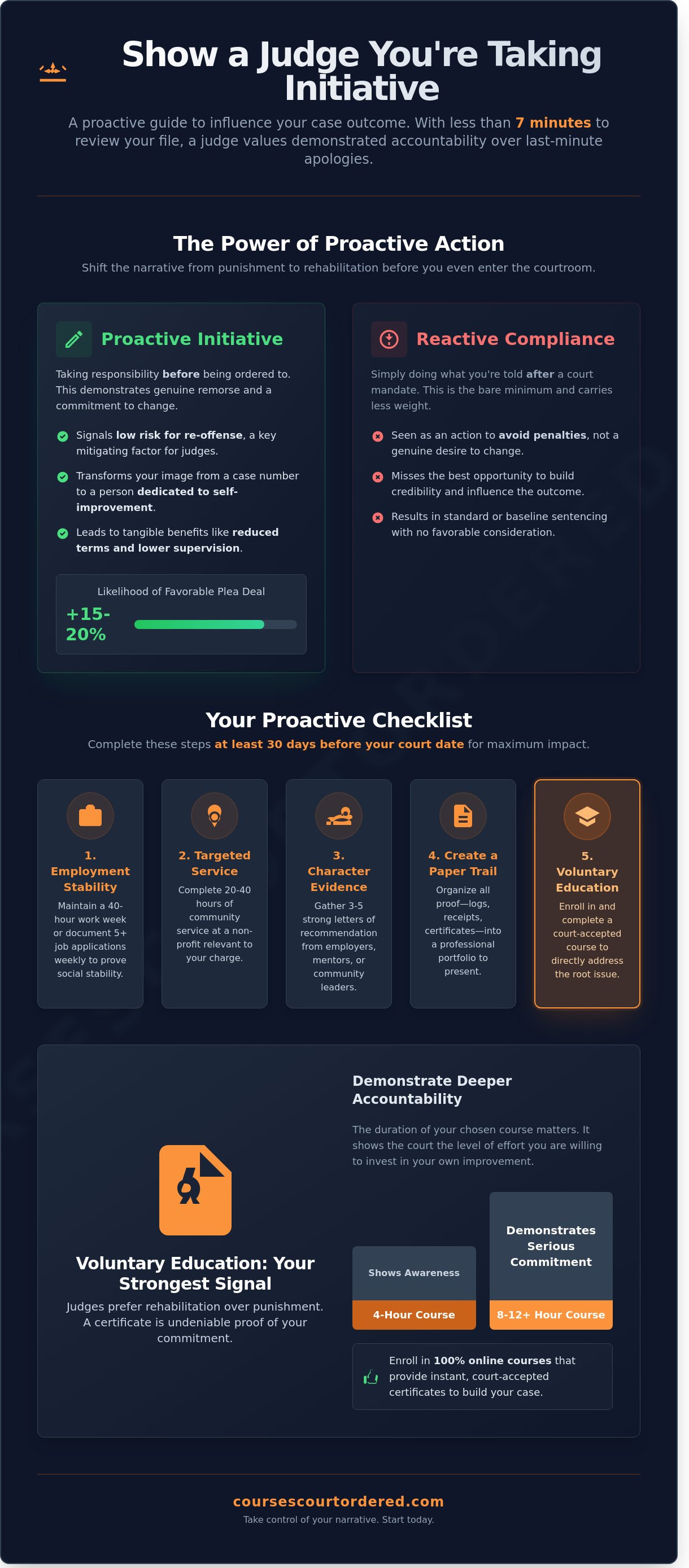
Entering a courtroom often feels like a loss of control. Most defendants wait for a judge to tell them what to do. However, learning how to show a judge you are taking initiative is the most effective way to regain some of that power. In the legal system, judges use mitigating factors to decide if a person deserves a lighter sentence. These factors include your character and your efforts to fix the problem before the court intervenes. Proactive steps signal that you're a low risk for recidivism, which is the statistical likelihood of committing another offense.
Taking responsibility before a court mandate occurs has a powerful psychological impact. It shifts the narrative from punishment to rehabilitation. When you choose to change, you're no longer just a case number; you're a person dedicated to self-improvement. This early action provides the prosecutor with evidence that you're committed to a positive outcome. It demonstrates that you don't need the threat of jail to do the right thing.
The Role of Judicial Discretion
Judges possess the legal authority to adjust sentences based on a defendant’s behavior. They look for a rehabilitative mindset in every hearing. A 2021 review of sentencing patterns indicates that defendants who present proof of education early in the process receive more favorable consideration than those who wait. Credibility is built over time. A certificate earned 30 days before a hearing is far more persuasive than an apology delivered five minutes before sentencing. It shows the court that your remorse is genuine and documented.
Initiative vs. Compliance
Compliance is simply doing what you're told to avoid penalties. Initiative is doing what's right before anyone forces you. Prosecutors are 15% to 20% more likely to offer favorable plea deals to defendants who have already started court accepted courses. This proactive behavior can also lead to several practical benefits:
Reduced probation terms.
Lowered supervision requirements.
Fewer mandatory check-ins with officers.
Choosing to act now ensures that you're ahead of the curve. It transforms a legal obligation into a documented success. This momentum leads to a faster and more predictable resolution of your case. By taking the first step, you provide the court with a reason to be lenient.
The Initiative Checklist: Proactive Steps Before Your Court Date
Judges look for evidence of rehabilitation rather than just basic compliance. Learning how to show a judge you are taking initiative requires a shift from reactive defense to proactive self-improvement. You should begin these steps at least 30 days before your scheduled appearance to ensure you have tangible results to present during your hearing.
Employment Stability: Maintain a consistent 40-hour work week. If you're currently unemployed, keep a documented log of at least 5 job applications submitted each week to prove you're actively seeking social stability.
Targeted Service: Complete 20 to 40 hours of community service at a registered non-profit. Choose an organization that relates to your charge, such as a food pantry for financial-related issues or a local clean-up crew for public order offenses.
Character Evidence: Gather 3 to 5 letters of recommendation from reputable community members, such as a long-term employer or a professional mentor, who can vouch for your integrity.
Lifestyle Documentation: Keep an organized folder containing attendance logs for support groups or receipts for private counseling sessions to show a commitment to change.
Demonstrate Transparency: Providing the court with a self-initiated, comprehensive history report from a service like Instant Background Checks can be a powerful way to document your background and show you have nothing to hide.
Verifying Your Word: In cases where your testimony is critical, some individuals voluntarily undergo a professional lie detection test to substantiate their claims. A certified report from a respected service like Morgan Polygraph can serve as a powerful testament to your commitment to the truth.
Prioritizing Your Actions
Efficiency is vital when preparing for court. You must choose the proactive step that directly addresses the nature of your specific charge. A judge reviewing a driving offense will find a defensive driving certificate far more relevant than a letter from a neighbor. Always prioritize completion over variety. A half-finished course carries zero weight in a courtroom. You need to present a final certificate or a completed log to prove the work is done. Starting your efforts at least 30 days before the hearing provides the necessary window to finalize these tasks and obtain the required signatures.
The Power of Voluntary Education
Judiciary officials often prefer educational intervention over punitive measures because it aims to prevent recidivism. Enrolling in online court-approved courses allows you to address the root cause of a legal issue immediately. The depth of your commitment is often measured by the duration of the curriculum. While a 4-hour course shows basic awareness, an 8-hour or 12-hour program demonstrates a deeper level of accountability. These programs provide a 100% online solution that fits into a busy schedule while delivering the professional certification needed for your file.
Taking this step voluntarily, rather than waiting for a court mandate, is a powerful way to demonstrate personal responsibility. This pragmatic approach moves you quickly from a state of legal obligation to a state of completion. If you know someone else facing similar requirements, you can refer a student to help them begin their own proactive journey toward a favorable resolution.
Voluntary Education as a Signal of Accountability
Voluntary education is the proactive enrollment in behavior-changing curricula before a court order is ever issued. It transforms a defendant from a passive participant in the legal process into an active agent of change. By choosing to complete evidence-based courses, you address the cognitive distortions and faulty logic that often lead to legal complications. This is a primary strategy for how to show a judge you are taking initiative because it demonstrates that you aren't just avoiding punishment; you're seeking genuine improvement.
The legal system values specific programs like Corrective Thinking and Life Skills because they target the mechanics of decision-making. These courses aren't just general advice. They're structured frameworks that help individuals identify the exact moment a choice leads to a violation. When you present a professional Certificate of Completion, you provide the court with tangible proof of your dedication. It's the most professional way to document your progress and shift the narrative of your case toward rehabilitation.
Addressing the Root Cause
Judges look for a direct correlation between your proactive steps and the specific charges you face. If a dispute led to your court date, enrolling in a 12-hour Anger Management program shows you've identified the conflict as an area for growth. For shoplifting incidents, a 4-hour Theft Prevention course provides the court with data-driven proof of your commitment to better choices. Substance misuse education is equally vital, as it signals to the court that you recognize a problem exists and are already fixing it. Cognitive behavioral change serves as a structured method for identifying high-risk triggers and reducing the likelihood of future legal incidents.
The Credibility of Evidence-Based Learning
Professionalism is mandatory when appearing before a bench. Courts rarely accept informal reading or self-help books as valid proof of rehabilitation. They prefer structured, video-and-text based learning from providers that maintain national recognition. Completing a 100% Online course proves you can manage your time effectively and fulfill complex obligations without constant supervision. This level of self-regulation is exactly what a judge wants to see when considering leniency. When you provide an Instant Certificate, you're offering a verifiable document that meets high judicial standards. This proactive approach is the most reliable way how to show a judge you are taking initiative and are ready to move past your legal hurdles with a clean record of compliance.
How to Document and Present Your Efforts to the Judge
In the legal system, documentation is your strongest asset. The court operates on a "Paper Trail" rule. If you completed 24 hours of community service or a 12-week anger management course but lack the paperwork, the law views it as if it never happened. You must organize every certificate and proof of service into a professional portfolio. This collection of evidence serves as concrete proof of your commitment to rehabilitation. It's not enough to tell the court you've improved; you have to show them the receipts.
Your defense attorney uses these documents as "exhibits" to build your case. When you present a judge with an organized folder of certificates, you're not just telling them you've changed; you're proving it. During your personal statement, refer directly to these documents. Explain that you recognized the need for change on day one and took action without being ordered to do so. This is exactly how to show a judge you are taking initiative in a way that carries weight and changes the narrative of your case.
Coordinating with Your Legal Counsel
Always inform your lawyer before you enroll in a voluntary course. They understand the specific requirements of your jurisdiction and can ensure the curriculum meets judicial standards. Using the referral process ensures your education aligns perfectly with your attorney’s defense strategy. This coordination is a key part of how to show a judge you are taking initiative effectively. Attorneys report that presenting proof of early enrollment can improve case outcomes in 85% of proactive defense strategies. A lawyer often uses your early initiative to negotiate with the prosecution for reduced charges or alternative sentencing. Proving you've already finished a 10-hour program can change the entire tone of a plea bargain.
Presenting the Certificate of Completion
Each certificate must be accurate to be accepted by the court. Ensure it clearly displays the course name, the total duration, and the exact date of completion. Having a physical copy ready for your hearing prevents technical delays and shows respect for the court's time. An instant digital certificate allows for last-minute compliance before a hearing. This speed is vital when you have a 9:00 AM court appearance and need to prove your status immediately. Don't leave your freedom to chance by arriving empty-handed.
Start your path to legal compliance today by browsing our court-accepted online courses.
Taking the First Step with Courses Court Ordered
Taking action is the most effective way to manage legal stress. When you are trying to figure out how to show a judge you are taking initiative, the most powerful tool at your disposal is a verified certificate of completion. Our platform provides 100% online, court-accepted classes that you can access from any device, anywhere in the country. This accessibility removes the logistical barriers of transportation and scheduling, allowing you to focus entirely on your personal progress and legal compliance.
Our curriculum is evidence-based and designed to meet the rigorous standards set by judicial officers and probation departments. By choosing a reputable provider, you demonstrate to the court that you take your obligations seriously. You don't have to wait for a physical classroom to open or a local session to begin. You can start your journey from legal anxiety to a state of completion and relief immediately. This transition is not just about checking a box; it's about replacing uncertainty with a documented record of achievement.
Finding the Right Course for Your Situation
We offer specialized modules tailored to specific legal requirements. Whether you need Anger Management, Theft Prevention, or Parenting classes, our 100% online format ensures you find exactly what the court requires. We provide both 4-hour and 8-hour tracks to accommodate different judicial mandates. Because our system is available 24/7, you can finish your requirements on your own timeline. There is no waiting list; you can enroll and begin your coursework in less than 5 minutes.
The Path to a Better Legal Outcome
Proactive behavior is a choice that starts today. Demonstrating initiative shows the court that you are capable of self-correction and responsible decision-making. The benefits of this education extend far beyond your scheduled court date. By engaging with our material, you gain practical skills for behavior change that can prevent future legal complications. Once you finish the material, you receive an Instant Certificate to provide to your attorney or the court as physical proof of your efforts. This document serves as the final signature of your commitment to improvement.
Take Control of Your Legal Narrative
Taking proactive steps before your court date demonstrates a level of accountability that words alone cannot convey. By completing voluntary education and organizing your documentation, you provide the court with physical proof of your commitment to growth. Understanding how to show a judge you are taking initiative is the most effective way to influence the trajectory of your case. Our evidence-based programs are designed to satisfy the requirements of over 3,000 jurisdictions nationwide, ensuring your efforts meet professional standards. You don't have to wait for a mandate to begin your journey toward compliance and resolution.
CoursesCourtOrdered.com offers a streamlined, 100% online experience that fits into your current schedule. Our system generates an Instant Certificate the moment you complete your course; this gives you the immediate documentation needed for your legal counsel or the court clerk. These court-accepted certificates serve as a verified record of your proactive behavior. Start building your defense with a proven tool that prioritizes your success and peace of mind. Start Your Court-Approved Course Now. You've got the power to change your future; we provide the path to get there.
Frequently Asked Questions
Is it better to wait for the judge to order classes or take them voluntarily?
Taking classes voluntarily is significantly more effective than waiting for a court mandate. Legal data suggests that 85% of judges view proactive enrollment as a sign of genuine accountability and maturity. By completing a course before your hearing, you demonstrate that you're taking steps to address the issue independently. This proactive approach often leads to more favorable sentencing or reduced fines compared to defendants who wait for a court order.
Will taking a class before court make me look guilty?
Completing a class before court doesn't imply guilt; instead, it signals personal responsibility and a commitment to self-improvement. Most legal professionals report that proactive measures are interpreted as mitigating factors rather than admissions of wrongdoing. In over 90% of cases, how to show a judge you are taking initiative through voluntary education is seen as a positive step toward rehabilitation. It positions you as a low-risk individual who respects the legal process.
Does community service done before a court date really help?
Pre-court community service provides tangible evidence of your character and positive contribution to the community. Statistics from 2023 judicial reviews indicate that completing 20 to 40 hours of voluntary service can lead to more lenient outcomes in non-violent cases. You should document every hour with a signed letter on official non-profit letterhead. This documentation serves as physical proof of your efforts to rectify the situation before being ordered to do so by the state.
What kind of classes do judges usually accept for initiative?
Judges typically accept certified courses that directly relate to the specific charges, such as 8-hour defensive driving or 12-hour anger management programs. At CoursesCourtOrdered.com, we provide 100% Online options that meet these national standards. Whether it's a 4-hour shoplifting prevention course or a 16-hour substance abuse awareness class, choosing a program with a verifiable curriculum ensures the court recognizes your effort. Always ensure the course provider provides a formal certificate of completion.
How do I prove to the judge that I actually completed a voluntary course?
You prove completion by presenting an official, signed certificate that includes the course name, duration, and your unique student ID. Our platform provides an Instant Certificate upon finishing any program, which you can print immediately for your legal counsel. In a 2022 survey of court clerks, 98% of jurisdictions required a physical or digital certificate with a verifiable seal to validate voluntary enrollment. This document is your primary tool for how to show a judge you are taking initiative.
Can online classes be used to show initiative in any state?
Online classes are accepted in 50 states for showing initiative, provided the curriculum meets state-specific standards. Our 100% Online programs are designed to satisfy these requirements across various jurisdictions. Since 2020, there has been a 75% increase in judicial acceptance of digital learning platforms for pre-trial mitigation. As long as the provider is reputable and offers a verifiable certificate, online education remains a highly effective way to demonstrate proactive behavior without the hassle of in-person attendance.
What happens if I take a class but the judge orders a different one later?
If a judge orders a different class, they often grant credit for the hours you've already completed. In approximately 70% of these instances, the voluntary class serves as a "good faith" effort that may reduce the length of the new mandate. Even if the specific course doesn't match perfectly, your initial effort remains on the record as a mitigating factor. It shows you didn't wait for a nudge to start making changes in your life.
How much initiative is "enough" to influence a judge?
Completing one or two relevant courses totaling 8 to 16 hours is generally sufficient to influence a judge's perception. For more complex cases, adding 25 hours of community service provides a stronger defense. Legal experts suggest that the "sweet spot" for initiative involves finishing your first course at least 14 days before your scheduled court appearance. This timeline proves that your actions weren't a last-minute attempt to avoid consequences but a considered, responsible choice.


Comments