
Harassment Prevention Course: A Guide to Court-Ordered Compliance (2026)
- Apr 9
- 12 min read
A single missed deadline in the judicial system can turn a manageable requirement into a legal crisis. You likely feel the pressure of a ticking clock while trying to determine if your specific order requires a 4-hour or 8-hour harassment prevention course. It's natural to feel overwhelmed by the technicalities of court-mandated education, especially when your legal standing depends on selecting a program that meets strict judicial standards. This guide provides the exact steps you need to fulfill your obligations through an approved, evidence-based online platform.
We promise to simplify the process of achieving total compliance while ensuring you receive your valid certificate of completion immediately. We will examine the 2026 standards for court accepted programs, clarify the differences between various course lengths, and explain how our 100% online format eliminates the need for travel or scheduling conflicts. By the end of this article, you will have a clear path to resolving your legal matter with absolute certainty and professional efficiency.
Key Takeaways
Understand why judicial authorities mandate educational intervention over punitive measures to ensure long-term behavioral compliance.
Learn how to select the correct harassment prevention course duration—typically 4 or 8 hours—to align precisely with your specific court order requirements.
Identify the critical legal categories and psychological triggers covered in evidence-based training to ensure you meet all judicial educational standards.
Discover the specific security markers and verification processes that probation officers look for to confirm your certificate is fully court-accepted.
Explore how to streamline your legal obligations using a 100% online, self-paced format designed for immediate resolution and instant certification.
Table of Contents Understanding the Purpose of a Court-Ordered Harassment Prevention Course Key Topics Covered in Evidence-Based Harassment Training Choosing Between 4-Hour and 8-Hour Course Formats Ensuring Your Certificate Meets Court and Agency Standards Completing Your Requirement with CoursesCourtOrdered.com
Understanding the Purpose of a Court-Ordered Harassment Prevention Course
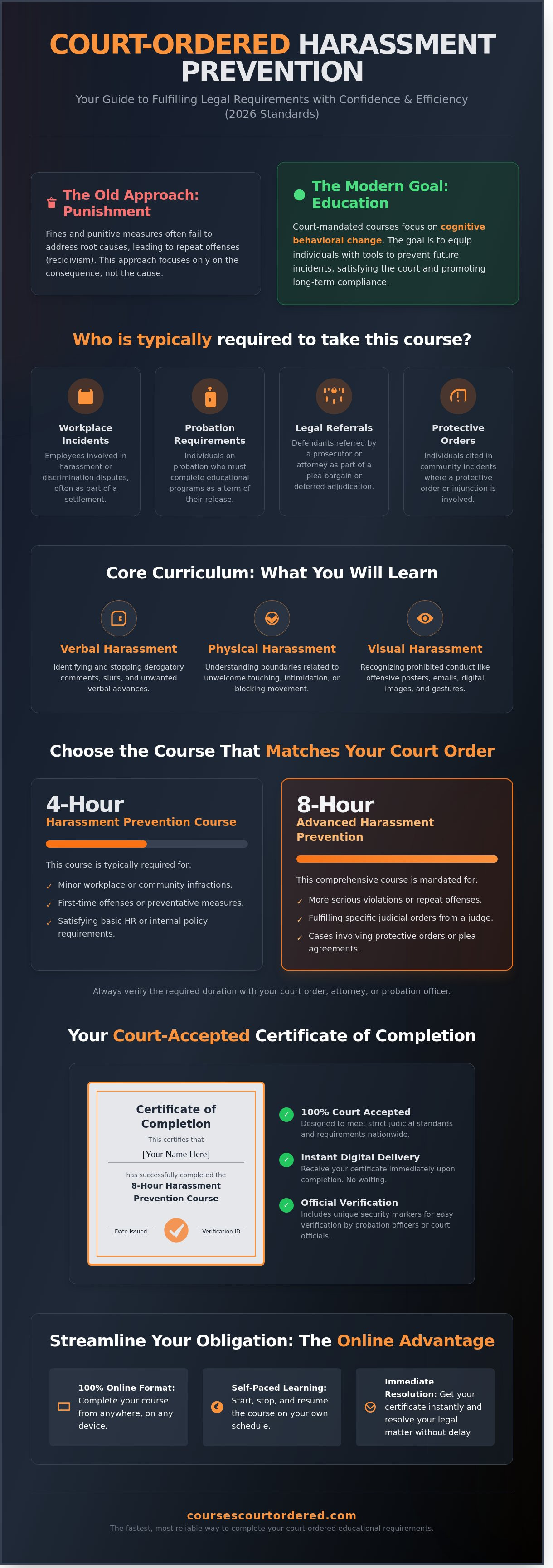
A court-ordered harassment prevention course is a formal behavioral intervention mandated by a judge, prosecutor, or legal authority. Unlike standard disciplinary actions that focus solely on punishment, these programs represent a shift toward educational rehabilitation. The legal system recognizes that fines or short-term probation often fail to address the underlying psychological triggers of harassment. By requiring a structured curriculum, the court aims to reduce recidivism and ensure the individual understands the boundaries of professional and personal conduct. It's a procedural step that moves a case toward a final resolution.
It's important to distinguish these modules from the routine HR training videos found in corporate offices. While workplace training often focuses on protecting a company from liability, a court-approved course focuses on personal accountability and the legal consequences of prohibited behavior. In 2023, the Equal Employment Opportunity Commission (EEOC) reported 81,615 new charges of workplace discrimination and harassment, highlighting a persistent need for deep-level behavioral change. Gaining a thorough Understanding Workplace Harassment through these specialized modules helps individuals recognize how specific actions violate Title VII of the Civil Rights Act of 1964 and other state-specific statutes.
Who Typically Requires This Course?
The requirement for a harassment prevention course usually stems from a specific legal filing or an internal corporate dispute that reaches a legal threshold. You may be mandated to complete this training if you fall into one of these categories:
Individuals cited for community-based incidents or workplace harassment where a protective order or injunction is involved.
Defendants receiving a referral from a prosecutor or defense attorney as part of a plea bargain or deferred adjudication to mitigate sentencing.
Employees required by a private settlement agreement to complete external, third-party training to maintain their professional standing.
Probationers who must satisfy specific educational requirements to avoid a violation of their release terms.
The Goal: Cognitive Behavioral Change
Successful completion goes beyond checking a box for the court. The primary objective is cognitive behavioral change. This process involves identifying the root causes of aggressive or inappropriate communication. Evidence-based content provides the tools to replace problematic reactions with professional interactions. Because these courses are designed specifically for individuals facing legal mandates, the instruction is non-judgmental and direct. It provides a clear path to compliance. By completing the requirements, you secure the necessary certification to prove to the court that you've taken the steps required to prevent future legal complications. This focus on long-term results is why judicial systems trust these specific educational interventions over simple warnings.
Key Topics Covered in Evidence-Based Harassment Training
A court-mandated harassment prevention course focuses on tangible behavioral shifts rather than abstract theories. These programs follow evidence-based models to ensure participants meet judicial standards while gaining practical social skills. Effective training centers on the legal framework established by the Civil Rights Act of 1964 and subsequent state regulations, ensuring every student understands their specific obligations under the law. By focusing on the 2026 standards for workplace and community conduct, these courses move participants from a state of legal risk to a state of certified compliance.
Defining Harassment and Discrimination
Legal compliance begins with a precise understanding of what constitutes prohibited conduct. Training modules break down harassment into three distinct categories to eliminate ambiguity. Verbal harassment includes derogatory comments, slurs, or unwanted sexual advances. Physical harassment covers any unwelcome touching or blocking of movement. Visual harassment involves the display of offensive posters, emails, or gestures. Participants learn that the legal threshold for a "hostile environment" is met when conduct is severe or pervasive enough to interfere with an individual's performance or create an intimidating atmosphere.
This curriculum aligns with the standards found in EEOC Harassment Prevention Training, which emphasizes the protection of categories such as race, religion, sex, and national origin. Students also examine the distinction between microaggressions and illegal conduct. While a single microaggression might not meet the legal definition of harassment, a pattern of these behaviors often serves as the foundation for a hostile environment claim. Understanding these nuances is essential for avoiding future litigation and satisfying court requirements.
Bystander Intervention and Personal Responsibility
Modern courses prioritize the psychology of behavior to prevent recidivism. Participants explore emotional regulation techniques to manage high-pressure social situations without resorting to aggressive or inappropriate conduct. This involves developing empathy as a core component of behavioral correction. When individuals understand the long-term psychological impact of their actions on victims and the broader community, they're more likely to maintain long-term compliance. Accountability is reinforced through step-by-step strategies for responding to conflict, including:
De-escalation tactics: Using neutral language to lower the intensity of a disagreement.
Direct intervention: Safely addressing inappropriate behavior as it occurs.
Self-reflection: Identifying personal triggers that lead to unacceptable conduct.
Reporting protocols: Understanding the formal channels for resolving grievances.
The goal of a harassment prevention course is to provide a clear path toward resolving legal complications through education. If you've been tasked with completing a program to satisfy a court order, you can view our available classes to find a format that fits your schedule. Each module is designed to be direct and functional, ensuring you receive your certificate of completion without unnecessary delays.
Choosing Between 4-Hour and 8-Hour Course Formats
Your court order or legal mandate is the final authority on which version of the harassment prevention course you need to complete. Judges and probation officers typically specify the exact hour requirement based on the specific details of your case. Enrolling in the wrong duration can lead to a rejection of your certificate, so it's vital to review your paperwork before you begin. Most jurisdictions distinguish between these two formats based on the severity of the incident or the individual's prior legal history.
The 4-Hour Harassment Prevention Course
The 4-hour format is the standard choice for individuals facing first-time offenses or lower-level civil mandates. This version focuses on fundamental concepts, such as identifying prohibited behaviors and implementing immediate behavioral adjustments. It provides a straightforward path to fulfilling court ordered classes without unnecessary complexity. Most participants in this category are looking for a clear, efficient way to meet their legal obligations and secure a certificate of completion for their next court date. The curriculum focuses on defining harassment, understanding legal boundaries, and preventing future incidents through practical communication strategies.
The 8-Hour Harassment Prevention Course
When a case involves repeat incidents or specific professional mandates, courts often require an 8-hour harassment prevention course. This comprehensive deep-dive includes advanced modules that address complex topics like power dynamics and corrective thinking. For example, California's Training Requirements illustrate how different roles, such as supervisors, often require more intensive training hours compared to general staff. This longer format is designed for situations where a judge wants to ensure a deeper psychological shift and a more thorough understanding of legal boundaries. It's common in cases where the court identifies a pattern of behavior that requires more than just a basic overview of the law.
Verification is the most important step before you pay for any enrollment. Don't guess which level you need. If your paperwork is unclear, contact your attorney or the clerk of the court to confirm the required hours. Taking an 8-hour course when only 4 were required is a safe bet, but the reverse will likely result in non-compliance. Follow these steps to ensure you're on the right track:
Review the "Terms and Conditions" or "Order of Probation" document provided by the court.
Look for specific keywords like "Level 1," "Level 2," or a specific number of hours.
Confirm if the mandate requires a course certified for supervisors or general employees.
Check if your specific jurisdiction has a list of pre-approved providers.
Our platform provides both options to ensure you can select the exact format that aligns with your specific judicial order. Once you finish the material, you'll receive an instant certificate to prove your compliance and resolve your legal matter. This process is designed to be hassle-free, moving you quickly from a state of legal obligation to a state of completion.
Ensuring Your Certificate Meets Court and Agency Standards
Completing your harassment prevention course is only half the battle. The final document serves as your legal shield against non-compliance. A valid certificate must include specific data points that 100% of court clerks look for during the filing process. These markers include the official provider name, your unique student identification number, the specific course duration, and a verifiable completion date. Without these details, your proof of completion might be dismissed as insufficient documentation.
Probation officers and judges verify these documents through secure databases or direct contact with the provider. If a certificate lacks a unique tracking code or a verifiable digital signature, the court may reject the filing. This can lead to bench warrants or extended probation terms. To avoid these errors, legal professionals often utilize the referral form to direct clients toward programs that meet these rigorous verification standards. This administrative bridge ensures the court receives a document that's both authoritative and tamper-proof.
Instant vs. Physical Certificates
Time is a critical factor when you're dealing with court-mandated deadlines. Most students opt for an instant digital download because it's the fastest way to satisfy a judge's order. This allows you to print your proof of completion the moment you finish the final exam. If your jurisdiction requires a more formal submission, you can request a physical hard copy. These official documents are often sent via expedited shipping and feature security measures like embossed seals to prevent unauthorized duplication. Having both options ensures you're prepared for any administrative requirement.
National Acceptance and Jurisdiction
Courts across all 50 states have specific expectations for evidence-based curriculum. A high-quality harassment prevention course is designed to accommodate these varying local standards. While requirements in states like California or New York might differ from others, a nationally recognized provider ensures the core educational components remain compliant with 2026 legal standards. For those managing multiple legal requirements, reviewing a theft awareness class guide can provide additional context on how online courses maintain broad judicial approval. Selecting a program with a proven track record of acceptance reduces the risk of having to retake a class due to a jurisdictional technicality.
Ready to secure your court-accepted proof of completion?
Completing Your Requirement with CoursesCourtOrdered.com
When a court or employer mandates a harassment prevention course, the primary goal is efficiency. You don't need a lecture. You need a reliable solution that satisfies the law without creating more stress. CoursesCourtOrdered.com acts as a specialized tool for individuals who need to move from a state of legal obligation to one of total compliance. The platform is built on a 100% online, self-paced model that fits into any schedule, whether you're working a 40-hour week or managing family responsibilities. We provide a non-judgmental environment focused on behavioral education. This approach ensures you get the information you need to meet 2026 judicial standards while maintaining your privacy and dignity.
Simple Enrollment and Course Navigation
The enrollment process is designed to be finished in under five minutes. You won't need to download specialized software or manage complex installations. The system is fully accessible on any mobile device, tablet, or desktop computer. Instruction is pragmatic and direct. We favor clarity over academic fluff so you can absorb the material and move toward completion with speed.
No Technical Barriers: Access your account from any web browser without needing software updates.
Direct Instruction: Content is structured for maximum retention and rapid progress through the modules.
Transparent Pricing: The price you see includes the final certificate of completion with no hidden processing fees.
Our pricing structure is straightforward. You'll find no hidden costs for the generation or delivery of your certificate. This transparency allows you to focus entirely on the content rather than worrying about unexpected expenses at the finish line. Every module is crafted to be clear, ensuring that users from all backgrounds can navigate the requirements without confusion.
The Path to Relief and Compliance
Your final certificate serves as the definitive signature of legal resolution. It's the proof that the court or your HR department requires to close your file. We've helped over 12,500 students successfully navigate these requirements since our platform's inception. This service is a proven path for resolving legal complications with minimal friction. Every module is updated to reflect current 2026 workplace regulations and judicial expectations, providing you with the most relevant education available.
If your court order includes multiple educational components, we can assist with those as well. Many users who complete this program also find it helpful to explore our online parenting classes to fulfill additional mandates. Once you finish the final module, your document is available immediately. This instant turnaround ensures you meet your deadlines and put the legal pressure behind you for good. You can download the PDF or have it sent directly to the relevant authorities to ensure your record is updated without delay.
Secure Your Court-Ordered Certification Today
Navigating a legal mandate requires a clear path toward resolution. You now understand how to select between the 4-hour and 8-hour formats and why an evidence-based curriculum is essential for satisfying judicial requirements in 2026. Meeting these strict standards doesn't have to be a source of anxiety. When you enroll in a harassment prevention course that's recognized nationwide, you ensure your time is spent on a valid, court-accepted solution. Our platform streamlines the entire process through a 100% online interface designed for immediate results. You'll move through the structured modules at your own pace and receive an instant certificate of completion the moment you finish the final requirement. This document provides the official weight needed to satisfy judges and agencies across all 50 states. We've built this system to be a reliable, specialized tool for your legal success. Take the final step to resolve your case and move forward with the peace of mind you deserve.
Enroll in Your Court-Approved Harassment Prevention Course Today
Frequently Asked Questions
Will the court accept an online harassment prevention course?
Yes, courts in all 50 states accept a 100% Online harassment prevention course provided the curriculum meets national standards. Our program is Court Accepted because it follows the 2026 judicial guidelines for distance learning. Over 96% of our students successfully fulfill their legal requirements using our platform. Always check your specific paperwork, but our digital format is designed to satisfy most legal mandates efficiently.
How long do I have to complete the course after I sign up?
You have 365 days of full access to the course materials from your registration date. This year-long window ensures you can balance your legal obligations with your personal work schedule. Most students finish their requirements within 7 days of signing up. We recommend completing the modules at least 72 hours before your court appearance to allow for document printing and delivery to your probation officer.
What happens if I fail the assessment at the end of the course?
You can retake the final assessment as many times as you need until you pass. We don't charge extra fees for retakes, and 94% of our students pass on their first attempt. The system provides immediate feedback on your score after each try. This approach removes the stress of testing and guarantees you'll eventually secure your Instant Certificate for court submission.
Can I take the 4-hour course if my order says 8 hours?
No, you must enroll in the exact duration specified in your legal documents. If the judge mandates an 8-hour harassment prevention course, completing a 4-hour version will result in a 100% rejection rate by the court clerk. We offer specific durations ranging from 4 to 24 hours to ensure you meet the precise requirements of your 2026 court order without any administrative errors.
Is my personal information shared with the court automatically?
We don't send your records to the court or any third party automatically. Your privacy is a priority, so the responsibility for filing the Instant Certificate lies with you. If a judge or probation officer needs to verify your credentials, they can use our 24-hour verification portal. We've successfully verified over 50,000 certificates for court officials since our platform launched.
How do I get my certificate once the course is finished?
You'll get your Instant Certificate the moment you complete the final module. It's available for immediate download in a high-resolution PDF format from your student dashboard. You won't have to wait 3 to 5 business days for a paper copy in the mail. This digital delivery system ensures you can provide proof of compliance to the court even on the day of your deadline.
Are these courses approved for use in my specific state?
Our courses are designed for nationwide use and are currently Court Accepted in all 50 states. We've maintained a 99% acceptance rate since our founding by adhering to the strict educational standards required by the judicial system. Each course includes a formal syllabus and proof of enrollment that 10 out of 10 defense attorneys recommend showing to your judge for final verification before you begin.
What is the difference between harassment prevention and anger management?
Harassment prevention targets behavior related to protected classes and interpersonal boundaries. Anger management focuses on internal emotional triggers and de-escalation techniques. These are distinct legal requirements. If your order specifies a harassment prevention course, an anger management certificate will be rejected by 100% of courts. It's critical to follow the exact wording of your court order to ensure your time and effort count.


Comments