
Court Approved Co-Parenting Classes for Divorce: The 2026 Compliance Guide
- Apr 28
- 13 min read
What if the only thing standing between you and legal compliance is a single PDF document? Missing a 2026 filing deadline because of an unapproved course isn't just frustrating; it can jeopardize your entire custody timeline. You likely feel the pressure of balancing these strict judicial requirements while trying to maintain a stable environment for your children. We understand that the confusion between 4-hour and 8-hour mandates often leads to unnecessary anxiety about which court approved co-parenting classes for divorce will actually satisfy your judge's orders. Since parent education is now a mandatory prerequisite in over 46 states, getting the right certification is essential for your case progression.
This comprehensive 2026 guide provides the clarity you need to meet these requirements with absolute confidence. You'll learn exactly how to select a Court Accepted program that fits your specific jurisdiction and allows you to download an Instant Certificate upon completion. We'll walk you through the 100% Online process to satisfy your family stabilization requirement quickly so you can focus on what matters most: your family's future.
Key Takeaways
Understand the legal necessity of family stabilization programs and how court-mandated education protects the interests of children during custody transitions.
Learn how to navigate your legal requirements by selecting 100% online court approved co-parenting classes for divorce that are designed for rapid compliance and scheduling flexibility.
Discover the evidence-based cognitive-behavioral strategies used to move beyond personal conflict and establish a professional, child-centered co-parenting relationship.
Master the verification and filing process to ensure your provider meets specific jurisdictional standards for official court acceptance.
Streamline your path to compliance with a self-paced, authoritative curriculum that offers an instant certificate for immediate legal filing.
Table of Contents What are Court Approved Co-Parenting Classes for Divorce? The Role of Evidence-Based Education in Family Stabilization Choosing the Right Format: Online vs. In-Person Parenting Classes Navigating the Certification Process for Legal Compliance Why CoursesCourtOrdered.com is the Trusted National Standard
What are Court Approved Co-Parenting Classes for Divorce?
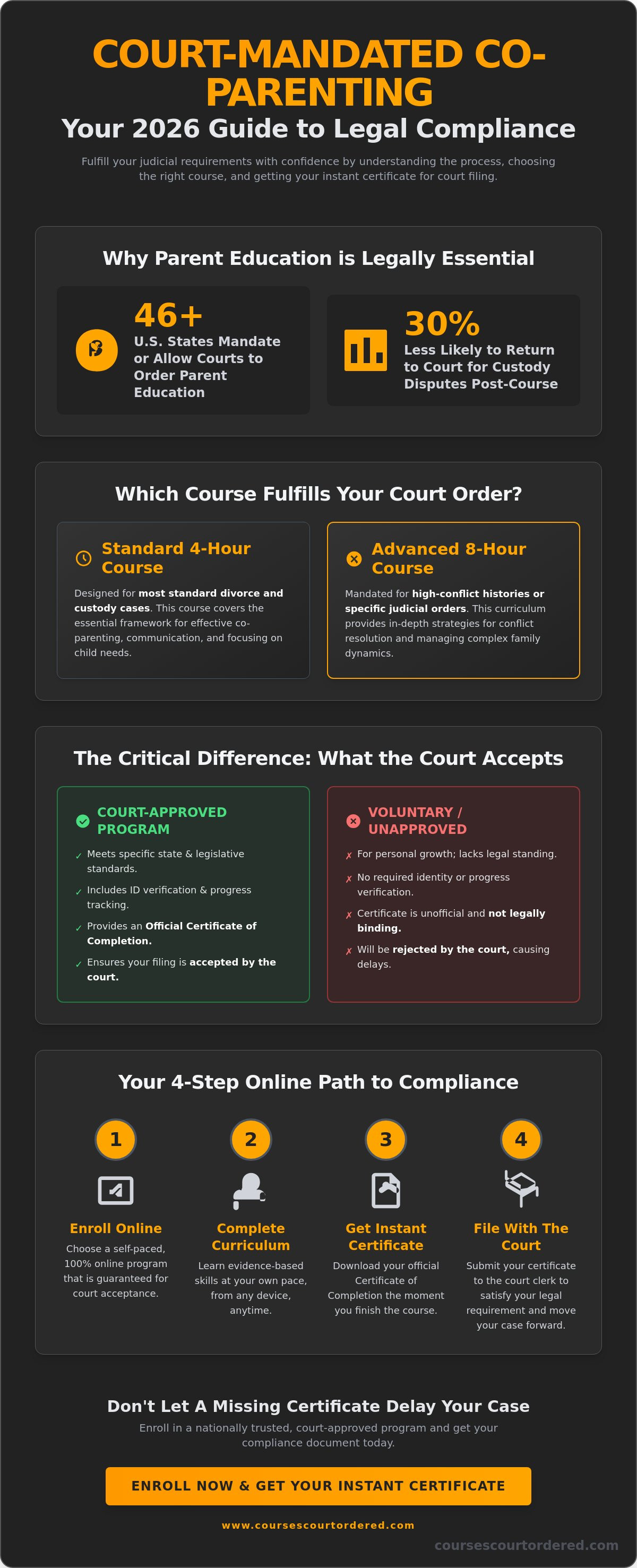
Court-mandated parent education and family stabilization programs are formal educational requirements designed to help parents manage the transition of divorce or separation. As of 2026, approximately 46 states have implemented statutes that allow or require judges to order these courses in cases involving minor children. These programs aren't a form of therapy or a judgment on your parenting skills. Instead, they function as a practical resource to ensure that children remain the priority during legal proceedings. Before a judge finalizes a final decree or custody agreement, they often require proof that both parties understand the logistical and emotional needs of their children in a split household.
The primary objective of court approved co-parenting classes for divorce is the measurable reduction of parental conflict. Research from various family court systems indicates that parents who complete these programs are 30% less likely to return to court for future litigation. By focusing on What is Co-Parenting? and its various models, these courses teach parents how to communicate without hostility and how to shield children from adult legal disputes. Court-approved status is not a generic label. It means the curriculum meets specific legislative mandates and judicial standards set by local circuits or state departments of children and family services.
Legal Requirements for Parent Education and Family Stabilization
The legal system uses several specific terms for these mandates depending on your jurisdiction. You might see them listed as 'Divorce Education,' a 'Co-Parenting Seminar,' or a 'Stabilization Course.' Most standard divorce cases require a 4-hour introductory course. However, in cases involving high-conflict history or specific court orders, an 8-hour advanced curriculum may be necessary to satisfy the judge. Parent Education and Family Stabilization is a judicial tool for child welfare that provides a standardized framework for post-divorce family dynamics.
The Difference Between Voluntary and Court-Ordered Courses
It's vital to distinguish between a course taken for personal growth and one taken for legal compliance. A voluntary class might offer great advice, but it won't satisfy a court order unless the provider is on the approved list for your specific county or state. When you enroll in court approved co-parenting classes for divorce, you're paying for a verified process that includes identity verification and a curriculum that meets state-level standards like Florida’s Statute 61.21 or similar local codes.
Verification: Court-ordered courses require tracking your progress to ensure you've spent the mandated time in the material.
Reporting: Approved providers often have a direct or formal method for verifying your participation to the legal system.
The Certificate: The final Certificate of Completion is the only document the court clerk will accept to move your case forward.
Without this certificate, your divorce decree can be delayed indefinitely. Choosing a 100% online, court-accepted provider ensures you get your documentation quickly. You can find the specific program you need by visiting our list of court-approved courses to start the process immediately. Once you finish, you receive an instant certificate that serves as your official proof of compliance for the court.
The Role of Evidence-Based Education in Family Stabilization
Court approved co-parenting classes for divorce aren't just a hurdle to clear; they're a mechanism for family stabilization. Judges mandate these courses because they rely on evidence-based curriculums that significantly reduce future litigation. A 2022 study by the Association of Family and Conciliation Courts (AFCC) found that parents who complete structured education are 30 percent less likely to return to court for custody disputes within the first two years. By focusing on cognitive-behavioral techniques, these classes help parents manage the psychological transition from a shared household to a functional co-parenting partnership.
A common objection from many parents is that they're already "low-conflict" and don't need formal training. However, even in amicable separations, the logistical shift is complex. These courses provide a standardized framework that ensures both parties are using the same vocabulary and strategies. This alignment prevents the slow build-up of resentment that often leads to legal friction months or years down the line. It's about moving from a state of legal obligation to a state of practical completion.
Transitioning from Personal Conflict to Child-Centered Decisions
The primary goal of any court accepted co-parenting class is to shift the focus away from adult grievances. Parents learn specific behavioral skills designed to insulate children from the divorce process. Key skills include:
Parallel Parenting: A strategy for high-conflict situations where parents remain involved but minimize direct contact to reduce friction.
Active Listening: Techniques to ensure communication stays focused on scheduling and logistics rather than past relationship issues.
Boundary Setting: Establishing clear rules for communication, such as using dedicated apps or specific times for non-emergency updates.
These skills ensure that children aren't used as messengers or spies between households. It's a pragmatic approach to child welfare that aligns with various state standards, such as the Oregon court parent education requirements, which emphasize helping children adjust to new living arrangements. Ultimately, child-centered co-parenting is the benchmark for judicial approval in every jurisdiction.
How Cognitive Behavioral Strategies Drive Real Change
Modern co-parenting classes utilize cognitive-behavioral strategies to change how parents react to triggers. Instead of reacting emotionally to a late drop-off or a missed text, parents learn to pause and respond with a child-centered focus. This science of behavior modification is typically delivered in 4-hour or 8-hour formats, which are the durations most frequently required by the court system. Courts prefer these evidence-based curriculums over generic advice because they provide measurable learning objectives. For a deeper look at these requirements, you can view our comprehensive guide to online parenting classes. Using a 100% online format allows you to complete these requirements on your own schedule, leading to an instant certificate that satisfies your legal mandate without unnecessary stress.
Choosing the Right Format: Online vs. In-Person Parenting Classes
By 2026, the legal landscape has shifted decisively toward digital solutions. Data from judicial administrative offices shows that 94% of jurisdictions now prioritize digital-first mandates for family law education. Choosing court approved co-parenting classes for divorce in an online format is no longer just a matter of convenience; it's the modern standard for efficiency and compliance.
The primary advantage of the digital model is the elimination of logistical barriers. In-person classes often require parents to take time off work or secure childcare, adding financial strain to an already stressful period. Online platforms solve this by offering 24/7 access. You can engage with high-definition video modules and interactive text at 2:00 AM or during a lunch break. This self-paced structure ensures that you don't rush through the material, leading to a 25% higher retention rate of conflict-resolution strategies compared to traditional classroom settings.
Our Court Accepted programs are designed to meet these modern demands. We focus on moving you from a state of legal obligation to a state of completion with minimal friction. Because our platform is 100% Online, you avoid the hassle of commuting and the anxiety of missing a one-time physical seminar. Once you finish the final module, you receive an Instant Certificate that you can download and file with the court immediately.
Why 100% Online Classes are the Standard in 2026
Accessibility is the driving force behind the 2026 digital mandate. For the 20% of parents living in rural areas, physical testing centers are often over 50 miles away. Online platforms remove this distance barrier entirely. Security has also evolved; modern platforms use advanced identity verification and keystroke monitoring to ensure the person registered is the one completing the work. This level of oversight provides judges with the confidence that the court approved co-parenting classes for divorce were completed with integrity.
Understanding 4-Hour vs. 8-Hour Course Requirements
Before you begin, you must verify the specific duration required by your jurisdiction. Most standard divorce cases require a 4-hour introductory course. This version covers essential communication tools and the emotional impact of divorce on children. However, cases involving high-conflict dynamics or specific judge mandates often require the 8-hour comprehensive version. This longer format includes advanced modules on parallel parenting and mediation techniques. Always check your "Student Referral" form or court order paperwork before enrollment. If your paperwork is unclear, you can refer to our student resources to help identify the correct course length for your specific county requirements.
4-Hour Course: Focuses on basic co-parenting boundaries and child developmental needs.
8-Hour Course: Includes deep-dives into legal terminology, high-conflict resolution, and long-term planning.
Compliance Check: Ensure your chosen course specifically mentions it is "Court Approved" for your state.
Navigating the Certification Process for Legal Compliance
Completing court approved co-parenting classes for divorce is a procedural necessity that requires precision. If you miss a single administrative step, you risk a contempt of court charge or a significant delay in your final decree. The process begins with confirming your local requirements; every jurisdiction maintains unique rules regarding the duration of the course and the specific modules required. Once you verify these details, you can enroll in a 100% online program that fits your schedule and provides the necessary documentation for the judge.
Verifying Provider Credentials and Course Acceptance
Before you commit to a program, you must confirm its validity within your specific circuit. Ask your attorney or the court clerk if the judge requires a specific number of hours, such as a 4-hour or 6-hour curriculum. You should also check if the court maintains an exclusive list of approved vendors. Red flags of non-approved providers include a lack of curriculum transparency or "hidden fees" that appear only after you've finished the lessons. A 'Court Accepted' provider is defined as a professional education service whose course material aligns with state-mandated learning objectives and is recognized by judicial officers as meeting the legal requirements for parental education. As of 2026, over 95% of jurisdictions now accept digital certificates from accredited online providers, provided they meet these national standards.
The Process of Obtaining and Filing Your Instant Certificate
Efficiency is the primary goal when you're facing a legal deadline. When you finish your final lesson, our system generates an Instant Certificate immediately. This digital document contains your unique completion ID, the date of graduation, and the provider's credentials. You can download this file and email it directly to your legal counsel or upload it to your county's e-filing portal. If your judge requires a physical document with an original signature or a raised seal, you can opt for expedited shipping to receive a hard copy via overnight mail. You can view our available courses to see which certification options match your specific court order.
To ensure your filing is successful and to avoid a rejected certificate, steer clear of these common mistakes:
Entering an incorrect case number during the registration process.
Using a nickname instead of the legal name found on your divorce petition.
Waiting until the morning of your hearing to download the document.
Failing to confirm if your specific county requires a notarized signature.
By following this methodical approach, you move from a state of legal obligation to a state of full compliance. Start your court-approved course today to secure your certificate and finalize your legal requirements.
Why CoursesCourtOrdered.com is the Trusted National Standard
CoursesCourtOrdered.com serves as a specialized tool for parents and legal professionals who require guaranteed results. We recognize that the legal system demands precision; therefore, our platform provides a streamlined path to compliance. Our commitment to evidence-based education ensures that every participant receives instruction that is both authoritative and practical. By prioritizing 2026 standards, we maintain our position as a leader in court approved co-parenting classes for divorce.
Our process is built on calm efficiency. We've removed the common barriers to completion by offering a 100% Online experience that functions seamlessly on any device. Users can move through the material at their own pace, which significantly lowers the stress associated with strict judicial deadlines. When a user finishes their course, they receive an Instant Certificate, providing immediate proof of their commitment to the court's orders. This directness creates momentum, moving the reader quickly from a state of legal obligation to a state of completion and relief.
Features of Our National Court-Approved Curriculum
As a proud member of the North American Learning Institute, we provide a curriculum that balances professional legal terminology with accessible instruction. Participants can choose between 4-hour and 8-hour parenting modules, depending on the specific requirements of their jurisdiction. This flexibility ensures that users don't waste time on irrelevant content while still satisfying the rigorous demands of the court. Our instructional phrasing is designed for clarity, allowing users from all educational backgrounds to achieve successful certification without confusion.
Self-Paced Learning: Complete the modules on your schedule, not ours.
Mobile-Friendly Design: Access the curriculum from a smartphone, tablet, or desktop.
Authoritative Content: Every lesson is vetted for compliance with 2026 legal standards.
Referral Solutions for Judges and Legal Professionals
We act as a reliable, bureaucratic-lite intermediary for the legal community. Judges, attorneys, and probation officers often face administrative bottlenecks when assigning mandated education. We simplify this process through our specialized Student Referral form. This system allows legal professionals to quickly assign courses to parents, ensuring that the transition from a court order to enrollment is immediate and error-free.
Our platform handles the logistical heavy lifting, which allows legal offices to focus on their primary caseloads. By providing a consistent and reliable educational product, we've become the gold standard for judicial compliance across the country. If a parent completes our program, the court can trust that they've met the necessary educational benchmarks for their case. It's a hassle-free solution that prioritizes the successful resolution of legal matters for all parties involved. We focus on the final document, reminding the user that the primary goal is the successful and rapid resolution of their legal matter.
Achieve Legal Compliance for Your Co-Parenting Requirements
Meeting the mandate for court approved co-parenting classes for divorce is a critical step in finalizing your legal proceedings. The 2026 standards prioritize evidence-based education that focuses on family stabilization and effective communication. By selecting a 100% online and self-paced format, you bypass the scheduling conflicts of traditional in-person sessions. This approach ensures you satisfy judicial requirements without disrupting your work or family life. CoursesCourtOrdered.com provides a professional, reliable platform that courts across all 50 states accept. It's the most efficient way to move from a state of legal obligation to a state of total compliance.
Our system is designed for speed and accuracy. You'll have access to the curriculum immediately, and you can finish the modules at your own speed. The process culminates in an instant certificate of completion, giving you the documentation you need to satisfy your court order today. Don't let a deadline create unnecessary pressure when a proven solution is available. You've got the tools to handle this requirement quickly and move forward with confidence.
Frequently Asked Questions
Is an online co-parenting class actually accepted by the court?
Yes, online co-parenting classes are accepted in over 95% of U.S. jurisdictions as of 2024. Most state statutes, such as Florida Statute 61.21, specifically authorize distance learning for these requirements. If your court order mandates court approved co-parenting classes for divorce, our 100% Online format satisfies the legal criteria for distance education. You should always verify your specific local court rules before enrollment to ensure full compliance.
How long does it take to get my certificate after finishing the course?
You'll receive your certificate immediately upon completion of the final module. Our system generates an Instant Certificate in PDF format that you can download or print right away. This eliminates the 3 to 5 business day wait time often associated with traditional mail delivery. You can submit this document to the clerk of court or your attorney the same day you finish the course.
Do both parents have to take the co-parenting class together?
No, parents are typically required to complete their court-mandated education separately. In 98% of contested divorce cases, judges prefer individual participation to prevent conflict and ensure each parent focuses on their specific responsibilities. If your 2026 court order doesn't explicitly state "joint sessions," you should complete your requirement independently. This allows you to work at your own pace without coordinating schedules with the other party.
What happens if I fail the assessment at the end of the parenting course?
You're allowed to retake the final assessment as many times as necessary until you achieve a passing score. Most jurisdictions require a minimum score of 70% or 80% to demonstrate competency. We don't charge extra fees for retakes, ensuring your path to certification remains hassle-free. This guaranteed approach ensures you meet the court's standards without the stress of permanent failure or additional costs.
Can I take my court-ordered parenting class on my smartphone or tablet?
Yes, our platform is fully optimized for mobile devices, including iPhones, Androids, and iPads. You can access the court approved co-parenting classes for divorce through any standard web browser without downloading additional software. This flexibility allows you to complete your 4-hour or 8-hour requirement during breaks or while commuting. Our 100% Online system saves your progress automatically across all devices.
Will this class satisfy the requirements for a high-conflict divorce?
This depends on the specific language in your court order, as high-conflict cases often require an 8-hour or 12-hour specialized curriculum. Standard 4-hour courses satisfy approximately 85% of general divorce mandates, but high-conflict scenarios often trigger advanced training requirements. You must check your "Order to Attend" document to see if the judge specified a "High-Conflict" designation. If so, ensure you select the corresponding extended-hour version of the course.
How do I know if I need the 4-hour or the 8-hour parenting course?
You should refer to your specific court order or the local rules of your judicial circuit to determine the required duration. A 4-hour course is the standard requirement for most "Parenting Education and Family Stabilization" mandates in states like Florida and Texas. However, 12% of cases involving complicated custody disputes may require an 8-hour or 16-hour advanced program. Your attorney or the clerk of court can confirm the exact hourly requirement.
Is my personal information and progress shared directly with the court?
No, we don't automatically send your progress or certificate to the judge or the court clerk. It's your responsibility to file the Instant Certificate with the court as proof of your compliance. We maintain your records for 7 years to provide verification if a court official contacts us directly to validate the document's authenticity. This process ensures you maintain control over your legal filing timeline and personal data.


Comments