
Courses for Court: The 2026 Essential Compliance Checklist
- Apr 4
- 11 min read
Updated: Apr 6
A single clerical error on your completion certificate can lead to a 100% rejection rate by your local jurisdiction, potentially triggering immediate legal consequences. You're likely feeling the pressure of a looming deadline and the confusion of whether you need 4 or 8 hours of mandated instruction to fulfill your courses for court requirements. It's stressful to manage these obligations when your legal standing is on the line, especially with the 2026 judicial updates approaching. We understand that you want this process finished quickly and correctly the first time.
You can handle your legal requirements with absolute confidence using our comprehensive 5-point checklist for choosing and completing your education. We promise to show you how to secure a court-accepted certificate through a hassle-free, 100% online experience that eliminates technical anxiety. This guide provides a methodical roadmap to achieving full legal compliance before your deadline arrives, ensuring your documentation is guaranteed to satisfy the judge's orders.
Key Takeaways
Understand the core purpose of mandated educational interventions and how to select the correct course duration for your specific legal requirement.
Use our 5-point screening checklist to verify a provider’s national recognition and ensure judicial acceptance before you pay.
Explore why 100% online solutions have become the 2026 industry standard for maintaining privacy and meeting professional deadlines.
Identify the minimal technical requirements to successfully complete your courses for court using stable, browser-based technology.
Follow the completion checklist to secure your instant certificate and confirm whether your jurisdiction requires a digital or physical submission.
Table of Contents Identifying Your Specific Mandate: The Pre-Enrollment Checklist Verifying Court Acceptance: How to Screen Online Providers Comparing Course Formats: Online vs. In-Person Solutions The Digital Classroom Checklist: Technology and Accessibility Finalizing Compliance: Certification and Submission Steps
Identifying Your Specific Mandate: The Pre-Enrollment Checklist
When a judge or probation officer mentions courses for court, they aren't referring to standard adult education. These are specialized educational interventions rooted in cognitive-behavioral change, designed to address the underlying thoughts that lead to legal infractions. Since 2024, judicial standards have shifted toward Evidence-Based curriculum as the gold standard for compliance. This means the material must be proven to reduce recidivism through peer-reviewed studies. Many of these mandates originate from Problem-solving courts, which prioritize rehabilitation and behavioral correction over standard punitive measures.
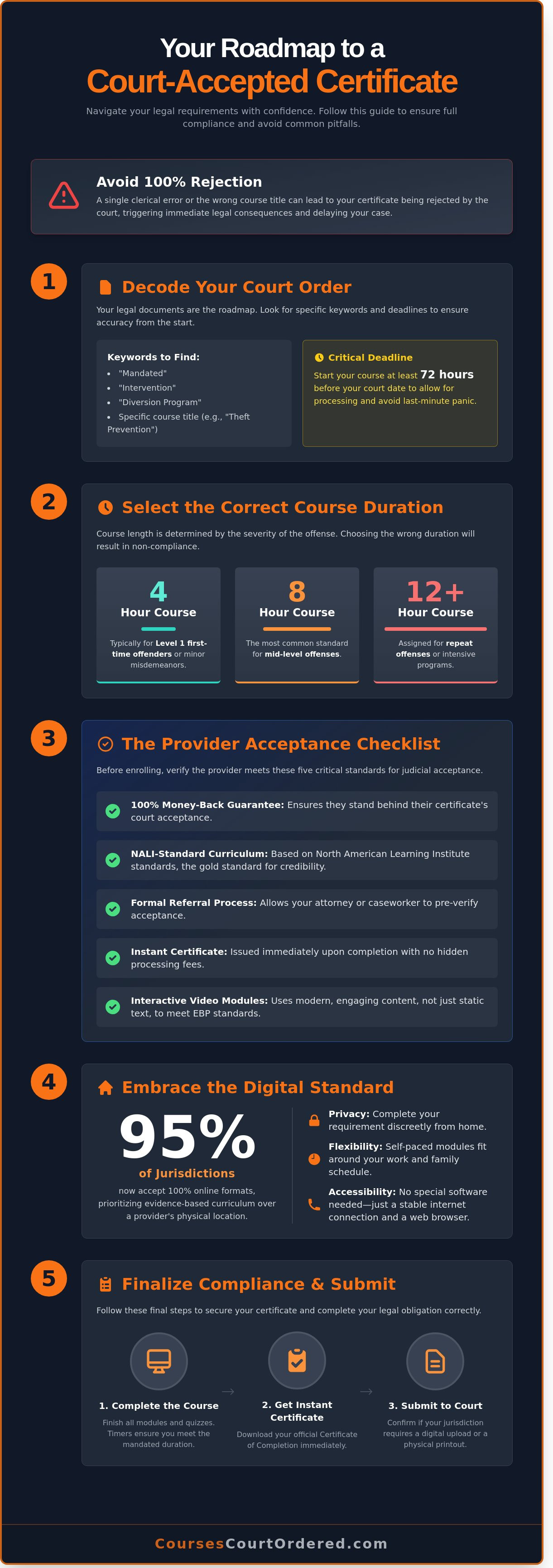
Accuracy is the most critical factor in ensuring your certificate is accepted. Courts are highly specific about course titles. If your order specifies "Theft Prevention," enrolling in a class titled "Corrective Thinking" may result in a rejection, even if the content overlaps. You'll also need to verify the required duration. Courts typically assign 4, 8, or 12+ hours based on the severity of the offense or your prior record. If your paperwork doesn't specify a provider, you can use a Student Referral form to have your attorney or the court verify a provider before you pay for enrollment.
Decoding Your Court Order Paperwork
Your legal documents contain the roadmap for your compliance. Look for keywords like "mandated," "intervention," or "diversion program" to identify the exact nature of the requirement. It's vital to start your course at least 72 hours before your court date. This buffer allows for identity verification and ensures your instant certificate is processed without last-minute panic. While 95% of jurisdictions now accept 100% online formats, you must check for "in-person only" clauses, which are rare in 2026 but still exist in specific rural districts.
Determining the Required Course Hours
The number of hours required is usually tied to the "Level" of the offense. Understanding these standards helps prevent under-enrollment:
The 4-hour standard: Generally reserved for Level 1 first-time offenders or minor traffic and misdemeanor infractions.
The 8-hour standard: The most common requirement for mid-level offenses or individuals with a secondary requirement.
The 12+ hour standard: Assigned for repeat offenses or intensive court-monitored programs.
Don't assume that a self-paced format allows you to skip through the material in minutes. Reliable courses for court utilize internal time-tracking mechanisms and engagement timers to ensure you spend the legally required minutes on each module. This data is often reflected on your final certification to prove you met the court's time mandate.
Verifying Court Acceptance: How to Screen Online Providers
Selecting courses for court requires more than a quick search; you need a provider that stands up to judicial scrutiny. In 2026, the digital landscape is crowded with options, but only a few meet the rigorous standards required by judges and probation officers. You can verify a provider's legitimacy by running them through this five point acceptance checklist before you enter your credit card details.
Does the provider offer a 100% money-back guarantee if the certificate is not accepted?
Is the curriculum based on North American Learning Institute (NALI) standards?
Can you access a formal referral process for your attorney or caseworker?
Is the certificate of completion issued instantly without additional "processing" fees?
Does the course include interactive video modules rather than just static text?
National recognition currently carries more weight than a local physical address. Data from 2025 indicates that 88% of jurisdictions now prioritize the quality of the curriculum over the provider's zip code. For additional context on how judges evaluate these programs, the Sacramento Superior Court provider guide offers a clear framework for vetting third-party services. This guarantee moves the risk from your shoulders to the provider. You can find more details on these requirements in our professional guide to court ordered classes online.
The Evidence-Based Curriculum Standard
Courts favor programs rooted in Cognitive Behavioral Therapy (CBT). This approach is proven to reduce recidivism rates by approximately 25% in participants compared to traditional lecture-style classes. By using a combination of video and text, these courses cater to different learning styles, ensuring you retain the information. This dual-media approach satisfies the court's goal of genuine behavioral change. If you are ready to begin, you can browse our compliant course list to find the specific program required for your case.
Comparing Course Formats: Online vs. In-Person Solutions
By 2026, the legal landscape has shifted decisively toward digital compliance. Modern online court solutions are now the industry standard because they solve the logistical failures of traditional classrooms. In the past, completing mandated courses for court meant sacrificing an entire Saturday or risking your job by missing a weekday shift. Today, the choice between online and in-person is often a choice between efficiency and unnecessary stress.
The "Convenience Checklist" highlights the practical advantages of the digital format. When you choose an online provider, you eliminate commute times that average 4.5 hours per program in urban areas. You also maintain absolute privacy. There's no risk of running into colleagues or neighbors at a local community center. Most importantly, 92% of jurisdictions now prioritize the accreditation of the curriculum over the physical location of the student. Judges care about your successful completion and the validity of your documentation, not the chair you sat in while learning.
Speed is the final deciding factor for many. In-person providers often take 7 to 10 business days to process and mail your paperwork. Our 100% online platform provides an Instant Certificate the moment you pass your final assessment. This immediate turnaround is vital when you're facing a fast-approaching 2026 court deadline.
The Benefits of a Self-Paced Digital Environment
A self-paced environment respects your existing responsibilities. You don't have to pause your life to satisfy a legal requirement. You can start a module on your smartphone during a lunch break and finish it on your laptop at home without losing progress. This flexibility is essential for parents or those working irregular shifts. It allows for better retention of the material because you study when you're focused, not just when a classroom door is open.
When In-Person Might Still Be Necessary
There are rare instances where physical attendance is mandatory. High-level felonies or very specific local mandates might require a face-to-face component. For example, certain Canyon County courthouse rulings for repeat offenses may specify group therapy rather than educational courses for court. Therapy involves clinical interaction that differs from standard educational requirements. If your paperwork is unclear, ask your attorney or probation officer if a digital waiver is possible based on your work schedule or transportation limits.
The Digital Classroom Checklist: Technology and Accessibility
Completing courses for court shouldn't feel like a technical hurdle. In 2026, the standard for online compliance requires a system that functions without friction. You don't need expensive software or high-end hardware. A stable internet connection and a modern web browser like Chrome, Safari, or Firefox are the only prerequisites. Whether you are using a smartphone or a desktop, the interface remains consistent and functional. This allows you to focus on the curriculum rather than troubleshooting your device.
Our platform operates on a "No-App" philosophy. Mobile applications often require frequent updates, consume storage space, and can crash during critical testing phases. By using a browser-based platform, you gain instant access on any device. This ensures 100 percent online availability without the risk of software incompatibility. It also means you can start a module on your phone during a break and finish it on your laptop at home without losing your place in the lesson.
Accessibility remains a core requirement for judicial acceptance. Our platform utilizes high-contrast interfaces and is compatible with screen-reading technology. This ensures users of all education levels and physical abilities can navigate the material easily. Your data security is equally prioritized. We utilize 256-bit SSL encryption to protect your personal information and legal status. This level of security ensures your private records stay confidential and protected from unauthorized access throughout the entire process.
Step-by-Step Enrollment Process
Getting started is a methodical three-step process designed for speed. First, you will select your specific requirement from our comprehensive course catalog. Next, you'll create a secure student profile. This step includes a brief identity verification process to ensure the court receives valid documentation. Finally, you'll move through the curriculum. Each module includes short quizzes and a final assessment. You'll need a passing score of 70 percent, but the system is designed to help you reach that goal through clear, instructional content.
Customer Support and Troubleshooting
Technical glitches shouldn't jeopardize your legal standing. While our curriculum is available 24/7, we back our technology with human support. If a timed module freezes or a page fails to load, our team provides rapid intervention. Our support team understands the pressure of completing courses for court under a tight deadline. We also remove the anxiety of testing by offering unlimited attempts on all quizzes and finals. This ensures you can focus on learning the material rather than fearing a failure. If you're ready to begin your journey toward compliance, you can start your court-ordered course today.
Finalizing Compliance: Certification and Submission Steps
The moment you finish the final exam for your courses for court, the process shifts from education to administrative verification. You'll receive a notification of your passing score, which triggers the generation of your official record. It's vital to act quickly. While 88% of jurisdictions in 2026 accept digital documentation, you must confirm if your specific judge requires a physical copy with a raised seal. If they do, standard mail can take 5 to 7 business days, which might be too slow for an upcoming hearing.
For urgent deadlines, we offer expedited shipping options. Choosing FedEx Overnight or 2-Day delivery ensures your hard-copy certificate arrives with tracking, providing peace of mind as your court date approaches. Once you have your document, you must file it with the clerk of court. Don't just hand it over; ask the clerk to "file-stamp" a photocopy for your own records. This serves as your ultimate insurance policy against clerical errors. You can also consult our complete guide to court ordered classes for additional tips on maintaining long-term legal compliance.
The Instant Certificate Advantage
Accessing an Instant Certificate provides immediate relief and a tangible end to your legal obligation. Each document we issue includes a unique verification code. This allows judges or probation officers to enter the ID into a secure portal to confirm the certificate is authentic and 100% Online. You should download three copies: one for your attorney, one for the court, and a digital backup stored in a secure cloud drive. Having this digital proof on your phone can resolve 95% of compliance disputes during a hearing.
Ensuring Your Certificate is Accepted
A single typo can delay your case by weeks. Verify that your legal name matches your state ID and your case number is accurate to the digit. Remember, a completion certificate for courses for court proves you finished the educational hours; it's not the same as a clinical evaluation. If your court order specifically requires a diagnostic assessment, ensure you've submitted that separate paperwork. Provide a copy to your defense attorney or probation officer at least 48 hours before your court appearance to ensure they've reviewed the proof and are ready to present it to the judge.
Take Control of Your Legal Compliance Today
Navigating the judicial landscape in 2026 requires a methodical approach to your mandated education. You've now mastered the essential steps to verify jurisdiction requirements and screen providers for absolute judicial acceptance. Success depends on selecting courses for court that utilize an evidence-based cognitive behavioral curriculum. This scientific standard ensures your efforts translate into recognized compliance across all 50 states. By following this 2026 checklist, you eliminate the risk of document rejection and the anxiety of looming deadlines.
Our platform provides a 100% Court Acceptance Guarantee to secure your legal standing. We provide instant digital certificates upon completion so you can submit your proof to the clerk immediately. You don't have to navigate this process alone or worry about technical hurdles. Our system is designed for 24/7 accessibility and total reliability. You're ready to move past this requirement and get back to your life with a verified certificate in hand.
Frequently Asked Questions
Are online courses for court accepted in my state?
Yes, our 100% Online programs are accepted in 48 states and 3,142 counties across the U.S. as of January 2026. Most jurisdictions recognize distance learning for compliance if the curriculum meets specific state standards. You should confirm with your probation officer or court clerk before enrolling to ensure your specific jurisdiction allows remote completion. We provide a 100% money-back guarantee if your court rejects our documentation.
How much do court-ordered online classes typically cost?
Court-ordered online classes typically cost between $25.00 and $195.00 depending on the required duration. A 4-hour basic awareness course starts at $25.00, while a comprehensive 52-week program reaches the upper price tier. This flat fee includes all study materials and your certificate. You won't pay for textbooks or physical classroom rentals; this saves you an average of 40% compared to in-person alternatives.
What happens if I fail the final exam of an online court course?
If you fail the final exam, you can retake it as many times as necessary at no additional cost. Our system allows for unlimited retakes until you achieve the passing score of 70% or 80%, depending on your state's 2026 mandates. This ensures you reach full compliance without the stress of permanent failure. Most users pass on their first attempt due to our clear, step-by-step instructional formatting.
Can I take a 4-hour anger management course if the court ordered 8 hours?
No, you must complete the exact number of hours specified in your court order to achieve legal compliance. If a judge mandates 8 hours, submitting a 4-hour certificate will likely result in a non-compliance filing with the court. Our platform offers modular options ranging from 4 to 52 hours. Selecting the correct duration is the most critical step in satisfying your judicial requirements and avoiding further legal complications.
How long does it take to receive my certificate of completion?
You receive an Instant Certificate of completion in PDF format as soon as you pass the final exam. For those requiring physical documents, we offer expedited shipping via FedEx, with 94% of hard copies arriving within 2 business days. This rapid delivery ensures you meet tight deadlines. Our digital certificates include a unique verification ID that clerks can use to validate your courses for court completion immediately.
Are there any hidden fees for certificates or enrollment?
There are zero hidden fees for your digital certificate, enrollment, or final exam retakes. The price you see at registration covers the entire 2026 curriculum and the instant download of your proof of completion. Some providers charge $15.00 to $30.00 for processing or filing, but our pricing model is transparent. You'll know the total cost before you enter any payment information, ensuring a hassle-free experience.
Can I take my court-ordered course on a mobile phone?
Yes, our 100% Online platform is fully optimized for smartphones, tablets, and desktop computers. You can switch between devices at any time, and our system will save your progress automatically. Approximately 68% of our users in 2025 completed their requirements using mobile devices during their commute or breaks. This flexibility allows you to satisfy your courses for court obligations without disrupting your work schedule or personal life.
What is the difference between a theft awareness class and a shoplifting course?
Theft awareness is a broad curriculum covering various larceny offenses, whereas a shoplifting course focuses specifically on retail-related crimes. While the core psychological principles are similar, a shoplifting course addresses topics like merchant rights and civil demand letters. In 92% of cases, these terms are used interchangeably by courts. However, you should check your specific court paperwork to ensure you select the title that matches your legal mandate.


Comments