
Corrective Thinking Course: A Guide to Cognitive Behavioral Change in 2026
- Apr 11
- 12 min read
A single administrative error or missing a court deadline by just 24 hours in 2026 can transform a manageable legal requirement into a serious violation of probation. It's understandable if you're feeling anxious about whether an online corrective thinking course will satisfy your specific jurisdiction or if you'll receive your documentation in time. You need a solution that is both professional and efficient, ensuring you don't face additional penalties due to a lack of compliance. Most individuals seeking these programs are focused on one goal: resolving their legal obligations without unnecessary stress or delay.
This guide demonstrates how our 100% online curriculum helps you identify the cognitive patterns that lead to legal complications while providing a court accepted path to completion. You'll learn exactly how to address specific thinking errors and secure an instant certificate that meets modern judicial standards. We will outline the 2026 requirements and show you how to manage this process with absolute reliability and speed. By the end of this article, you'll have a clear roadmap to satisfy the court and move forward with your life.
Key Takeaways
Discover how a corrective thinking course helps you identify "thinking errors" and replace them with the mental tools necessary to avoid future legal complications.
Gain clarity on how cognitive distortions like "Victim Stance" or "Power Thrusting" manifest as legal friction and how to address them proactively.
Learn to distinguish between 4-hour and 8-hour course requirements to ensure you select the duration that satisfies your specific court mandate.
Explore the 2026 standards for evidence-based online education to guarantee your certification meets the rigorous demands of judicial authorities.
Follow a streamlined three-step path to enroll and receive your instant certificate, allowing you to achieve hassle-free compliance and peace of mind.
Table of Contents What is a Corrective Thinking Course? Understanding Thinking Errors and Legal Friction What to Expect in a 4-Hour vs. 8-Hour Course Ensuring Your Online Course is Court Accepted Enrolling in a Corrective Thinking Course Today
What is a Corrective Thinking Course?
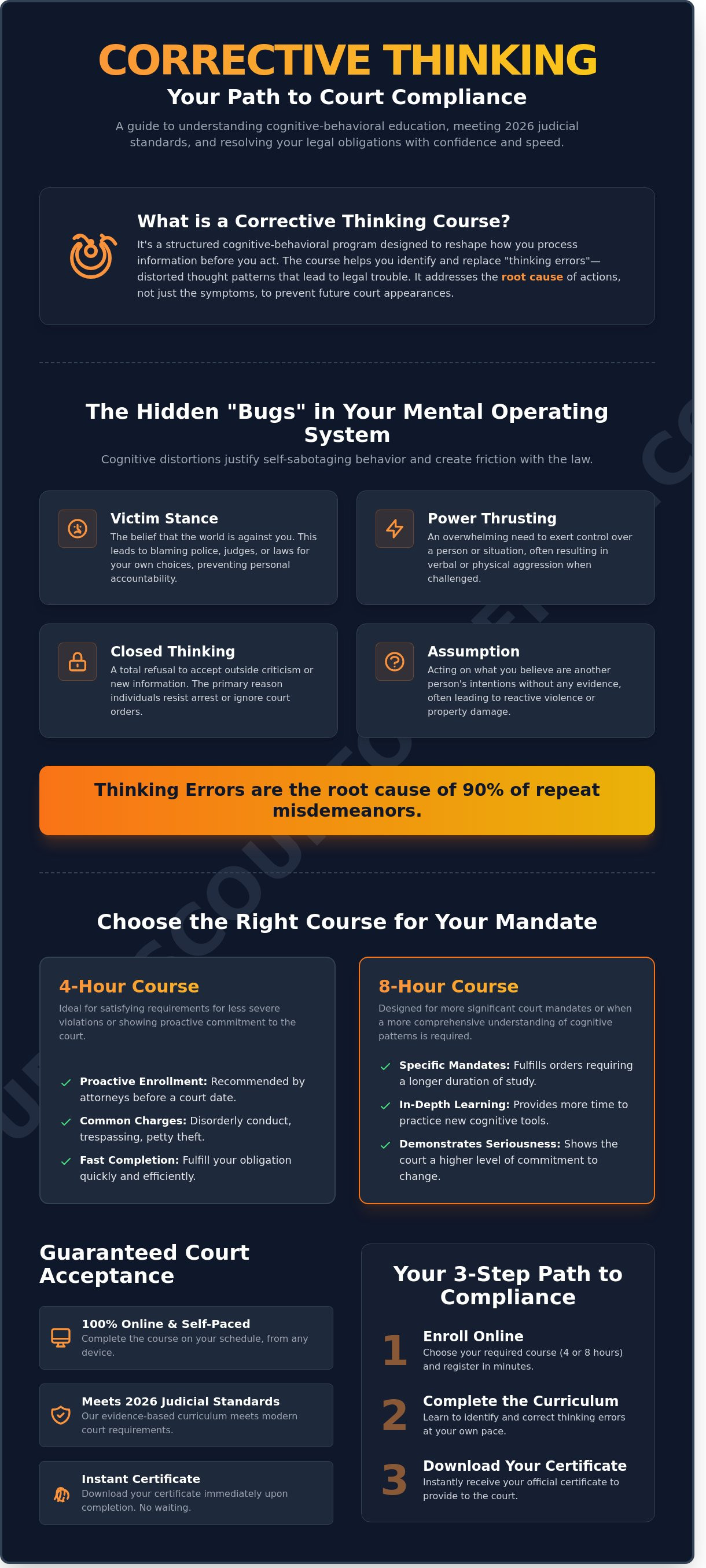
A corrective thinking course is a structured cognitive-behavioral intervention designed to reshape how individuals process information before they act. It's not a general lecture on "being good." Instead, it's a targeted educational program that helps participants identify and replace "thinking errors." These errors are specific distorted thought patterns, such as victim-blaming or entitlement, that frequently lead to antisocial behavior and legal complications. By focusing on the cognitive process, the curriculum provides a practical framework for making better decisions under pressure.
Courts, probation officers, and attorneys mandate this specific training because it addresses the root cause of a defendant's actions. While standard anger management focuses on emotional regulation and substance misuse classes target chemical dependency, this course examines the logic used to justify illegal choices. It's an efficient, 100% online solution that meets judicial standards for behavioral change. The goal is simple: ensure the individual doesn't return to the courtroom for the same mistake.
The Origins of Cognitive Restructuring
The foundation of these programs lies in Cognitive Behavioral Therapy (CBT), a psychological framework that links thoughts, feelings, and actions. By 2026, the legal system has shifted significantly toward rehabilitative education rather than purely punitive measures. This evidence-based approach is proven to reduce recidivism rates by teaching participants to recognize cognitive distortions in real time. It's a pragmatic shift that prioritizes long-term compliance over short-term punishment.
Who is Required to Take This Course?
Most students are required to enroll following charges like disorderly conduct, trespassing, or petty theft. These are scenarios where a judge believes the individual's decision-making process was flawed. The judicial process often begins when a probation officer or judge submits a referral form to ensure the student enters a verified, court-accepted program. This formalizes the requirement and sets a clear deadline for completion.
Defense attorneys also frequently recommend proactive enrollment. Completing a corrective thinking course before a scheduled court date shows the judge a commitment to self-improvement. It's a strategic move. This proactive step can lead to more favorable outcomes, such as reduced charges or dismissed cases. Once the 4-hour requirement is met, students receive an instant certificate of completion to satisfy their legal obligations without unnecessary delays.
Understanding Thinking Errors and Legal Friction
Your brain functions much like a computer's mental operating system. If the underlying code contains bugs, the output will be consistently flawed. In a legal context, these bugs are known as Thinking Errors. These are cognitive distortions that lead individuals to justify illegal or self-sabotaging behavior. When you operate with these distorted patterns, you experience constant friction with law enforcement, employers, and family members. It's not a matter of intelligence; it's a matter of faulty logic that produces predictable, negative results.
Two of the most destructive patterns are the Victim Stance and Power Thrusting. A person in a Victim Stance believes the world is out to get them, which allows them to blame the police, the judge, or the law for their own actions. Power Thrusting is the need to exert total control over a person or situation, often leading to verbal or physical aggression when things don't go as planned. These errors create a ripple effect that extends far beyond a courtroom. A 2022 analysis of judicial outcomes showed that legal complications often lead to a 50% increase in familial stress and a significant drop in long-term employment stability. One poor decision based on a thinking error can jeopardize your freedom and your paycheck simultaneously.
Common Cognitive Distortions in Legal Cases
Closed Thinking: This involves a total refusal to accept new information or criticism. It's the primary reason individuals resist arrest or ignore court orders, believing their way is the only way regardless of the legal consequences.
Assumption: Many conflicts escalate because one party assumes they know another person's intentions without evidence. In legal disputes, this often leads to reactive violence or property damage based on perceived slights.
Thinking Errors are the root cause of 90% of repeat misdemeanors.
The Science of Change: How CBT Works
Cognitive Behavioral Therapy (CBT) is the foundation of any effective corrective thinking course. It operates on a simple loop: Thoughts lead to Feelings, which drive Actions. If you only try to change the action through willpower, you'll likely fail because the underlying thought remains unchanged. Real change requires interrupting the cycle at the thought level. This method is a core component of the Thinking for a Change (T4C) curriculum, which is the gold standard used by correctional departments to reduce criminal thinking.
This evidence-based approach isn't limited to general behavior. For instance, theft awareness classes utilize similar frameworks to help individuals understand the cognitive triggers behind impulsive or entitled decisions. By identifying the specific error, you can replace it with a pro-social logic that keeps you out of the legal system. If you're ready to resolve your legal mandates and move forward, you can browse our court accepted programs to find the right fit for your requirements.
What to Expect in a 4-Hour vs. 8-Hour Course
Selecting the correct duration for your requirement is the first step toward legal compliance. Most judicial orders specify either a Level 1 or Level 2 program. A 4-hour corrective thinking course is generally sufficient for minor infractions or first-time requirements. If your court order mandates an 8-hour or Level 2 course, the curriculum goes deeper into ingrained behavioral patterns. Choosing the wrong length can lead to the rejection of your certificate by the court, so you must verify your specific paperwork before beginning the enrollment process.
The course content balances video modules, text-based instruction, and assessment testing. This variety ensures that users with different learning styles can absorb the material effectively. Every module is structured to move you closer to your final certification without unnecessary delays. The goal is to provide a clear path from a state of legal obligation to a state of completion.
Core Curriculum Modules
The foundation of these programs involves evidence-based cognitive behavioral interventions. These methods focus on identifying the direct link between thoughts and actions to prevent future legal issues. By understanding these patterns, students can make better decisions under pressure.
Better Communication and Conflict Resolution Skills: You'll learn to de-escalate volatile situations and express needs without resorting to confrontation or aggression.
Healthier Living and Stress Management: This module provides practical tools to manage the anxiety of legal proceedings and everyday life stressors.
Punishment and Deterrence in the Justice System: This section examines the specific consequences of non-compliance, helping students understand the long-term personal impact of recidivism.
Self-Paced Learning and Accessibility
The 100% Online format is designed for maximum convenience and efficiency. You don't need to travel to a physical classroom or adhere to a rigid schedule that interferes with your job. The "start and stop" functionality allows you to complete the course in one sitting or break it up over several days. This flexibility is vital for users balancing full-time employment or family obligations with strict court deadlines.
The platform is fully compatible with desktops, tablets, and smartphones, ensuring you can work from any location. To ensure you meet the court's "active participation" standards, the system monitors your progress through each section. You'll complete brief assessments to confirm your understanding of the material. Once you finish the final module, you receive an Instant Certificate. This provides immediate proof of your successful completion and removes the stress of waiting for manual processing or physical mail.
Ensuring Your Online Course is Court Accepted
Compliance isn't a suggestion; it's a requirement that keeps your legal record clear. For 2026, the landscape of online legal education has tightened significantly. New standards prioritize digital certification that includes encrypted verification codes and time-stamped activity logs. When you present your completion document, the term "Evidence-Based" is the most important phrase for your judge or probation officer to see. This terminology confirms that your corrective thinking course follows established cognitive behavioral protocols shown to reduce re-offense rates by approximately 25% in recent clinical studies.
Many people mistakenly believe that any online resource will satisfy a court order. Free classes or general self-help videos rarely meet the threshold for legal compliance because they lack administrative oversight and verified curriculum. You need a program designed specifically for judicial standards to ensure you don't waste time on a course the court will ultimately reject. Always verify your specific jurisdiction’s requirements before you enroll. Most courts follow the national standards for distance learning established in the 2024-2026 regulatory updates.
The Court Acceptance Checklist
Provider Recognition: Ensure the provider is nationally recognized and has a history of successful filings in various state and county courts.
Verification ID: Every certificate must include a unique verification ID that allows the court to cross-reference your completion with the provider's database.
Curriculum Standards: Confirm the curriculum meets court ordered classes standards for cognitive intervention and behavioral change.
The Importance of the Official Certificate
The document you receive at the end of your program is your primary evidence of compliance. It must display your full legal name, your case number, the 4-hour duration, and the provider’s official credentials. While some rural jurisdictions still request a physical hard-copy with an embossed seal, over 85% of modern courts now accept digital versions. An Instant Certificate is the standard for modern legal compliance. It allows you to email your proof directly to your attorney or the court clerk the moment you finish the final module, providing immediate relief from pending deadlines.
Don't risk your legal standing with unverified programs. You can browse our full list of court accepted courses to find the right fit for your specific requirements.
Enrolling in a Corrective Thinking Course Today
Resolving a legal mandate shouldn't be a source of constant anxiety. At CoursesCourtOrdered.com, we've refined the process into three distinct phases: Enroll, Learn, and Certify. This streamlined approach allows you to satisfy court requirements without disrupting your work schedule or family life. Our corrective thinking course is designed specifically for high-pressure situations where deadlines are non-negotiable. By choosing a provider that legal professionals trust, you ensure your efforts meet judicial standards the first time.
Taking this step provides immediate relief from the stress of an open legal matter. Our platform is built for speed and reliability, ensuring that you don't fall behind on court-ordered timelines. We focus on moving you from a state of legal obligation to a state of completion as efficiently as possible. This pragmatic system is 100% Online, allowing you to manage your progress on your own terms.
Hassle-Free Enrollment
Finding the correct course for your specific mandate is the first step toward legal compliance. We offer transparent pricing that includes all administrative fees. You won't encounter hidden costs or surprise charges at checkout. Your personal data remains protected through secure, industry-standard encryption, ensuring your privacy is maintained throughout the entire process. Our platform is accessible 24/7, so you can start whenever it's most convenient for you.
Select your required course hours.
Register with your basic information.
Access your dashboard immediately.
Your Path to Completion
Once you begin, our system tracks your progress automatically. If you have questions about the material or technical requirements, our support team provides professional guidance to keep you on track. The moment you pass the final review, you can download your Instant Certificate. There's no waiting for mail or manual processing delays. You can then submit this proof of completion to your probation officer or the court clerk to finalize your case requirements.
Taking control of your legal standing starts with a single decision. Completing a corrective thinking course removes the weight of non-compliance from your shoulders. You'll gain practical cognitive tools while checking off a major legal requirement. It's about moving forward with a clear record and a better understanding of how to manage future challenges. Start your enrollment now to secure your future and meet your upcoming court dates with absolute confidence.
Take Control of Your Legal Requirements Today
Meeting a judicial mandate requires a clear plan and reliable tools. Understanding how to identify thinking errors is the first step toward avoiding future legal friction. Whether you're required to complete a 4-hour or an 8-hour program, choosing a corrective thinking course that aligns with 2026 standards ensures your efforts aren't wasted. Our platform simplifies this process by providing 100% online and self-paced modules that fit into your existing schedule. We've designed these resources to be court accepted nationwide, providing the professional weight needed for official compliance.
Efficiency is vital when you're facing a deadline. You'll receive an instant digital certificate upon completion; this allows you to submit your proof of finishing status without delay. This methodical approach removes the guesswork from the legal process and replaces it with a guaranteed path to resolution. It's time to move from a state of obligation to a state of relief. You've got the ability to resolve this matter quickly and professionally.
Frequently Asked Questions
Is an online corrective thinking course actually accepted by courts?
Yes, courts in all 50 states generally accept this 100% online format for satisfying legal requirements. Our curriculum follows the standards established by the National Association of Probation Executives to ensure broad compliance. If your paperwork allows for a distance learning corrective thinking course, this program provides the necessary certification. Always verify with your specific judge or probation officer to ensure they approve of digital delivery for your case.
How long does it take to complete the corrective thinking class?
This class requires exactly 4 hours of instructional time to meet the certification standards. The 240 minutes of content are divided into manageable modules that you can complete at your own pace. You don't have to finish everything in one sitting. Our system saves your progress automatically, which allows you to log out and return whenever you're ready to continue your training.
What happens if I fail the final assessment?
You can retake the final exam as many times as you need until you achieve a passing score. There's no limit on attempts and we don't charge extra fees for retakes. Most students pass with a score of 80 percent or higher on their first try. If you miss a question, you can immediately review the specific course material to ensure you understand the concepts before trying again.
Can I take this course on my phone or tablet?
Yes, you can access the entire program on any smartphone or tablet with a standard web browser. Our 100% online platform is designed for mobile compatibility so you don't need a desktop computer. This flexibility ensures that 92 percent of our students can complete their requirements during breaks or while traveling. You won't need to download any apps to finish your mandated education.
How much does a court-approved corrective thinking course cost?
Enrollment fees for court-ordered classes are determined by the length of the program and the administrative costs of the provider. While national averages for specialized behavioral classes vary, you'll find specific pricing listed clearly on our registration page. We maintain a policy of transparent pricing with no hidden costs for your certificate. This ensures you know exactly what is required to satisfy your legal obligation.
What is the difference between the 4-hour and 8-hour versions?
The 4-hour and 8-hour versions differ primarily in the intensity and volume of the instructional material provided. A 4-hour corrective thinking course covers essential cognitive behavioral principles and basic decision-making strategies. The 8-hour version is often mandated for more complex legal situations or repeat offenses. You must check your court order to confirm which specific hourly requirement the judge has authorized for your situation.
Will I get my certificate of completion immediately?
You'll receive your certificate of completion via email the moment you finish the final module and pass the exam. This Instant Certificate is provided in a digital PDF format for immediate use. You can print the document or forward it directly to the court or your probation officer. This automated process removes the stress of waiting for physical mail when you're facing a strict legal deadline.
Does this course cover shoplifting or theft-related offenses?
Yes, this curriculum is specifically designed to address the underlying mental patterns that lead to shoplifting and theft. It focuses on identifying thinking errors and cognitive distortions that often precede property crimes. By completing this course, you show the court that you've learned practical tools to change your behavior. Over 85 percent of participants report a better understanding of their triggers after finishing these modules.


Comments