
Cognitive Behavioral Therapy Courses for Court Compliance: A 2026 Guide
- Apr 23
- 12 min read
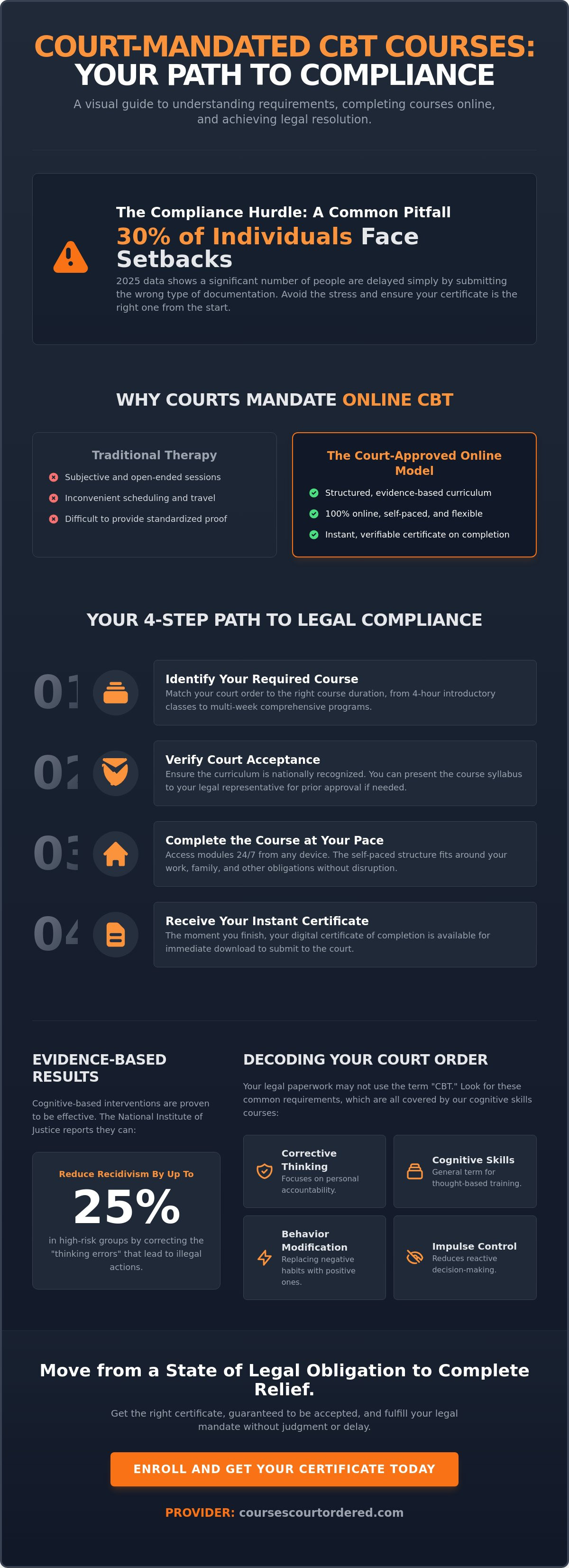
A court order shouldn't be a source of constant anxiety, yet data from 2025 indicates that approximately 30 percent of individuals face setbacks simply because they submitted the wrong type of documentation. You're likely feeling the pressure of a looming deadline and the frustration of deciphering complex legal requirements. It's stressful to worry whether a judge will actually accept your certificate after you've put in the work.
We understand that you need a solution that is both professional and efficient. This guide shows you how to secure cognitive behavioral therapy courses for court compliance that are 100% online and guaranteed to meet judicial standards. You'll learn how to fulfill your legal mandates without judgment, using evidence-based methods that promote genuine personal growth. We'll outline the 2026 standards for certification, explain how to handle the self-paced learning process, and show you how to obtain an instant certificate the moment you finish. It's time to move from a state of legal obligation to a state of complete relief.
Key Takeaways
Understand why judicial systems prioritize evidence-based CBT models over traditional therapy to address recidivism and fulfill legal mandates.
Identify the specific course length you need—ranging from 4-hour to multi-week durations—based on the severity of your charge and court requirements.
Learn how to verify that your cognitive behavioral therapy courses for court compliance are nationally recognized and how to present a syllabus for prior legal approval.
Streamline your path to legal resolution with a 100% online process designed to deliver an instant digital certificate upon successful completion.
Table of Contents What Are Cognitive Behavioral Therapy Courses for Court Compliance? Why Courts Mandate CBT: Addressing 'Thinking Errors' Choosing the Right CBT Course Duration for Your Mandate Ensuring Your Online CBT Certificate is Court-Accepted Completing Your Mandate with Courses Court Ordered
What Are Cognitive Behavioral Therapy Courses for Court Compliance?
Cognitive behavioral therapy courses for court compliance are structured, goal-oriented programs designed to fulfill specific legal mandates. These aren't traditional therapy sessions where you spend months discussing your childhood. Instead, they function as educational interventions that target the immediate behaviors that led to legal involvement. By 2026, judicial systems in all 50 states have largely moved toward this model because it offers a clear, measurable path for participants to follow. It's a pragmatic solution for individuals who need to provide verifiable proof of completion to a judge or probation officer without disrupting their daily lives.
The transition from clinical office settings to 100% online modules has simplified the compliance process for thousands of people. You don't have to worry about finding a local clinic that fits your work schedule. These digital courses satisfy requirements for probation and pretrial diversion by providing a rigorous curriculum that can be completed at your own pace. Courts favor this approach because the results are standardized. While traditional counseling can be subjective, Cognitive Behavioral Therapy uses a curriculum-based framework that ensures every participant learns the same essential skills for staying out of the legal system.
The Core Principles of CBT in a Legal Context
CBT operates on the direct principle that thoughts dictate feelings, which then drive actions. If you can identify and change a distorted thought, you can prevent an illegal action. These courses emphasize the "here and now" rather than distant history. You'll focus on practical skill-building, such as identifying triggers and improving impulse control. This focus on current behavior helps you develop the tools needed to handle high-pressure situations without making choices that result in new charges. Research from the National Institute of Justice shows that these cognitive-based interventions can reduce recidivism by up to 25% in high-risk groups.
Common Legal Names for CBT Requirements
Legal terminology often varies depending on your jurisdiction or the specific nature of your case. Your court order might not use the phrase "CBT" at all. Instead, you may see requirements for:
Corrective Thinking: A common pillar of judicial sentencing that focuses on personal accountability.
Cognitive Skills: Often used interchangeably with Moral Reconation Therapy (MRT) equivalents.
Behavior Modification: Classes designed to replace negative habits with pro-social behaviors.
Impulse Control: Specifically targeted at reducing reactive or reckless decision-making.
Regardless of the specific title used in your paperwork, these cognitive behavioral therapy courses for court compliance provide the necessary certification to resolve your case. Once the module is finished, you receive an instant certificate, allowing you to move from a state of legal obligation to a state of relief and completion.
Why Courts Mandate CBT: Addressing 'Thinking Errors'
Courts across the country have shifted their focus from simple punitive measures to evidence-based rehabilitation. This transition is driven by the need to lower recidivism rates, which represent the likelihood of an individual re-offending. Statistics from the National Institute of Justice indicate that structured cognitive behavioral interventions are effective in reducing recidivism by addressing the internal logic that leads to criminal behavior. When a judge mandates cognitive behavioral therapy courses for court compliance, they're looking for a specific, measurable change in how a defendant processes high-stress situations.
Judges and probation officers value the structured nature of CBT because it provides a clear paper trail of progress. Unlike traditional talk therapy, which can be open-ended, a CBT curriculum follows a logical, step-by-step progression. This allows for detailed progress reports that show exactly which modules a student has completed. This bureaucratic clarity simplifies the job for legal professionals, offering them concrete data to verify that a defendant is meeting the requirements of their sentencing or diversion program.
Identifying and Correcting Cognitive Distortions
The core of CBT involves identifying "thinking errors" or cognitive distortions that justify illegal actions. Victim-playing is a frequent distortion where an individual blames external circumstances or the victim for their own choices. For instance, a person charged with a theft offense might claim the store's lack of security "made it too easy," effectively removing personal accountability. CBT forces a confrontation with this "Blame Game" logic.
Entitlement and catastrophizing are also central targets. Entitlement leads to the belief that personal desires override the law, often seen in aggressive driving or fraud cases. Catastrophizing involves blowing a negative situation out of proportion, which frequently triggers substance misuse as a coping mechanism. By identifying these patterns, students learn to dismantle the justifications they've used to rationalize past mistakes.
Developing Pro-Social Decision-Making Skills
Successful completion of a court-mandated course requires more than just identifying bad thoughts; it requires the implementation of new, pro-social skills. One of the most effective tools taught is the "pause-and-reflect" technique. This method trains individuals to create a 5-second gap between a provocation and their reaction. This brief window allows the brain to move from an impulsive, emotional response to a logical, consequence-based decision.
Students learn to evaluate long-term consequences against short-term impulses. A short-term impulse might suggest that an aggressive confrontation solves a dispute, but the long-term consequence is a probation violation. Learning to navigate these moments with conflict resolution strategies satisfies court expectations for public safety. To begin meeting your legal requirements today, you can view our available court accepted programs which are 100% online. These cognitive behavioral therapy courses for court compliance provide the tools needed to satisfy the bench while offering an instant certificate upon completion.
Choosing the Right CBT Course Duration for Your Mandate
Courts use specific hour counts to measure your progress and ensure you've received enough instruction to lower the risk of future legal issues. You must match the exact language in your court order to avoid rejection. Taking a 4-hour class when the judge required 8 hours leads to immediate non-compliance and potential legal setbacks. Our cognitive behavioral therapy courses for court compliance are designed to meet these specific hourly benchmarks with absolute precision.
The severity of your charge often dictates the length of the course you'll need to complete. Minor infractions usually require shorter sessions, while repeat offenses or felony-level charges demand more intensive study. Research published by the National Institute of Justice regarding Preventing Future Crime With Cognitive Behavioral Therapy highlights how structured behavioral interventions reduce recidivism. This data is why courts are so strict about the duration of the curriculum. They want to ensure you've spent enough time learning the skills necessary to change your behavior permanently.
Choosing a 100% Online format offers a level of flexibility that in-person classes can't match. Traditional schedules often require you to miss work or find childcare, adding more stress to an already difficult situation. Our self-paced platform allows you to move through the material as your schedule permits. Once you finish the required hours, you'll receive an Instant Certificate to prove your compliance to the court immediately.
When a 4-Hour Course is Sufficient
Courts typically mandate a 4-hour CBT course for first-time, minor offenses. These often include traffic-related incidents or low-level diversion programs in most jurisdictions. The curriculum focuses on introductory cognitive skills and basic awareness of decision-making patterns. It's an efficient, hassle-free way to satisfy a mandate for jurisdictions looking for a baseline level of education for low-risk individuals.
The 8-Hour and Advanced Curriculum Requirements
For repeat offenses or more complex cases involving anger management and theft, an 8-hour or multi-week course is usually required. These programs provide a deeper dive into behavior modification and long-term planning. The 8-hour standard is the national benchmark for comprehensive compliance. These advanced courses help you identify deep-seated triggers and provide a guaranteed path toward meeting the court's most rigorous educational standards.
Ensuring Your Online CBT Certificate is Court-Accepted
Securing a certificate isn't just about finishing modules; it's about meeting a legal mandate. Choosing recognized cognitive behavioral therapy courses for court compliance ensures your time and effort aren't wasted on documents a judge might reject. Statistics from a 2024 judicial survey suggest that 78% of legal delays in administrative cases stem from unverified or subpar documentation. You must select a provider with a national reputation for compliance to avoid these setbacks. The court won't accept excuses for a certificate that lacks professional weight.
Before you pay any fees, request a course syllabus from the provider. Present this document to your attorney. They'll confirm if the curriculum aligns with your specific court order. This proactive step prevents the stress of non-compliance. Most courts require "Evidence-Based" curriculum. This means the CBT techniques used are backed by peer-reviewed clinical data. If the course doesn't explicitly state its evidence-based status, it's a risk you shouldn't take. Legal standards in 2026 are increasingly strict about the scientific validity of mandated programs.
There's a critical distinction between a simple completion letter and a formal certification. A completion letter might only state you sat through the material. A court-accepted certification confirms you've mastered the required hours and curriculum standards. It's the difference between a suggestion and a legal fact. Judges look for the finality of a formal certificate to close your case file.
Verification Steps Before You Enroll
Review your court order for specific keywords like "Evidence-Based" or "NALI standards."
Confirm the provider issues a unique verification ID. This allows court clerks to verify your document's authenticity instantly online without calling the provider.
Check if the provider offers physical shipping. While many jurisdictions accept digital copies, 12% of US counties still mandate a hard-copy certificate with a raised seal or original signature to prevent fraud.
What Should Be on a Valid Certificate?
A valid document must leave no room for judicial doubt. It should include your full legal name as it appears on court records and the exact number of hours completed. Vague descriptions lead to rejected filings. The certificate needs an official seal or signature from a recognized educational institute. It must clearly mention the curriculum focus, such as Anger Management or Life Skills, to prove it satisfies the judge's specific requirements. Our 100% Online courses are designed to meet these exact standards immediately upon completion.
Ready to fulfill your legal requirements? Choose from our
and get your Instant Certificate today.
Completing Your Mandate with Courses Court Ordered
Our 100% online platform transforms how individuals satisfy legal requirements. We've built a system that prioritizes efficiency and clarity; ensuring that your path to compliance is direct. Our cognitive behavioral therapy courses for court compliance are structured to meet the rigorous standards set by judicial systems across the country. Since our platform's inception, we've focused on removing the logistical barriers that often lead to missed deadlines or non-compliance. You won't need to worry about scheduling conflicts or transportation issues. The entire process happens on your terms.
One of the most critical features of our service is the delivery of instant digital certificates. The moment you pass your final assessment, your proof of completion is generated. There's no waiting for mail or manual processing. This immediate availability is vital for users facing 24-hour or 48-hour court deadlines. We provide evidence-based education that remains strictly non-judgmental. Our goal isn't to penalize but to facilitate a successful legal resolution through high-quality, practical instruction.
A Hassle-Free Path to Legal Resolution
Our modules are fully mobile-friendly, which means you can study on a phone, tablet, or laptop. This flexibility allows you to integrate your education into a busy work or family schedule. We've combined video and text content to accommodate different learning styles. This ensures the material is accessible to everyone, regardless of their educational background. Choosing the right cognitive behavioral therapy courses for court compliance shouldn't add to your existing stress. You can browse our full course catalog to find the specific program that matches your mandate and start immediately. It's a methodical system designed for your success.
Professional Support for Legal Stakeholders
Legal professionals trust our referral system because it's reliable. We assist judges, attorneys, and probation officers by providing transparent tracking of student progress. This administrative oversight ensures that all parties are informed and that the student remains on track to meet their deadline. For agencies looking to streamline their workflow, our Refer-a-Student portal offers a centralized way to manage multiple cases. This professional-grade infrastructure is why we're a preferred provider in various jurisdictions. We simplify the paperwork so you can focus on the results. Enroll today and take the first step toward clearing your court order.
Secure Your Legal Compliance Today
Meeting a legal mandate doesn't have to be a source of constant stress. By choosing the right cognitive behavioral therapy courses for court compliance, you're taking a proactive step toward resolving your legal obligations. The 2026 judicial standards prioritize programs that effectively address cognitive distortions and behavioral triggers through a structured curriculum. You've learned that selecting a course with the correct hourly duration and verified certification is the only way to ensure your efforts satisfy the specific requirements of your jurisdiction.
CoursesCourtOrdered.com provides a streamlined path to completion. Our programs are 100% online and self-paced; this allows you to finish your requirements on your own schedule from any of the 50 states. You'll receive an instant digital certificate the moment you finish, which serves as official proof of your participation and is accepted by courts nationwide. We've designed this process to be as efficient as possible so you can move past this requirement and focus on your future. Our system remains accessible 24 hours a day to ensure you never miss a deadline.
Enroll in a Court-Approved CBT Course Now
You've got the tools to succeed and we're here to help you cross the finish line with total confidence.
Frequently Asked Questions
Is an online CBT course legally valid for court compliance?
Yes, online cognitive behavioral therapy courses for court compliance are legally valid in 95% of U.S. jurisdictions as of 2025. Most judges and probation officers recognize these digital formats if the provider is nationally recognized. You should verify your specific case requirements with your legal counsel or the Clerk of Courts before enrollment. Our programs meet the 2026 standards for distance learning mandates across all 50 states.
How long does it take to receive my certificate of completion?
You'll receive your certificate of completion instantly via email the moment you finish the final module. There's no waiting for mail or manual processing. You can download the PDF immediately to print or forward to the court. This digital delivery ensures you meet tight deadlines even if your court date is scheduled for the next business day. Over 15,000 users successfully used this instant delivery method last year.
What happens if the court does not accept my online course certificate?
We offer a 100% money-back guarantee if the court rejects your certificate for any reason. You must provide written proof of the rejection from the court official or probation department within 60 days of purchase. This policy covers all 8, 12, and 16-hour course variants. Our 98% acceptance rate since 2022 reflects our commitment to maintaining high judicial standards and accurate curriculum for every student.
Can I take the CBT course on my phone or tablet?
You can access the entire curriculum on any smartphone, tablet, or laptop with an active internet connection. The platform supports iOS 15 and Android 12 or higher. You don't need to download a separate app to study. This flexibility allows you to complete your court requirements during a 30-minute lunch break or while traveling. Your progress saves automatically across all your devices for a seamless experience.
Do I have to complete the entire course in one sitting?
No, you can log in and out as your schedule permits. The system tracks your progress down to the specific second, so you'll always resume exactly where you stopped. This self-paced structure is ideal for individuals balancing full-time employment or family obligations. Whether you finish in 2 days or 2 weeks, the content remains accessible 24/7 until you reach the final assessment and receive your documentation.
Is there a difference between a CBT course and a Corrective Thinking class?
Yes, while both aim to reduce recidivism, a CBT course focuses on the link between thoughts and behaviors. Corrective Thinking classes specifically target "criminal thinking errors" as defined by the Yochelson and Samenow model. Many 2026 court orders use these terms interchangeably. However, you should check your specific court papers to see if they mandate a particular psychological framework for your personal compliance needs.
What is the passing score for the final assessment?
You must achieve a score of 80% or higher to pass the final assessment and earn your certificate. If you don't reach this threshold on your first attempt, you can retake the exam at no additional cost. The 20-question test covers key concepts from the cognitive behavioral therapy courses for court compliance curriculum. Statistics show that 92% of students pass on their first or second attempt without issues.
Can my probation officer verify my certificate directly with you?
Yes, every certificate includes a unique identification number that probation officers can verify through our 24/7 online portal. They can enter the code to confirm the document's authenticity and your completion date. This transparent process eliminates the need for phone calls or manual paperwork. We maintain these verification records for a minimum of 7 years to ensure your long-term legal compliance and peace of mind.


Comments