
Are Online Court Classes Legitimate? How to Verify Acceptance in 2026
- 4 days ago
- 11 min read
What if the certificate you just spent eight hours earning is dismissed by the judge in seconds? This fear is the primary reason people ask are online court classes legitimate before they commit to a program. You're likely feeling the pressure of a looming court date and the high stress of potential non-compliance. It's natural to feel confused by legal requirements, especially since there's no single national governing body that accredits every online course for every jurisdiction in 2026.
You can secure a 100% legitimate, court-accepted online class if you follow a specific verification protocol. This guide provides the exact steps to confirm acceptance with your probation officer or judge before you pay for enrollment. We'll examine why over 25,000 clients have successfully used online formats since 2006 and how to leverage money-back guarantees for absolute peace of mind. You'll learn how to move from a state of legal obligation to a state of completion with an instant, verifiable certificate that satisfies the court without requiring travel or time off work.
Key Takeaways
Define what makes a program legally valid by focusing on national standards for behavioral intervention and cognitive-behavioral change.
Learn the critical distinction between "court-approved" and "court-accepted" to determine if are online court classes legitimate for your specific jurisdiction.
Identify trustworthy providers by looking for institutional backing from organizations like the North American Learning Institute (NALI).
Follow a step-by-step verification process using your court order to match required hours and topics with provider credentials.
Gain access to standardized, high-quality material that judges prefer due to its ease of digital verification and instant certification.
Table of Contents What Makes an Online Court Class Legitimate in 2026? 4 Key Indicators of a Trustworthy Online Program Why Judges and Probation Officers Prefer Modern Online Classes How to Verify a Course Before You Enroll Courses Court Ordered: A Reassuring Path to Legal Compliance
What Makes an Online Court Class Legitimate in 2026?
In the 2026 legal environment, determining if are online court classes legitimate requires looking beyond a website's appearance. A legitimate program is defined as a structured curriculum that meets national standards for behavioral intervention. This means the material isn't just informational. It's designed to reduce recidivism through evidence-based cognitive-behavioral change. Legitimacy is the alignment of curriculum with judicial rehabilitation goals.
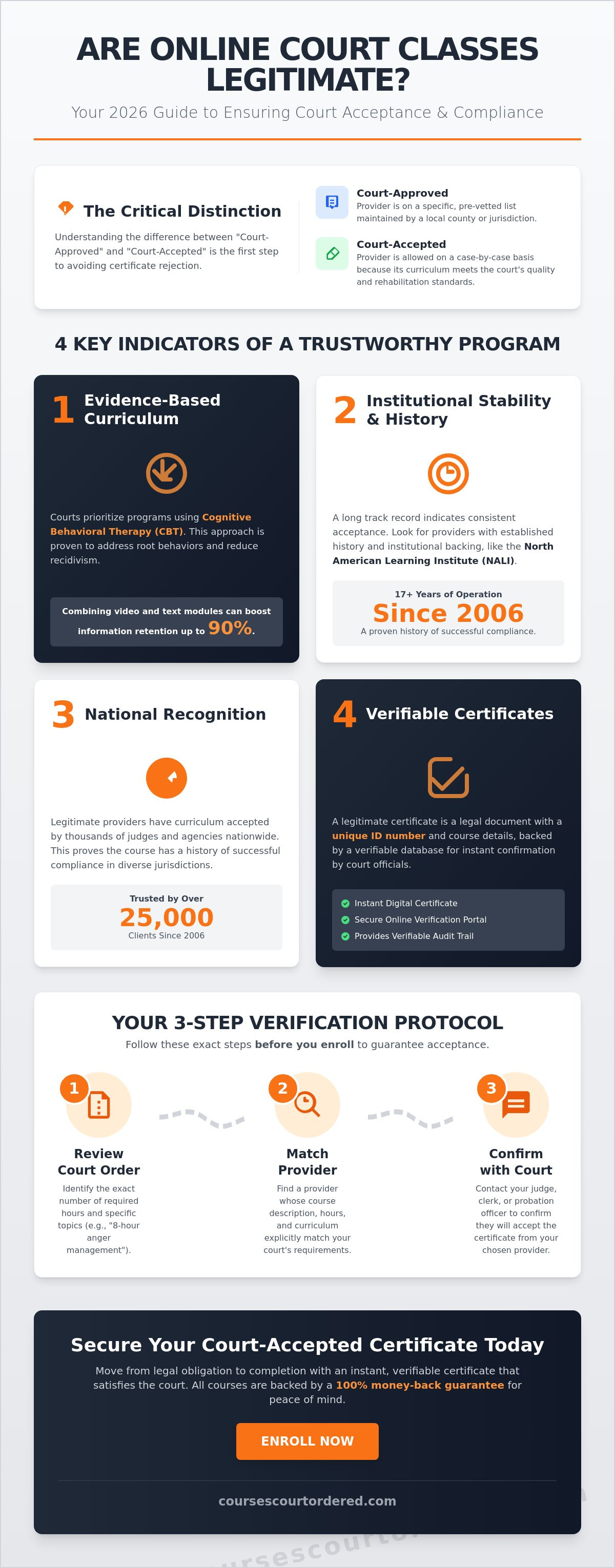
You must understand the distinction between "court-approved" and "court-accepted" providers. A court-approved provider is often on a specific list maintained by a local county. A court-accepted provider is one that a judge or probation officer allows on a case-by-case basis because the curriculum meets the court's standards. Modern standards in 2026 prioritize digital accessibility and data-driven results. This shift allows judges to accept remote programs that offer higher quality education than local, in-person alternatives that may not have updated their materials in years.
The Role of National Recognition
Providers like Courses Court Ordered have maintained national standards across multiple jurisdictions since 2009. This longevity is a key indicator of trust. When a provider is nationally recognized, it means their curriculum has been reviewed and accepted by thousands of judges and agencies across the country. The evolution of distance education has made it possible for specialized institutes to deliver consistent, high-quality material that local jurisdictions may lack the resources to produce. Being "nationally recognized" is the first checkbox for legitimacy because it proves the course has a history of successful compliance.
Verifiable Certificates of Completion
A legitimate certificate is more than a piece of paper. It acts as a legal document that courts verify through modern digital portals. Each certificate from a reputable source includes a unique identification number, the exact completion date, and a detailed breakdown of the curriculum hours. While many users value the convenience of an instant digital certificate for immediate filing, these documents must be backed by a verifiable database. This allows a probation officer to check the status in seconds. This transparency ensures that the 4-hour or 8-hour requirement was met through active participation in the mandated course. The difference between a legitimate program and a fraudulent one often comes down to this ability to provide a verifiable audit trail for the court.
4 Key Indicators of a Trustworthy Online Program
Evaluating the credibility of a provider is a critical step in your legal journey. To determine if are online court classes legitimate, you need to look for specific operational markers that distinguish professional institutes from unverified websites. State agencies often provide tools to verify providers, such as the ability to verify a course with the DMV for traffic-related offenses. This level of government oversight highlights that legitimacy is built on rigorous standards rather than just a digital presence. If a site focuses only on the lowest price and ignores these regulatory markers, it's a red flag for your compliance.
Evidence-Based Behavioral Intervention
Courts prioritize programs that utilize Cognitive Behavioral Therapy (CBT). This psychological framework is proven to address the root causes of behavior rather than just providing surface-level information. High-quality courses combine textual instruction with video modules to improve material retention. Research suggests that students retain up to 90% of information when visual and textual elements are combined effectively. This multi-modal approach is a key requirement because it directly correlates with lower recidivism rates. When a program is evidence-based, it meets the rehabilitation goals set by the judicial system, making it more likely to be accepted by your judge or probation officer.
Institutional Stability and History
Look for providers backed by established educational groups like the North American Learning Institute (NALI). A provider that has operated since 2009 offers a level of stability that newer sites cannot match. This 17-year track record indicates that their certificates have been consistently accepted by judges and probation officers across thousands of jurisdictions. Institutional history is a safeguard against scams. It ensures the business has the infrastructure to provide ongoing student support and long-term record keeping. Checking these indicators will help you decide if are online court classes legitimate for your specific legal needs.
Legitimate platforms also use secure, self-paced systems that prevent students from skipping ahead. This ensures that a 4-hour course actually takes 4 hours to complete, which is a non-negotiable requirement for court compliance. Finally, a trustworthy provider maintains a transparent corporate identity. You should easily find their physical address, phone number, and parent company details on their website. If you're ready to start a program that meets these high standards, you can browse our court-accepted courses to find the specific curriculum mandated for your case.
Why Judges and Probation Officers Prefer Modern Online Classes
Judges and probation officers often prioritize digital formats because they eliminate the variability inherent in traditional classroom settings. In the past, the quality of a court-ordered intervention depended heavily on the specific facilitator available in a local area. Today, the legal system relies on the standardization that online platforms provide. When officials ask are online court classes legitimate, they're looking for a guarantee that every student receives the same high-quality, evidence-based material regardless of their location. This consistency allows the court to maintain a predictable standard of rehabilitation across all cases.
Legal professionals can utilize our Referral Program for Legal Professionals to streamline the assignment process. This tool ensures that defendants are directed toward programs that meet the specific hours and curriculum requirements mandated by the court. By using a centralized referral system, judges can be confident that the student is enrolled in a verified program rather than an unvetted local class.
Standardized Intervention Standards
Online platforms ensure there's no geographical bias in the quality of education a student receives. Whether a defendant is in a major metropolitan hub or a rural county, they access the same rigorous curriculum. Agencies often look for programs modeled after National Safety Council authorized courses to ensure the training meets established safety and education benchmarks. Automated testing plays a vital role here. Unlike in-person sessions where participation might be passive, online courses require students to pass quizzes to move forward. This data provides the court with concrete proof of student comprehension and progress, making the rehabilitation process more transparent and trackable.
Administrative Efficiency
The shift toward digital education has significantly reduced the administrative burden on probation officers and court clerks. Traditional systems often involve manual paperwork and slow mail delivery, which can lead to missed deadlines and legal complications. Modern online classes offer a state-of-the-art solution through digital portals. These portals allow for the instant issuance and verification of certificates. For more details on specific course validity, see Are Online Court Classes Accepted? A 2026 Guide. When a student completes their 4-hour or 8-hour requirement, the certificate is available immediately. This speed prevents court delays and ensures that compliance is recorded well before the next hearing date. The efficiency of these systems is a primary reason why are online court classes legitimate is a question with a resounding "yes" from modern judicial perspectives.
How to Verify a Course Before You Enroll
Verification isn't just a suggestion. It's a mandatory step to ensure your certificate is filed correctly and accepted by the judge. When users ask are online court classes legitimate, the answer often depends on how well the chosen course aligns with the specific details of their court order. You should start by reviewing your paperwork carefully. Look for the exact topic, the total number of hours required, and the final filing deadline. Missing even one of these specific details can result in a rejected certificate and the anxiety of legal non-compliance.
Matching the Mandate to the Module
Courts are precise about time requirements. If a judge mandates an 8-hour Anger Management course, submitting a certificate for a 4-hour module will likely lead to a rejection. This is a common error that causes significant legal stress for defendants. For a deeper look at these requirements, read A Guide to Court-Ordered Online Classes. You must also ensure the topic is an exact match. For example, a "Life Skills" course is not a substitute for a mandated "Theft Awareness" program. Each module is designed to address specific behavioral issues as determined by the court's rehabilitative goals. If the course title doesn't match your order, the court may not credit your time.
Researching the Provider's Reputation
Legitimacy is often visible in the professional details of a provider's website. You should avoid sites that offer 'guaranteed' legal outcomes or those that lack clear, accessible contact information. A professional provider will always list their physical address and corporate parentage. You can use the Courses Court Ordered course list to cross-reference our 4-hour and 8-hour options with your specific mandate. Look for providers with established institutional referrals and a long history of service. If a site looks like it was built overnight or uses vague curriculum descriptions, it's safer to move on. While verification is your responsibility, choosing a provider with a history dating back to 2009 significantly reduces your risk of rejection.
Once you've confirmed your hours and topic, the final step is to verify the provider's standing with your specific jurisdiction. If you're still unsure, you can present the course syllabus to your probation officer for pre-approval. This proactive approach ensures that your time and money are well spent. To ensure you meet your legal obligations today, select your court-accepted course and begin your path to compliance.
Courses Court Ordered: A Reassuring Path to Legal Compliance
Choosing a provider with a proven institutional history is the most effective way to answer if are online court classes legitimate for your situation. Courses Court Ordered operates as part of the North American Learning Institute (NALI), which has maintained a legacy of trust in the judicial system since 2009. Our programs provide pragmatic, 100% online solutions that are self-paced and accessible on any device. This flexibility ensures you can meet your legal obligations without the logistical burden of travel or rigid classroom schedules. By focusing on evidence-based text and video content, we ensure that the curriculum doesn't just check a box but actively supports the behavioral change goals mandated by the court.
One unique factor that separates our platform from unverified sites is our direct relationship with the legal community. We provide a specialized student referral form specifically for judges, probation officers, and attorneys. This formal process allows officials to assign mandated courses with confidence, knowing the curriculum meets national standards for rehabilitation. When a court uses a referral system, it reinforces the legitimacy of the digital format and simplifies the path to compliance for the defendant.
Designed for Compliance and Relief
High-pressure legal deadlines create significant anxiety. Our platform is engineered to lower these stress levels through a well-oiled administrative process. The "Instant Certificate" promise is a core value proposition, providing you with a downloadable document the moment you complete your final module. This allows for immediate resolution of your case requirements. Our professional distance and authoritative tone are intentional. They satisfy judicial standards for officiality while remaining accessible to users from all backgrounds. This balance ensures that your certificate carries the necessary weight when presented at your next court hearing.
Our Specialized Course Offerings
We offer a wide range of specialized modules designed to meet the exact requirements of various jurisdictions. These include 4-hour and 8-hour options for Anger Management, Theft Prevention, and Substance Misuse education. For those requiring a deeper understanding of specific mandates, you can review our guide on Understanding Anger Management Classes. Every course we offer is built on psychological frameworks like Cognitive Behavioral Therapy to ensure high-quality intervention. If you're facing a deadline and need a reliable, court-accepted solution, you can enroll in a court-accepted online class today and secure your verifiable certificate of completion.
Finalize Your Court Mandate with Confidence
Identifying if are online court classes legitimate depends on your ability to match your specific court order to a provider's credentials. You've learned that legitimacy in 2026 is defined by national standards and the use of evidence-based intervention. By verifying your required hours and topic specificity before you enroll, you eliminate the risk of a rejected certificate. This proactive approach ensures your time is spent on a program that judges and probation officers trust.
Courses Court Ordered has functioned as a reliable intermediary since 2009. As an institute operated by the North American Learning Institute (NALI), our curriculum is recognized nationwide for its clinical depth and institutional stability. We provide the tools you need to move from a state of legal obligation to a state of completion with efficiency and professional weight. Our process is designed to handle the bureaucratic details so you can focus on meeting your requirements.
Don't let a looming deadline increase your stress. You can Enroll in a Court-Accepted Online Course Today and receive your instant certificate upon completion. Taking this step ensures you meet your mandated requirements on time and with absolute confidence. Your path to legal resolution is straightforward and within reach.
Frequently Asked Questions
Are online court classes actually legal and valid?
Online court classes are legal and valid when they adhere to the specific mandates of the local court or agency requiring them. While no national governing body regulates all jurisdictions, most courts recognize digital formats that provide evidence-based curricula. To determine if are online court classes legitimate for your case, you must verify that the course hours and topic match your legal order exactly.
How do I know if my judge will accept an online certificate?
The most reliable way to confirm acceptance is to check your court order or consult your probation officer directly. Since 2009, thousands of judges have accepted certificates from the North American Learning Institute because the programs meet strict behavioral intervention standards. If you're unsure, presenting the course syllabus to your attorney before enrollment is a proactive way to ensure compliance.
What happens if the court rejects my online class certificate?
If your certificate is rejected, many professional providers offer a money-back guarantee with written proof of denial from the court. This policy protects you from financial loss and ensures you can seek an alternative without double the cost. It's essential to choose a provider with a clear refund policy to mitigate the stress of potential non-acceptance.
Can I take a court-ordered class on my phone or tablet?
Yes, modern platforms are fully responsive and accessible on any mobile device or tablet. You don't need a desktop computer to complete your 4-hour or 8-hour requirement. This flexibility allows you to fulfill your legal obligations during breaks or while traveling, ensuring you don't miss critical court-ordered deadlines.
Is there a difference between a 4-hour and 8-hour online course?
The primary difference is the depth of the curriculum and the specific duration mandated by the judge. A 4-hour course covers fundamental concepts, while an 8-hour course provides a more comprehensive behavioral intervention. Submitting the wrong duration is a common reason for rejection, so always match the course length to the exact numbers listed in your paperwork.
How long does it take to receive my certificate of completion?
You'll receive your certificate of completion instantly via download the moment you finish the final module. This rapid issuance is a signature value proposition of 100% online programs. It allows you to email the document to your probation officer or print it for a hearing immediately, removing the delays associated with traditional mail.
Do I have to complete the entire online course in one sitting?
No, these courses are designed to be self-paced, allowing you to log in and out as your schedule permits. The system saves your progress automatically, so you can finish a 4-hour course over several days if necessary. This methodical approach helps you retain more information and reduces the pressure of completing the material under a single, long session.
Are online classes more or less expensive than in-person sessions?
Online classes are generally more cost-effective because they eliminate travel expenses and the need to take time off from work. While in-person fees vary by county, digital programs offer a fixed price that includes the curriculum and the instant certificate. This financial predictability helps lower the stress for individuals managing the costs of a legal case.


Comments