
Anger Management Programs: A Comprehensive Guide to Court-Ordered Compliance
- Apr 20
- 12 min read
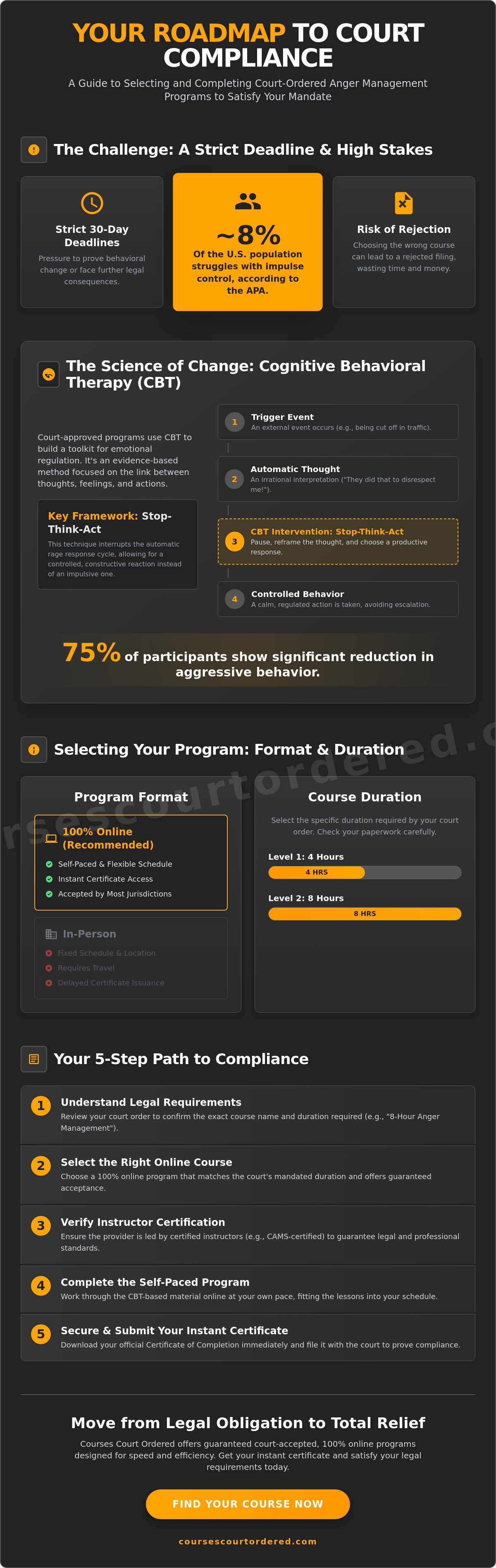
On a Tuesday morning, a defendant in a busy municipal court receives a strict 30-day deadline to prove they've addressed their behavioral triggers or face further legal consequences. This scenario is common, as nearly 8% of the U.S. population struggles with impulse control according to research from the American Psychological Association. You're likely feeling the pressure of this deadline and the anxiety that choosing the wrong course could result in a rejected filing. It's difficult to focus on self-improvement when you're worried about whether a 4-hour or 8-hour certificate will actually satisfy the clerk's requirements.
This guide explains how to select anger management programs that meet judicial standards, ensuring you receive a court-accepted certificate without the usual bureaucratic stress. We'll show you how to navigate these requirements efficiently so you can move quickly from legal obligation to total relief. You'll learn the steps to complete your mandate through a 100% online format and how to secure an instant certificate that proves your compliance to the legal system. By the end of this article, you'll have a clear roadmap to satisfy the judge and gain practical tools for emotional control.
Key Takeaways
Understand the legal framework behind court-mandated educational interventions and how they satisfy specific judicial requirements.
Explore how science-based Cognitive Behavioral Therapy (CBT) provides the tools needed to identify triggers and regulate emotional responses effectively.
Navigate the differences between Level 1 and Level 2 anger management programs to select the specific course duration required by your court order.
Follow a proven 5-step verification process to confirm that your program features CAMS-certified instructors for guaranteed legal acceptance.
Learn how to secure an instant certificate through a 100% online format designed to move you quickly from legal obligation to full compliance.
Table of Contents What Are Anger Management Programs? Understanding the Legal Framework The Science of Behavioral Change: How Evidence-Based Programs Work Selecting the Correct Program Duration: 4-Hour vs. 8-Hour Courses Navigating the Path to Compliance: Verification and Court Acceptance Streamlining Your Requirements with Courses Court Ordered
What Are Anger Management Programs? Understanding the Legal Framework
Anger management programs are structured educational interventions designed to help individuals develop practical skills for emotional regulation and communication. These programs don't function like clinical therapy. While therapy often focuses on diagnosing psychological disorders or exploring deep-seated childhood trauma, educational anger management focuses on immediate behavioral change. The goal is to provide participants with a toolkit to identify stressors and respond to conflict without escalating into legal or professional trouble. The formal study of Anger Management highlights that these techniques are essential for maintaining social and legal stability.
Judges, probation officers, and HR departments mandate these courses because they provide a measurable way to track a person's progress toward behavioral compliance. When you're assigned one of these programs, the legal system isn't looking for a medical diagnosis; it's looking for proof that you've learned the rules of social engagement. For a deeper look at how these requirements function within the justice system, you can review our guide on Understanding Anger Management Classes. By completing a recognized course, you demonstrate to the court that you're taking proactive steps to meet your legal obligations.
The Purpose of Court-Ordered Intervention
The primary objective of court-ordered intervention is the reduction of recidivism. In the legal context, recidivism refers to the likelihood of an individual committing the same offense again. By 2026, data from various state judicial councils showed that participants who completed mandated behavioral courses were 30% less likely to re-offend within the first year. These programs serve as a pragmatic alternative to more severe sanctions like heavy fines or incarceration. They're typically triggered by conflict-related offenses, such as domestic disputes, disorderly conduct, or workplace harassment. The system's goal is behavioral correction, moving you from a state of legal jeopardy to one of certified compliance.
Online vs. In-Person Program Formats
Choosing the right format is vital for meeting your deadline without disrupting your life. Traditional in-person classes often require you to travel to a specific location at a set time, which can be difficult for busy professionals. Modern digital programs offer a 100% online experience that's entirely self-paced. This flexibility allows you to log in whenever your schedule permits, whether it's late at night or during a lunch break. In 2026, judicial acceptance of online formats has become the standard across most jurisdictions, provided the course offers a verifiable certificate. These programs prioritize speed and efficiency, often providing an instant certificate upon completion so you can submit your proof of compliance to the court immediately.
If you're ready to begin your journey toward legal resolution, you can view our full list of court-accepted courses to find the right fit for your mandate.
The Science of Behavioral Change: How Evidence-Based Programs Work
Court-mandated progress depends on more than just showing up. It's a process that requires a fundamental shift in how the brain processes conflict and social interactions. High-quality anger management programs utilize Cognitive Behavioral Therapy (CBT) because it produces measurable, repeatable results. Research from the American Psychological Association indicates that evidence-based interventions significantly reduce aggressive behavior in approximately 75% of participants. This scientific foundation is why judges and probation officers prioritize specific curriculums over general counseling sessions.
Cognitive Behavioral Techniques in Anger Management
CBT focuses on the powerful connection between thoughts, feelings, and behaviors. Participants learn to identify "automatic thoughts," which are the split-second, often irrational interpretations that trigger a rage response. If someone perceives a minor slight as a personal attack, the body's fight-or-flight system activates instantly. Professional programs teach the "Stop-Think-Act" framework to interrupt this cycle. This method creates a necessary pause between the trigger and the physical reaction, allowing the logical brain to take control. CBT serves as a precision tool for restructuring emotional responses by replacing reactive hostility with reasoned analysis.
The role of "Corrective Thinking" is equally vital in breaking cycles of aggression. This process involves auditing one's own logic to find errors like "all-or-nothing" thinking or "mind-reading." By breaking these patterns at the cognitive level, the individual moves from a state of legal obligation to genuine behavioral change. This transition is essential for those looking to satisfy court requirements while improving their personal lives and social stability.
Skill-Building and Emotional Regulation
Evidence-based programs don't just focus on theory; they provide practical, everyday tools. Assertive communication is a core skill taught in these courses. It's a method that allows individuals to express their needs and boundaries clearly without resorting to intimidation or violence. Integrating anger management tips such as controlled breathing and physical relaxation helps manage the physiological spikes that accompany frustration. These skills provide long-term benefits that extend far beyond simple legal compliance, often improving workplace performance and family dynamics.
Modern delivery methods ensure these concepts are accessible to everyone. Most anger management programs now use a combination of video and text content to cater to different learning styles. This multimodal approach increases retention rates and ensures that the participant can apply the lessons in high-pressure situations. If you need to meet a specific judicial requirement, you can explore our certified course options to find a curriculum that fits your schedule. Ensuring your program uses an evidence-based curriculum is the most reliable way to guarantee court approval and avoid the stress of non-compliance.
Selecting the Correct Program Duration: 4-Hour vs. 8-Hour Courses
Choosing the right length for your anger management programs isn't a matter of personal preference; it's a strict requirement for legal compliance. The specific duration is almost always determined by the presiding judge or the severity of the offense listed in your court records. If you complete a 4-hour course when the court mandated an 8-hour session, your certificate won't be accepted. This mistake leads to missed deadlines and potential legal repercussions. It's essential to review your court order or consult your probation officer before you pay for any enrollment.
The distinction between "Level 1" and "Level 2" is the most common way courts categorize these requirements. Taking the wrong level is one of the primary reasons certificates are rejected by court clerks. To avoid this, look for specific keywords in your paperwork such as "8-hour mandate," "Level 2," or "Advanced Anger Management." Verify the hour count exactly as it's written to ensure your efforts lead to a successful case resolution.
When Is a 4-Hour Program Sufficient?
A 4-hour course, frequently labeled as a "Level 1" program, serves as the standard for minor, first-time offenses. These situations often involve non-violent verbal disputes or basic employer-mandated training. The curriculum is streamlined to cover essential behavioral shifts. You'll study modules on identifying emotional triggers, primary stress management, and basic communication tools. This format is designed for efficiency, allowing you to satisfy requirements while gaining practical tools for daily life. If this matches your paperwork, you should review the steps on how to complete an online anger management course to ensure your submission is valid and timely.
Understanding the 8-Hour and Extended Mandates
Courts mandate an 8-hour "Level 2" course when a case involves repeat offenses or more significant incidents. This extended duration allows for a more rigorous examination of conflict patterns. Unlike the shorter version, these anger management programs dive into empathy development and long-term cognitive restructuring. You'll work through complex scenarios that require advanced de-escalation techniques. In some specific jurisdictions, such as those handling domestic issues or high-level misdemeanors, the court may even require 12-hour, 26-week, or 52-week programs. If your legal documents specify a specific number of hours, don't assume a shorter course will suffice. Accuracy at the start prevents the stress of non-compliance later.
Navigating the Path to Compliance: Verification and Court Acceptance
The most pressing concern for anyone facing a legal mandate is whether their chosen anger management programs will actually satisfy the court. It's a common fear. You spend hours on a course only to have a clerk or probation officer reject the document. This usually happens because the provider lacks the necessary credentials or the curriculum doesn't meet specific jurisdictional standards. To avoid this setback, you must treat the selection process with the same level of detail as the legal order itself.
Courts typically look for "CAMS" (Certified Anger Management Specialist) status. This designation ensures the instructor has undergone rigorous training and adheres to a professional code of ethics. Most judges recognize that accredited anger management programs prioritize evidence-based results over simple participation. If you're unsure about a provider, don't guess. You should verify their standing before you pay a single fee.
Step-by-Step Verification Checklist
Step 1: Review your court order. Look for specific language regarding hour requirements, such as 8, 12, or 52 hours. Check if there are explicit bans on "online" formats, though 95% of modern jurisdictions now accept digital certificates.
Step 2: Verify CAMS credentials. Ensure the lead instructor is a Certified Anger Management Specialist. This professional weight often determines whether a judge accepts your proof of completion.
Step 3: Confirm evidence-based curriculum. The course should use recognized models like the Anderson & Anderson approach, which is a standard in the industry.
Step 4: Check for "Instant Certificate" availability. If your court date is 48 hours away, you can't wait for a document to arrive in the mail. Ensure you can download a digital copy immediately.
Step 5: Compare against free alternatives. Be cautious of "free" classes. You can read the specific risks in our guide on The Truth About Free Anger Management Classes.
The Importance of the Certificate of Completion
Your certificate is the only evidence the court cares about. It's the finality of your legal obligation. A valid certificate must include your full legal name, the specific number of hours completed, the date of completion, and the official signature of the CAMS instructor. It should also feature a unique verification ID number that a court clerk can use to validate the document's authenticity.
While digital copies are standard, some traditional jurisdictions still require a hard copy with a physical seal. In these cases, look for providers that offer expedited shipping via FedEx or USPS. This ensures your paperwork arrives at the courthouse well before your deadline. For legal professionals looking to assist their clients, the Refer-a-Student form provides a streamlined way to ensure the right course is assigned and tracked from start to finish.
Ready to resolve your legal requirements with a proven provider? Enroll in a court-accepted anger management program today.
Streamlining Your Requirements with Courses Court Ordered
Navigating legal mandates shouldn't feel like a second trial. Courses Court Ordered provides a specialized, bureaucratic-lite framework designed to help you meet judicial requirements without the typical administrative friction. Our anger management programs are 100% online, allowing you to fulfill your obligations on your own schedule from any device. Every course is backed by the North American Learning Institute (NALI), ensuring that the curriculum meets the rigorous standards expected by judges, probation officers, and legal professionals across various jurisdictions. We prioritize a non-judgmental user experience that focuses on your successful completion and legal relief.
Why Choose Our Evidence-Based Curriculum?
Stability matters when your legal standing is on the line. Since its founding in 2009, the North American Learning Institute has established itself as a leader in distance learning for court-mandated education. We maintain a professional distance that respects your privacy while providing the authoritative weight necessary for court acceptance. Our anger management programs don't just fill a requirement; they provide pragmatic tools for behavioral change through a structured, evidence-based approach.
The curriculum is designed to be direct and functional. It satisfies the specific hour or unit requirements often dictated by the court system. Once you finish the final module, you receive an Instant Certificate. This document serves as the final, verifiable proof of your compliance. You can download it immediately to provide to your attorney or the court clerk, removing the anxiety of waiting for mail delivery while a deadline approaches. This focus on speed and reliability is why thousands of individuals have utilized our platform to resolve their legal obligations since 2009.
Getting Started: Your Path to Legal Resolution
The enrollment process is built for speed and clarity. You can sign up in under five minutes and gain immediate access to your dashboard. There are no waiting periods, no physical classrooms to attend, and no complex software to install. This hassle-free approach is specifically designed for individuals facing high-pressure legal deadlines. We focus on moving you from a state of legal obligation to a state of completion with minimal stress.
Select your specific state and required course hours.
Complete the 100% online modules at your own pace.
Download your official certificate the moment you finish.
Browse our available courses to find the specific duration required by your court order. Our system tracks your progress automatically, so you can stop and start as needed. Resolving your legal mandate is the first step toward moving forward with your life, and we provide the most direct path to get there.
Move Forward with Verified Court Compliance
Navigating judicial requirements doesn't have to be a source of stress. Whether you're mandated to complete a 4-hour or 8-hour course, selecting the right anger management programs is the most critical step toward satisfying your legal obligations. By choosing a NALI-operated provider that has served users since 2009, you ensure your progress is backed by a nationally recognized evidence-based curriculum. This professional approach guarantees that your efforts meet the rigorous standards expected by the court system across various jurisdictions.
The process is designed for maximum efficiency. Once you finish your coursework, you'll receive an instant digital certificate of completion to provide immediate proof of your hard work. You can transition from legal uncertainty to full compliance in a single session. Our 100% online format allows you to manage your schedule without compromising the quality of your certification. It's a reliable way to resolve your legal matters while gaining valuable behavioral insights. You have the tools to succeed, and we're here to provide the official pathway to get there. Take the final step to clear your records and regain your peace of mind.
Frequently Asked Questions
How do I know if the court will accept an online anger management program?
Most jurisdictions accept online anger management programs if they meet specific duration and curriculum standards set by the court. You should verify your specific court order for language like "distance learning" or "nationally recognized." Our programs are designed to satisfy judicial requirements in over 3,000 counties nationwide. If you're unsure, present our syllabus to your probation officer or judge for prior approval to ensure 100% compliance.
How long does it take to get my anger management certificate after finishing?
You'll receive your official certificate of completion instantly upon finishing the final module. There's no waiting for mail or manual processing times. Our automated system generates a downloadable PDF document the second you pass. This allows you to meet tight legal deadlines even if you finish the course at 2:00 AM on a Sunday morning. We also offer expedited hard-copy shipping if your court requires an original embossed seal.
Can I take my anger management course on a phone or tablet?
You can access our anger management programs on any smartphone, tablet, or computer with an internet connection. The platform is optimized for mobile use, allowing you to complete your mandated hours during breaks or while commuting. There's no specialized software or app to download. Simply log in through any web browser like Chrome or Safari to resume your progress exactly where you left off. This flexibility ensures a hassle-free experience.
What is the difference between Level 1 and Level 2 anger management programs?
The primary difference lies in the total number of mandated hours required by the court system. A Level 1 course typically consists of 8 to 12 hours and is often assigned for first-time or minor incidents. Level 2 programs are more intensive, spanning 16 to 24 hours for cases involving recurring issues or specific legal mandates. Always check your court paperwork to confirm the exact hour count required to satisfy your legal obligation.
Are these anger management programs accepted in all 50 states?
Our curriculum is designed to meet national standards and is accepted by courts in all 50 states, including California, Texas, and Florida. While most judges accept 100% online formats, 3 specific counties in certain states may require in-person attendance for domestic violence cases. We provide a money-back guarantee if your certificate is declined by the court for any reason. This ensures your path to legal compliance is entirely risk-free and professionally managed.
Is there a final exam for the online anger management course?
Every course concludes with a final exam designed to verify your understanding of the material. You must achieve a passing score of 70% or higher to receive your certification. If you don't pass on your first attempt, you can retake the test as many times as necessary at no additional cost. This guaranteed passing structure removes the stress of testing and focuses on your successful completion of the mandated program requirements.
What happens if I miss my court-ordered deadline for the certificate?
Missing a court-mandated deadline can result in a violation of probation or an issuance of a bench warrant. According to standard judicial procedures, you should contact your attorney or probation officer immediately if a delay occurs. Our 100% online platform helps you avoid these risks by providing 24-hour access and instant certificate delivery. This speed allows most users to finish their requirements 2 to 3 days before their scheduled court date.


Comments